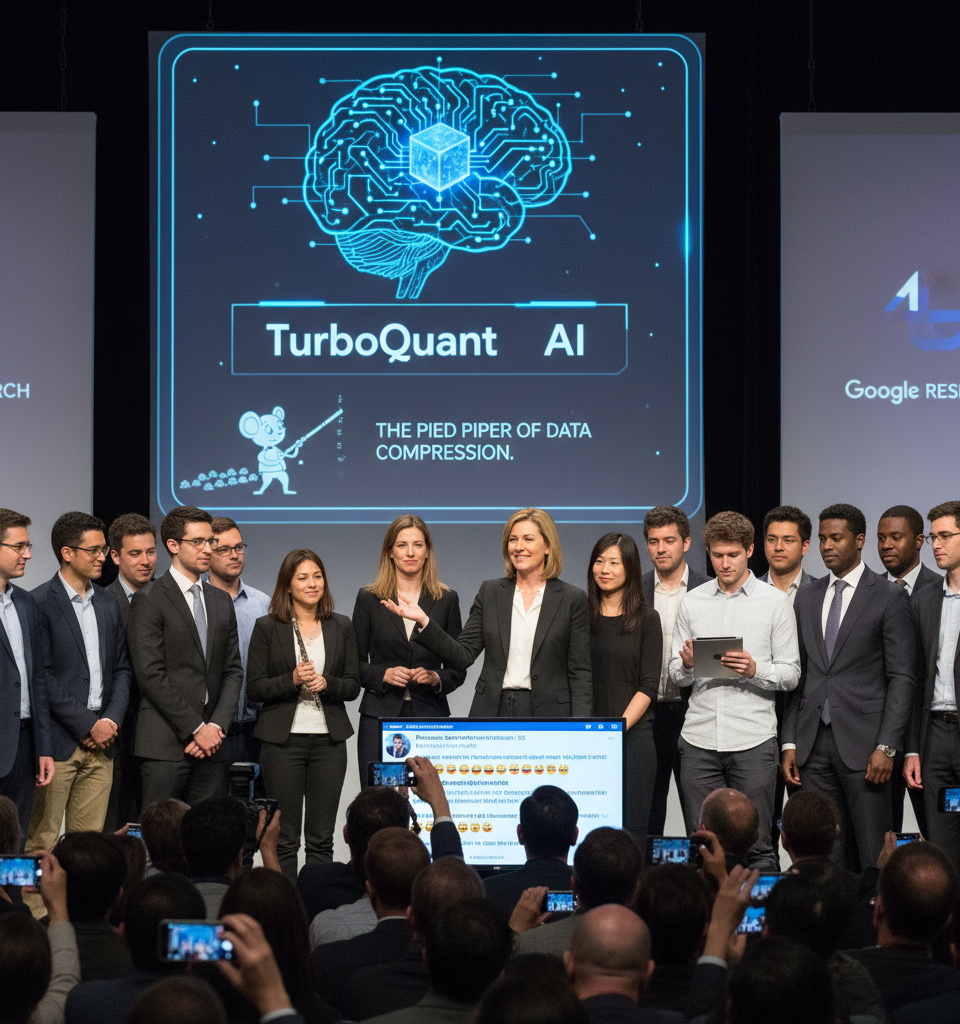
MOUNTAIN VIEW, CA – Google announced today the development of TurboQuant, a novel artificial intelligence (AI) memory compression algorithm that promises to fundamentally reshape the operational efficiency and scalability of large language models (LLMs). Unveiled by Google's AI research division, this breakthrough technology is designed to significantly reduce the 'working memory' footprint required by sophisticated AI systems, potentially by a factor of six. The innovation has not only sent ripples of excitement through the technological community but has also spontaneously ignited comparisons to the fictional compression startup 'Pied Piper' from HBO's satirical series Silicon Valley, highlighting both the potential and the pop culture resonance of Google's latest advancement.
The Quest for Efficiency: Why AI Memory Matters
The ability of AI models, particularly LLMs, to process and generate complex information is directly tied to their memory capacity and efficiency. As these models grow exponentially in size and sophistication, their computational demands and energy consumption skyrocket. Traditional memory architectures often create bottlenecks, limiting the scale and speed at which AI can operate. TurboQuant addresses this critical challenge by intelligently compressing the data LLMs actively use, allowing them to perform more complex tasks with less physical memory and, consequently, reduced energy expenditure. This efficiency gain is crucial for democratizing access to powerful AI and enabling its deployment in more constrained environments, from edge devices to enterprise-scale applications.
TurboQuant's Technical Prowess and Industry Implications
While specific technical details remain under wraps, Google has indicated that TurboQuant leverages advanced neural network techniques to identify and compress redundant or less critical data within an AI model's active memory. The projected sixfold reduction in 'working memory' could translate into numerous benefits, including faster inference times, the ability to run larger models on existing hardware, and substantial cost savings in data centers. For developers, this means the potential to build more powerful and responsive AI applications without the prohibitive hardware investments previously required. Experts anticipate this could lead to a new era of 'smarter' AI that is also greener and more accessible.
Reshaping the AI Landscape: A Paradigm Shift for LLMs
The introduction of TurboQuant could trigger a significant paradigm shift within the rapidly evolving AI landscape. Companies currently grappling with the immense computational cost of deploying and scaling LLMs – such as OpenAI, Microsoft, and Meta – could find their operational overhead drastically diminished. This compression technology might also accelerate the development of more specialized and domain-specific LLMs by making them more economically viable. Furthermore, it could empower smaller startups and independent researchers to compete more effectively, fostering a more diverse and innovative ecosystem around advanced AI development. The potential for a new wave of localized AI applications, running efficiently on consumer-grade hardware, is also considerable.
Expert Insights: The Promise and the Practicalities
Industry analysts are largely optimistic yet cautiously awaiting further details on TurboQuant's real-world performance. Dr. Evelyn Reed, a lead AI researcher at Quantum Labs, commented, "A 6x memory compression is not just an incremental improvement; it's transformative. This could unlock entirely new capabilities for AI, allowing models to hold more context, understand nuance better, and perform vastly more complex reasoning tasks without hitting memory walls." However, questions remain regarding the trade-offs, such as potential impact on model accuracy or the computational cost of the compression and decompression process itself. "The devil," Dr. Reed added, "will be in the implementation details and how seamlessly it integrates with existing AI frameworks."
The Road Ahead: Integration and Future Developments
Google has yet to announce a specific timeline for the general availability or integration of TurboQuant into its broader AI offerings, such as Google Cloud's AI platform or products leveraging its proprietary LLMs like Gemini. However, the unveiling suggests that internal testing has demonstrated significant promise. The next phase will likely involve extensive benchmarking, potential open-sourcing of components, or strategic partnerships to integrate the technology across various hardware and software stacks. Given the intense competition in the AI space, Google will be keen to leverage TurboQuant as a key differentiator, potentially leading to faster, more robust, and more cost-effective AI solutions for both enterprise and consumer markets. The long-term implications point towards a future where AI's intellectual capacity is less constrained by its physical footprint.