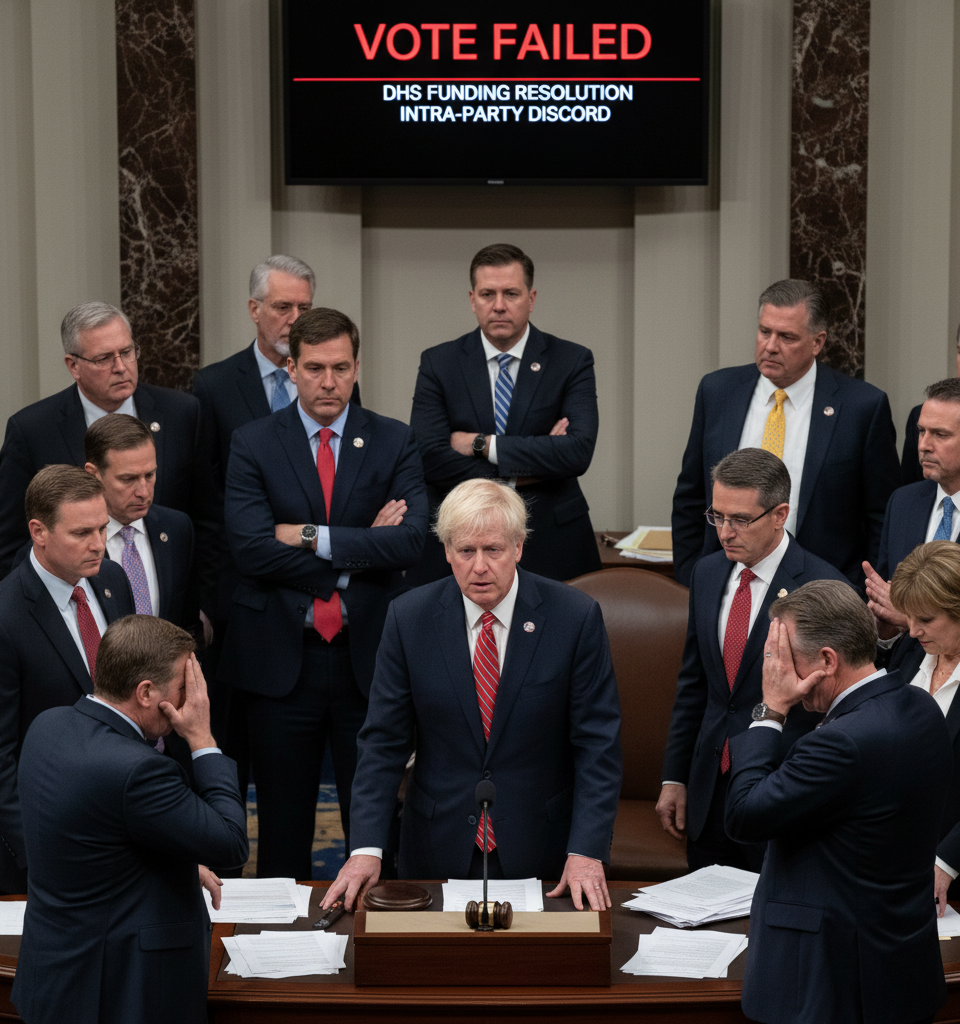
Washington D.C. – Lawmakers, fresh from a two-week recess, have returned to a tumultuous House of Representatives, where the Republican legislative agenda lies in disarray. Efforts to swiftly reauthorize funding for the Department of Homeland Security (DHS) have stalled, exposing deep and persistent fault lines within the GOP and casting significant doubt on its ability to govern effectively. The impasse reflects a broader struggle for control and ideological direction within the party, hindering critical government functions and signaling a challenging path forward for any bipartisan cooperation.
A Recurrent Crisis: The Perils of Partisan Infighting
This latest legislative bottleneck is not an isolated incident but rather a recurring symptom of the heightened polarization that has characterized Capitol Hill for over a decade. The current stalemate over DHS funding echoes previous fiscal cliffs and government shutdowns, albeit with a unique set of demands stemming from the hardline conservative wing of the Republican Party. These members, often associated with the House Freedom Caucus, are leveraging their numerical strength to demand significant concessions on immigration policy and border security, even if it means jeopardizing the operational capabilities of a vital federal agency. The annual appropriations process, once a routine legislative exercise, has transformed into a high-stakes battleground for ideological purity.
Key Sticking Points and Public Statements
At the heart of the current deadlock is a fundamental disagreement over border policy and the use of the appropriations process as a lever for political change. Hardline Republicans insist on attaching stringent border security measures, including increased funding for a border wall and limits on asylum claims, to any DHS funding bill. Speaker Johnson, caught between the demands of his conservative base and the need for bipartisan support to pass legislation, faces an increasingly untenable position. "We cannot continue to fund a department that is actively undermining our national security at the border," stated Representative Mark Green (R-TN), Chairman of the House Homeland Security Committee, expressing a sentiment widely held by the party's right flank. Democrats, conversely, accuse Republicans of political posturing and attempting to defund a critical agency for ideological reasons, advocating for a clean funding bill. The existing stopgap measure, known as a continuing resolution, is set to expire on, intensifying pressure for a resolution.
Broader Economic and Security Implications
The extended uncertainty surrounding DHS funding carries significant implications for national security and the broader economic landscape. A partial shutdown or severe underfunding of DHS would not only impact border patrol operations but also cripple agencies like FEMA, the Coast Guard, and the Secret Service, compromising disaster relief efforts, maritime security, and presidential protection. Economically, government shutdowns, even partial ones, can create uncertainty in financial markets, reduce consumer confidence, and lead to Furlough hundreds of thousands of federal employees, impacting their livelihoods and local economies. The ripple effects of a dysfunctional Congress extend far beyond Washington, directly affecting the lives of millions of Americans and potentially diminishing the nation's standing on the global stage.
Expert Analysis: A Test of Leadership and Cohesion
Political analysts view the current situation as a critical test of Speaker Johnson's leadership and the Republican Party's ability to coalesce around a common agenda. "This isn't just about DHS funding; it's about the internal coherence of the modern Republican Party," explains Dr. Sarah Jenkins, a political science professor at Georgetown University. "The Speaker is navigating a treacherous path between a highly activist, conservative wing and the pragmatic demands of governing a diverse nation. Failure to pass basic appropriations bills chips away at institutional credibility and empowers political extremism." Dr. Jenkins suggests that the GOP's slim majority amplifies the power of a relatively small faction, making it difficult for leadership to compromise without facing internal rebellion and potential threats to the Speakership.
The Path Forward: Negotiations and Potential Outcomes
The immediate future points towards intense, likely behind-the-scenes negotiations to avert a full or partial government shutdown. Potential outcomes range from a bipartisan agreement on an omnibus spending bill, which would require significant concessions from both sides, to another short-term continuing resolution, merely kicking the can down the road. A less likely, but still possible, scenario involves a partial government shutdown impacting DHS, which would almost certainly invoke a strong public backlash. The upcoming weeks are critical, and the resolution of this crisis will not only determine the fate of DHS funding but also provide a strong indicator of the Republican Party's capacity for unity and effective governance as the nation heads into a pivotal election year. The pressure on Speaker Johnson to demonstrate leadership and secure results is mounting with each passing day.