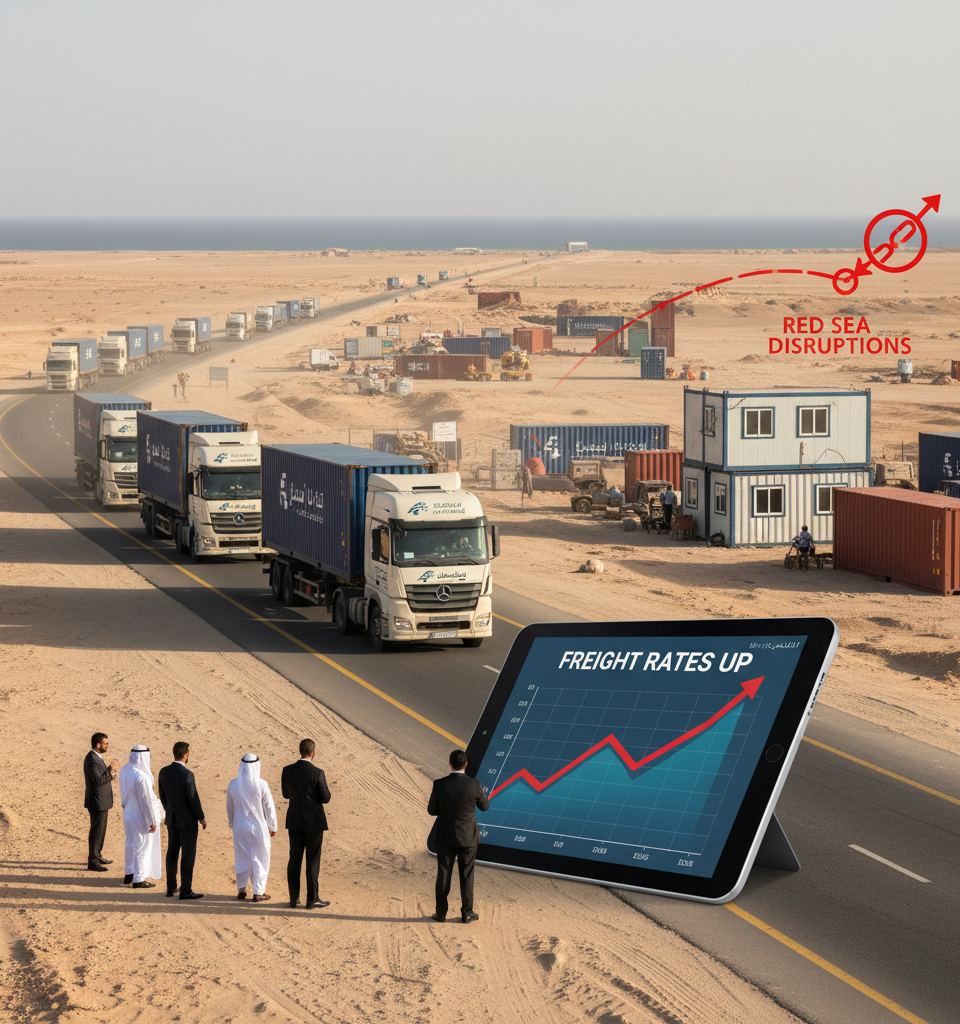
Freight rates for cargo traversing the Gulf region have witnessed an unprecedented escalation, with some routes experiencing a quadrupling of costs, as shipping lines increasingly bypass maritime routes in favor of overland trucking. This pivot, largely a response to persistent disruptions in critical sea lanes, including heightened security risks in the Red Sea, is forcing businesses to absorb thousands of dollars in additional expenses. The fundamental challenge lies in the inherent limitations of road transport: a single lorry can only carry a fraction of the goods typically moved by a large container ship, creating bottlenecks and driving up per-unit costs across various industries.
Context and Background
The current crisis in Gulf freight logistics is a direct consequence of escalating geopolitical tensions impacting global shipping. The Suez Canal, a vital artery for East-West trade, has seen reduced traffic due to Houthi attacks in the Red Sea, forcing many vessels to reroute around the Cape of Good Hope. While this primarily affects global routes, it has a cascading effect on regional feeder services and container availability within the Gulf. The immediate impact is a scramble for alternative transport methods, with trucking emerging as the default, albeit financially punitive, solution for intra-Gulf cargo movements. This phenomenon underscores the fragility of tightly integrated supply chains when confronted with persistent geopolitical instability.
Key Details and Impacts
The most acute impacts are being felt on routes that previously relied heavily on sea freight for cost-effectiveness. For instance, the cost of moving a 40-foot container from Jebel Ali Port in Dubai to Riyadh, Saudi Arabia, has reportedly surged from approximately $1,200 to over $4,500 in recent weeks. Similarly, transit times have become unpredictable. While ocean freight typically offers higher capacity and lower per-unit costs, the current climate of delays and surcharges makes land transport, despite its higher base cost, a more reliable, albeit inefficient, alternative for time-sensitive cargo. Businesses are reporting significant strain on their profit margins, with some considering price increases for consumers.
Industry and Market Impact
This dramatic shift is reverberating across multiple sectors. Retailers are grappling with higher import costs, which could translate into increased consumer prices, potentially fueling inflation. Manufacturing and industrial firms dependent on just-in-time inventory systems are facing considerable challenges in maintaining production schedules and managing inventory levels. The logistical bottleneck is also placing immense pressure on the trucking industry, leading to increased demand for drivers and vehicles, which further contributes to rising costs. The broader Gulf economy, which relies heavily on trade and efficient logistics, is experiencing a discernible slowdown in the movement of goods, affecting both imports and exports within the regional bloc.
Expert Perspective
Logistics experts and economists are warning of the long-term implications should the Red Sea situation remain unresolved. "The reliance on trucking for routes traditionally served by sea is a short-term crisis management strategy, not a sustainable solution," states Dr. Ahmed Al-Mansoori, a regional supply chain analyst. "Capacity constraints for road transport are significant, and the environmental footprint is considerably larger. We are seeing a fundamental repricing of risk in regional logistics, and businesses must adapt by looking at diversified sourcing and more resilient supply chain models." Analysts suggest that if these elevated costs persist, some businesses may re-evaluate their presence or operations within the region, seeking more stable logistical environments.
What's Next
The immediate future hinges on the de-escalation of tensions in the Red Sea and the restoration of normal shipping patterns. However, even with a resolution, the experience has highlighted the vulnerabilities in current supply chain designs, prompting a re-evaluation by many companies. Investors are closely monitoring the situation, with logistics and transport companies potentially seeing increased revenues in the short term, albeit with higher operational costs. Longer-term, there may be a strategic focus on investing in multi-modal transport infrastructure within the GCC, including enhanced rail networks, to reduce over-reliance on a single mode of transport and build greater resilience against future disruptions. Businesses are advised to review their contracts, explore alternative sourcing locations, and consider building larger safety stocks to mitigate against further volatility.
Resilience and Adaptation Strategies
In response to the volatile freight landscape, many companies are actively implementing resilience strategies. These include diversifying their shipping partners, exploring less conventional overland routes where feasible, and renegotiating terms with logistics providers. Investment in advanced supply chain analytics and real-time tracking is becoming crucial for managing uncertainty. Furthermore, some larger corporations are beginning to explore regionalization of manufacturing and warehousing to reduce the dependency on long-distance, high-risk global supply lines. This strategic pivot aims to not only mitigate current risks but also to build a more robust and adaptable supply chain for future challenges, emphasizing localized production and inventory management to buffer against external shocks.