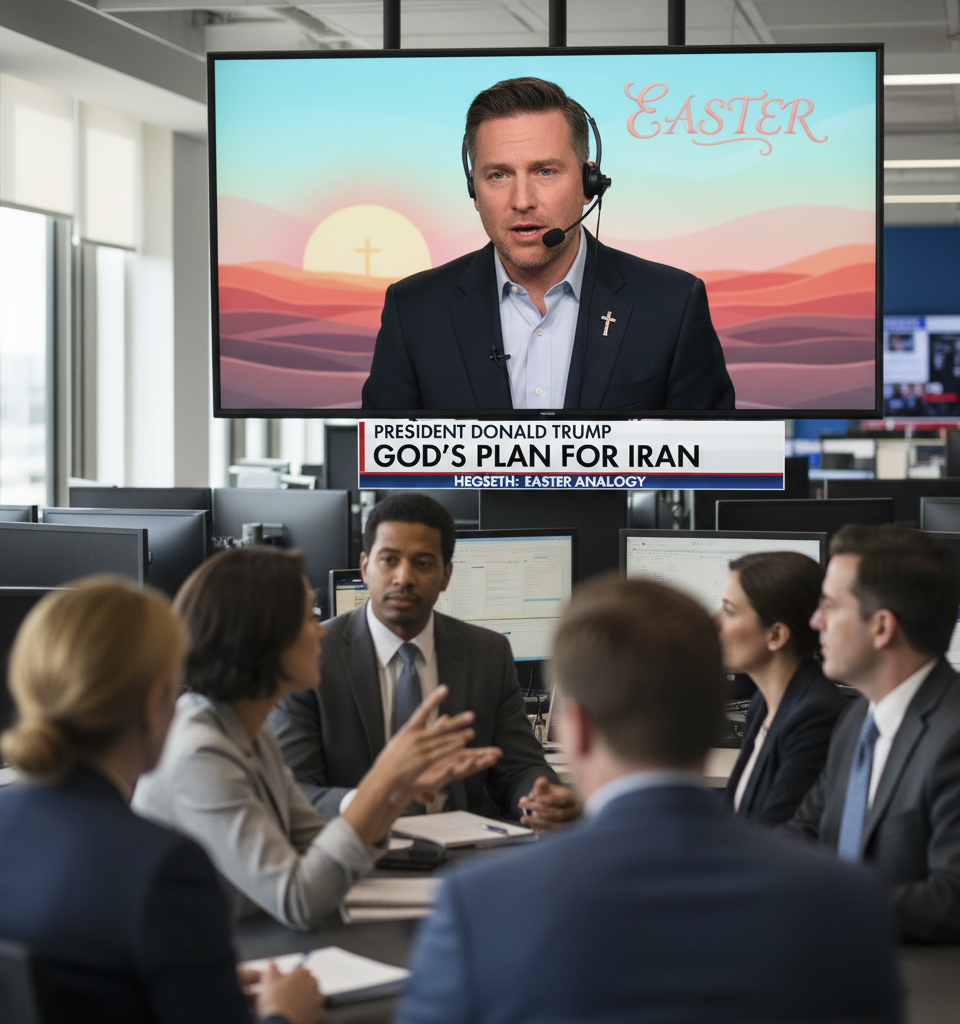
During an Easter Sunday broadcast, Fox News commentator Pete Hegseth drew a contentious parallel between the rescue of a U.S. airman and the resurrection of Jesus Christ, sparking immediate and varied reactions across social and traditional media. This highly scrutinized statement emerged in close proximity to former President Donald Trump's declaration that God endorses America's military posture concerning Iran, justifying potential intervention on the grounds of divine beneficence and humanitarianism. The confluence of these remarks has not only fueled a fiery debate on the intersection of faith and geopolitics but also raised serious questions about the rhetorical strategies employed in contemporary political discourse.
Context and Historical Precedent for Religious Rhetoric in Politics
The use of religious analogy and divine justification in American political rhetoric is deeply embedded in the nation's history, frequently employed by leaders to rally support for policy decisions, both domestically and internationally. From manifest destiny to various military interventions, appeals to a higher power have served to imbue secular actions with moral and sacred authority. Hegseth's comparison, however, ventured into theological territory by directly equating a human event, albeit a heroic one, with a central tenet of Christian faith. Trump's assertion, meanwhile, echoes a historical pattern of leaders invoking divine will to legitimize foreign policy, a strategy that often polarizes public opinion and draws criticism for conflating national interests with religious doctrines. The sensitivity around such pronouncements is particularly acute when discussing potential military conflicts, given the grave human cost involved.
Key Details and Public Reaction
Pete Hegseth's remarks, delivered during a segment on a prominent national news network, were not made lightly; they were a deliberate rhetorical choice during a significant religious holiday. While the specific details of the airman's rescue were praised by many as an act of bravery and operational excellence, Hegseth's direct equation to a cornerstone of Christian dogma for millions ignited accusations of sacrilege and sensationalism. Simultaneously, former President Trump's comments, positing that "God is good, and God wants to see people taken care of" as a rationale for military action against Iran, were met with a similar dichotomy of staunch support from his base and fervent condemnation from critics. These critics argue that such statements not only misrepresent religious tenets but also dangerously oversimplify complex geopolitical realities, potentially escalating tensions in an already volatile region. Analysts noted that these statements, widely disseminated across digital platforms, quickly became flashpoints in the ongoing culture wars.
Geopolitical Implications and Market Impact
The implications of such high-profile religious rhetoric extend beyond mere debate, potentially influencing international relations and market stability. Trump's direct linkage of divine will to action against Iran could be perceived by nations in the Middle East, particularly Iran, as a declaration of ideological warfare rather than a secular geopolitical strategy. This perception could inadvertently fuel extremist narratives, deepen existing regional divides, and destabilize global oil markets. While there's no immediate measurable market impact directly attributable to these specific statements, continuous escalation of rhetoric around potential conflict zones demonstrably increases risk premiums for oil, shifts investment from emerging markets, and triggers defensive plays in global equities. Investors assess not just the likelihood of conflict, but also the perceived rationale behind it, which in this case, involves a highly unpredictable element of divine justification.
Expert Perspectives on Religious Justification in Foreign Policy
Political scientists and theologians have weighed in on the recent statements, offering critical perspectives. Dr. Eleanor Vance, a professor of international relations at Georgetown University, notes, "When political leaders articulate foreign policy through a religious lens, it complicates diplomacy immensely. It can be seen as an imposition of one's belief system, making rational engagement significantly harder." Similarly, Reverend Dr. James Sterling, a scholar of religion and ethics, expressed concern over Hegseth's analogy: "To conflate a human rescue, no matter how heroic, with the divine miracle of resurrection risks trivializing deeply held spiritual beliefs and can be profoundly offensive to many." He added, "These types of statements often alienate rather than unite, both domestically and internationally, fostering an environment of dogma over dialogue."
The Road Ahead: Potential for Escalation and Scrutiny
The immediate aftermath of these remarks suggests a continued cycle of debate and scrutiny. Moving forward, the international community and domestic stakeholders will keenly observe how such religious-infused rhetoric impacts foreign policy decisions, particularly concerning the Middle East. The Biden administration, which has sought a more multilateral and less overtly religious approach to foreign affairs, may find itself navigating the reverberations of these pronouncements, especially if Trump's influence continues to shape a significant portion of public opinion. Future policy deliberations regarding Iran will undoubtedly be viewed through this lens, with increased pressure on leaders to articulate a clear, secular rationale for any proposed actions. As the 2024 election cycle looms, the interplay between faith, media, and foreign policy is poised to remain a central and contentious theme, often overshadowing substantive policy discussions with emotionally charged arguments. The long-term impact on America's standing in the world, particularly in regions sensitive to religious proselytization, remains a significant concern for policymakers and analysts alike.
This incident underscores a broader trend wherein media personalities and political figures strategically use religious language to frame national events and foreign policy, signaling a continued blurring of lines between religious doctrine and secular governance. The public remains sharply divided on the appropriateness and implications of such rhetoric, setting the stage for ongoing cultural and political clashes.