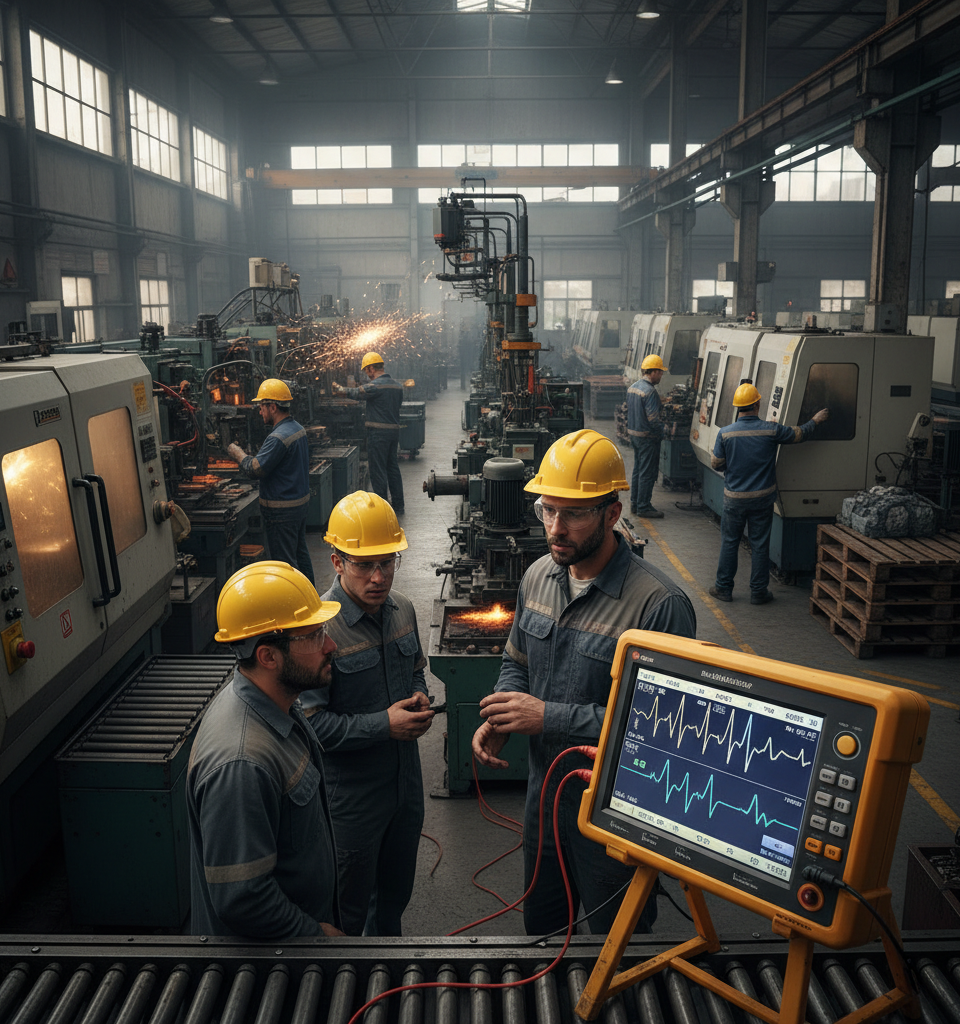
While catastrophic power outages capture headlines, a more insidious and far costlier threat silently plagues manufacturing floors worldwide. This hazard isn't the complete loss of electricity, but rather intermittent, often imperceptible fluctuations in power quality—transients, sags, swells, and harmonics—that disrupt sensitive industrial equipment. These fleeting events, lasting milliseconds, are frequently overlooked in data logs, yet their cumulative impact leads to billions in lost productivity, damaged machinery, and wasted resources annually.
The issue represents a critical blind spot for many manufacturers, who often misattribute equipment failures or production anomalies to other causes, failing to connect the dots to their power supply. This phenomenon isn't new, but its impact has intensified with the proliferation of sophisticated, digitally controlled machinery in modern manufacturing. Older, more robust electromechanical systems were less susceptible to minor power aberrations.
Today's highly sensitive programmable logic controllers (PLCs), robotic systems, and precision instruments, however, are easily perturbed by even minor voltage deviations or frequency shifts. The historical focus on preventing total blackouts has inadvertently overshadowed the pressing need for granular power quality monitoring. The financial ramifications are staggering, with estimates suggesting that poor power quality collectively costs global industries hundreds of billions of dollars each year, far exceeding losses from major outages that tend to trigger immediate, comprehensive investigations.
The Anatomy of a Hidden Cost
The most prevalent and damaging power quality events include voltage sags, which are brief drops in voltage often caused by heavy equipment starting up, and transient spikes, which are momentary increases in voltage, frequently triggered by lightning strikes or switching of large inductive loads. A typical voltage sag lasting just 16 milliseconds can cause a CNC machine to reset, leading to product defects or half-finished components requiring rework. A recent study by the Electric Power Research Institute (EPRI) indicated that momentary voltage sags account for approximately 90% of all power disturbances, costing U.S. industries an estimated $10 billion to $20 billion annually. Individual manufacturers often report losses ranging from tens of thousands to millions of dollars monthly due to these issues. For example, a semiconductor fabrication plant can incur losses exceeding $1 million from a single event due to ruined batches of wafers, while an automotive plant might lose $50,000 to $100,000 for every minute of disrupted assembly. The subtle nature of these events means they often go undiagnosed, leading to repeated equipment failures and a cycle of reactive maintenance rather than proactive prevention.
Broader Market Repercussions
The widespread prevalence of undetected power quality issues has significant ripple effects across the industrial landscape. It drives up operational costs, erodes profit margins, and can even hinder technological adoption. Companies hesitant to invest in advanced automation due to perceived reliability issues might unknowingly be battling power quality problems rather than inherent equipment flaws. This also creates a lucrative, albeit specialized, market for power quality solutions, including uninterruptible power supplies (UPS), voltage regulators, surge protectors, harmonic filters, and advanced power monitoring systems. Furthermore, the push towards smart factories and Industry 4.0, with their reliance on interconnected, data-intensive systems, makes robust power quality more critical than ever. Supply chain stability can also be compromised, as disruptions at one manufacturing node due to power quality issues can cascade, delaying production of components essential to downstream industries.
Expert Insights and Emerging Solutions
Industry experts and power engineers are increasingly vocal about the need for a paradigm shift in how manufacturers perceive and manage their electrical infrastructure. Dr. Alan M. McMichael, a renowned power quality consultant, notes, “Many manufacturers invest heavily in redundant power sources for outages but neglect the 'invisible' disturbances that occur daily. The true cost of poor power quality is often obscured in maintenance budgets and scrap reports.” He advocates for continuous, real-time power quality monitoring and advanced analytics that can correlate equipment malfunctions with specific electrical events. Companies like Eaton and Schneider Electric are developing integrated hardware and software solutions that not only monitor power grids but also predict potential issues and offer insights for mitigation. The focus is shifting from simply documenting power problems to proactively analyzing wave patterns and system behavior to prevent them before they impact production.
The Path Forward: Proactive Management and Smart Grids
The future of manufacturing reliability hinges on a proactive approach to power quality management. This involves significant investment in advanced power conditioning equipment, comprehensive real-time monitoring systems, and specialized training for maintenance personnel to interpret power quality data. The increasing adoption of smart grid technologies, which aim to make electricity distribution more resilient and responsive, also holds promise for mitigating power quality issues at the utility level. However, manufacturing facilities must also take responsibility for optimizing their internal electrical environments. Companies that embrace these strategies will not only mitigate financial losses but also enhance their operational efficiency, improve product quality, and strengthen their competitive edge in an increasingly automated and interconnected world. The silent threat of poor power quality is no longer a footnote; it is a fundamental challenge demanding strategic attention.