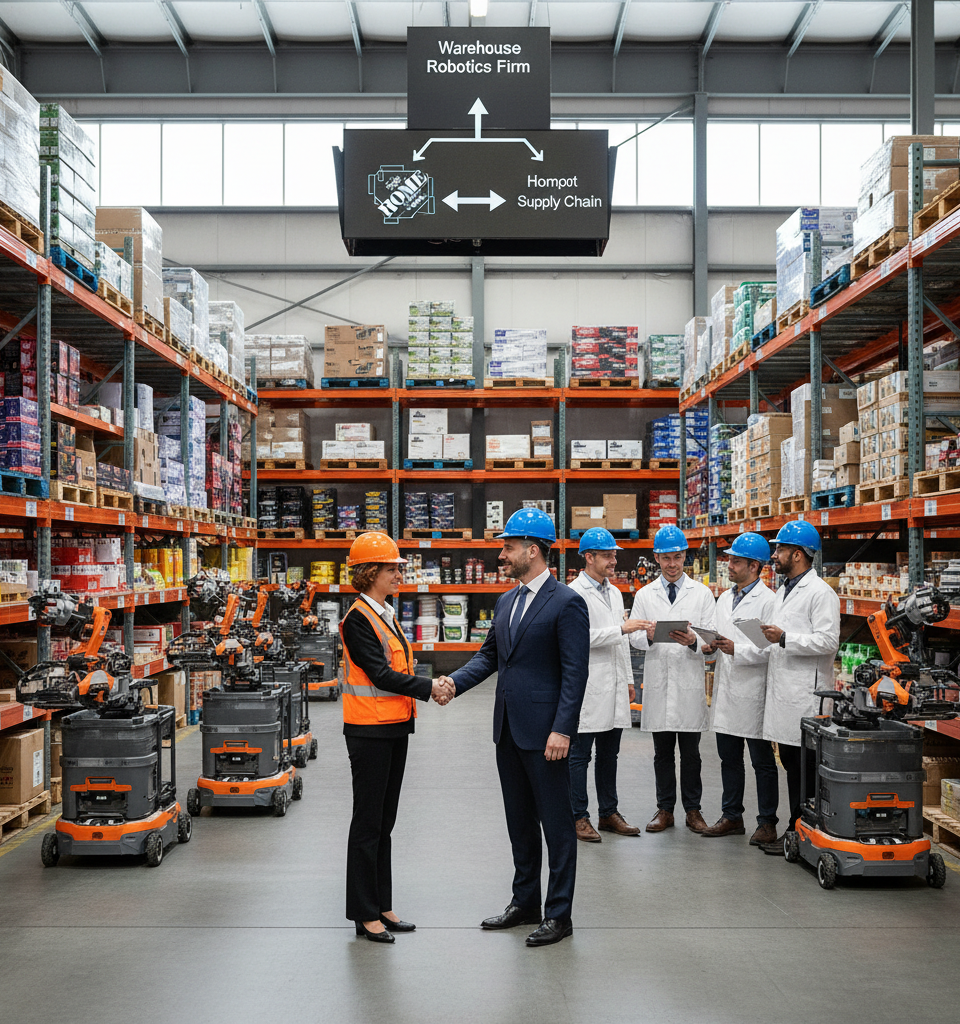
Home Depot Acquires Warehouse Robotics Firm for Supply Chain Automation Drive
Eric Kulisch•April 20, 2026•4 min read
Key Takeaways
Read this first — then go as deep as you need.
Home Depot Bolsters Logistics with Strategic Robotics Acquisition ATLANTA, GA – Home Depot, the nation's largest home improvement retailer, has finalized the acquisition of an unnamed but prominent warehouse automation firm, a strategic maneuver aimed at drastically enhancing its fulfillment capabilities and streamlining its vast supply chain operations. The deal, completed in recent weeks, underscores the retailer's aggressive push to integrate advanced robotics and automation technologies into its distribution network, directly addressing the growing pressures of e-commerce demand and the need for quicker, more efficient order fulfillment for both DIY customers and professional contractors. This acquisition arrives amidst a broader industry trend where retailers are heavily investing in automation to optimize their supply chains. Home Depot has been at the forefront of this evolution, investing billions in its 'One Home Depot' strategy, which includes significant upgrades to its logistics and fulfillment infrastructure. The integration of the acquired firm's technology is expected to provide a crucial competitive edge, allowing Home Depot to process a higher volume of orders with greater accuracy and reduced lead times, particularly for its critical last-mile delivery services. While specific financial terms of the acquisition and the name of the acquired firm were not immediately disclosed, company insiders suggest the deal represents a substantial investment in cutting-edge robotics. The acquired firm specializes in autonomous mobile robots (AMRs) and automated guided vehicles (AGVs) designed to optimize item picking and sorting within large-scale warehouse environments. Juan Perez, Home Depot's Chief Interconnected Experience Officer, has previously highlighted the critical role of automation in scaling operations, stating, "As customer expectations for speed and convenience continue to rise, our ability to leverage innovative technologies becomes paramount." This acquisition is a direct outcome of that strategic vision. The implications for the broader retail and logistics industries are significant. Home Depot's move signals a deepening commitment to in-house technological solutions rather than relying solely on third-party providers. This vertical integration allows for customized automation solutions tailored precisely to Home Depot's unique inventory scale and product diversity, ranging from small hardware items to large lumber and appliance deliveries. Competitors, particularly in the big-box retail space, will likely feel increased pressure to accelerate their own automation initiatives to keep pace with Home Depot's enhanced efficiency. According to Dr. Evelyn Clarke, a supply chain analyst at Retail Insights Group, "This acquisition is a masterstroke for Home Depot. By bringing automation expertise in-house, they not only gain control over their technological roadmap but also cultivate a proprietary competitive advantage. We're seeing a clear shift from incremental improvements to transformative investments driven by the necessity for hyper-efficient fulfillment in the omnichannel retail landscape." Dr. Clarke also noted that the move could lead to a significant reduction in operational costs over the long term, offsetting the initial investment through improved labor utilization and reduced error rates. Looking ahead, Home Depot plans to integrate the acquired firm's technology across a significant portion of its distribution and fulfillment centers over the next 18 to 24 months. This phased rollout will likely begin with high-volume facilities before expanding to regional distribution hubs. The company anticipates a measurable improvement in order fulfillment times, potentially shaving hours off current processing cycles, especially for complex online orders. Furthermore, this initiative is expected to enhance workplace safety by automating repetitive and ergonomically challenging tasks, potentially leading to a more engaged and specialized workforce. The strategic value of this acquisition extends beyond mere efficiency gains. It positions Home Depot to better handle future surges in demand, adapt to evolving consumer behaviors, and maintain its leadership position in an increasingly competitive market. The integration of advanced robotics is not just about speed; it's about building a resilient, agile, and future-proof supply chain capable of meeting the demands of tomorrow's retail landscape.
Discussion
Join the discussion
Sign in to leave a comment on this article.
Loading comments...
Enjoying this article?
Get more like it delivered to your inbox — free.
This article was compiled by GlobalSell News from publicly available reporting and has been edited for clarity and length. For full details, read the original source.