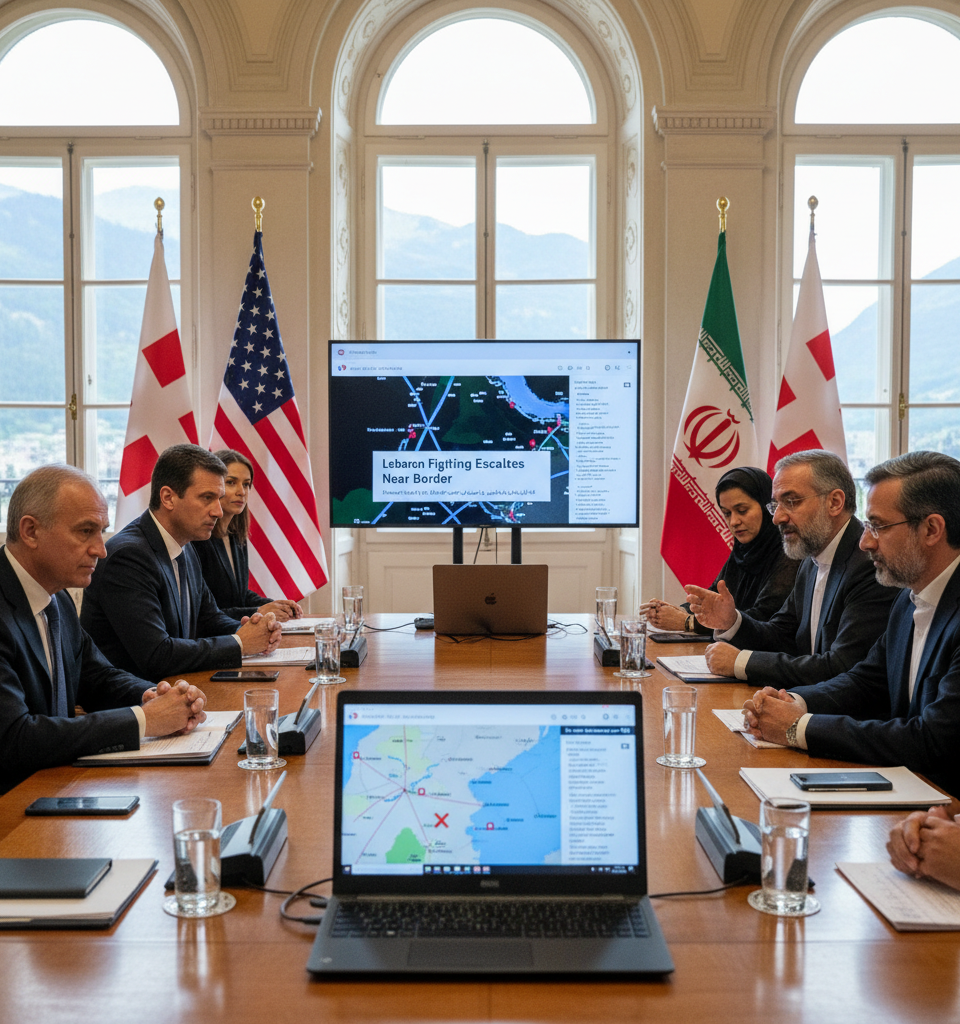
Amidst an already fraught geopolitical landscape, "technical-level" discussions between US and Iranian teams are scheduled to unfold this Sunday in Switzerland, as confirmed by Pakistan's foreign ministry. These critical talks, aimed at addressing various points of contention, arrive at a precarious moment, significantly complicated by recent Iranian assertions regarding the Strait of Hormuz and intensifying conflict in Lebanon. The convergence of these issues threatens to derail what has been described as a tentative agreement, emphasizing the delicate nature of ongoing diplomatic efforts.
This round of discussions is particularly noteworthy given the persistent tensions between Washington and Tehran, which have often manifested in proxy conflicts and strategic posturing across the Middle East. The Strait of Hormuz, a narrow chokepoint through which a significant portion of the world's oil supply transits, has historically been a flashpoint. Iranian claims over the strait frequently coincide with periods of heightened regional instability, serving as a reminder of Tehran's perceived leverage and its ability to influence global energy markets. The timing of these renewed claims, just days before high-stakes talks, suggests a calculated diplomatic maneuver designed to strengthen Iran's negotiating position.
The strategic importance of the Strait of Hormuz cannot be overstated. Roughly one-fifth of the world's total oil consumption and about one-third of the world's liquefied natural gas (LNG) pass through this waterway daily, making any threat to its free passage a matter of international economic and security concern. Previous instances of disruption or threats to shipping lanes in the strait have consistently led to spikes in global oil prices and increased geopolitical anxiety. The current Iranian statements, therefore, resonate far beyond the immediate diplomatic table in Switzerland, potentially impacting commodity markets and global economic stability.
Adding another layer of complexity to the upcoming negotiations is the escalating violence in Lebanon. While specific details of the fighting remain under close watch, the region's intricate web of alliances and rivalries means that conflict in one area can quickly reverberate, influencing broader geopolitical dynamics. Both the US and Iran have significant interests and influence in Lebanon, and any intensification of hostilities there could be perceived by either side as a challenge or an opportunity, thereby complicating goodwill efforts.
For market observers and energy analysts, the convergence of these factors creates significant uncertainty. The prospect of an agreement, even a tentative one, could offer some stability, but the concurrent claims over the Strait of Hormuz and the fighting in Lebanon suggest that any progress will be hard-won and fragile. Analysts have frequently pointed out that the success of such technical talks often hinges not just on the direct agenda items but also on the overall regional security environment. A volatile regional backdrop can easily overshadow and undermine trust-building efforts.
The discussions in Switzerland are expected to delve into a range of technical issues, likely encompassing aspects related to sanctions, nuclear program parameters, regional security, and possibly prisoner exchanges. However, the external pressures—specifically the Strait of Hormuz claims and the Lebanese fighting—will undoubtedly loom large over the proceedings, potentially shaping the tenor and outcome of the negotiations. The precise nature of the "tentative agreement" referred to by Pakistan's foreign ministry remains unspecified, but its fragility is now more apparent than ever.
Looking ahead, the outcome of Sunday's meeting will be closely scrutinized for any indications of breakthroughs or, conversely, further impasses. Should the talks collapse under the weight of these external pressures, the international community could anticipate a period of heightened tensions and increased focus on maritime security in the Persian Gulf. Conversely, any unexpected progress, despite the challenging environment, would be hailed as a significant diplomatic achievement, providing a rare positive signal amidst the protracted US-Iran rivalry.
The global community remains on edge, keenly observing whether diplomacy can navigate the perilous waters of regional conflict and strategic posturing. The stakes are exceptionally high, not only for the United States and Iran but for the broader Middle East and the stability of global energy supplies. The next few days in Switzerland could therefore prove pivotal in shaping the trajectory of regional relations and international security for the foreseeable future.