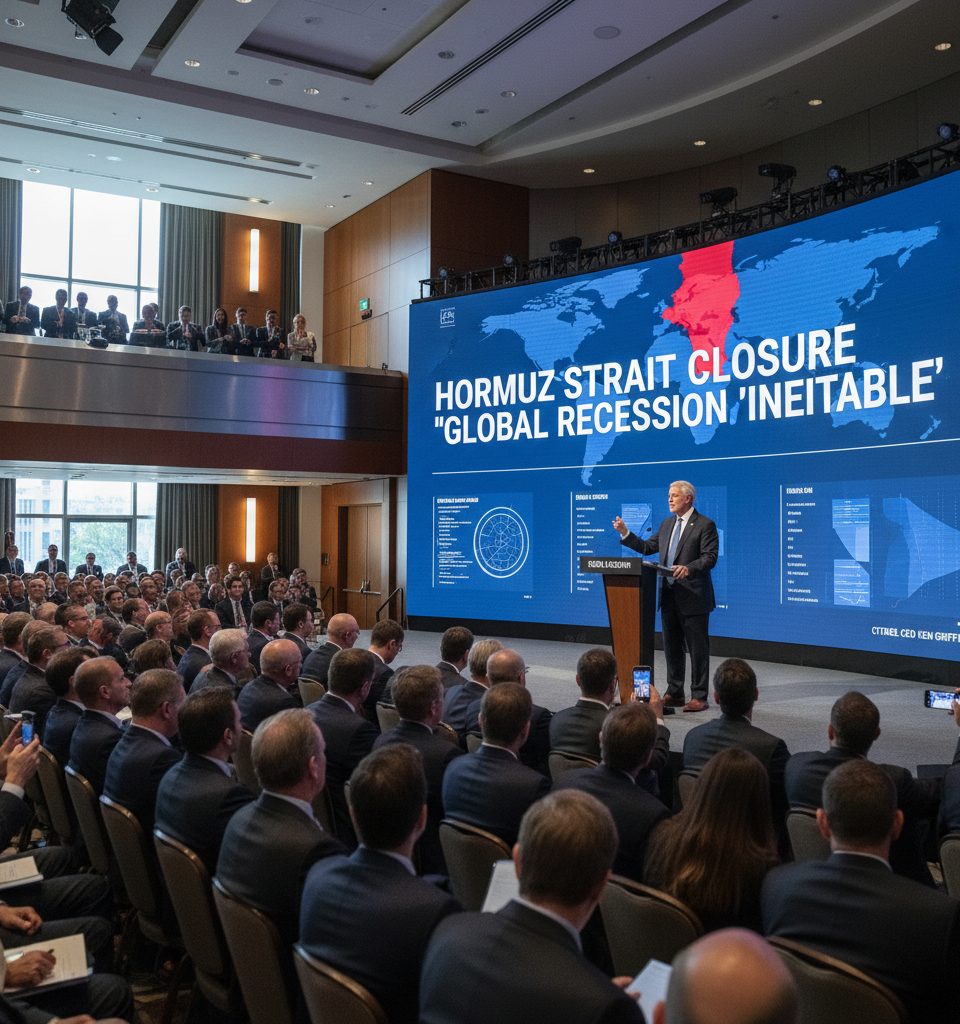
New York, NY DPA - Ken Griffin, the influential founder and CEO of Citadel, one of the world's largest hedge funds, delivered a sobering assessment this week, stating that a sustained closure of the Strait of Hormuz for six to twelve months would precipitate an “unavoidable global recession.” Speaking at an exclusive industry event, Griffin underscored the catastrophic economic repercussions of disrupting this critical maritime artery, highlighting the profound interconnectedness of global energy supplies and economic stability.
The Strategic Significance of the Strait of Hormuz
This dire warning from a titan of finance underscores the geopolitical fragility impacting global commerce. The Strait of Hormuz, a narrow waterway between the Persian Gulf and the Gulf of Oman, is arguably the world's most important oil chokepoint. Approximately one-fifth of the world's total petroleum liquids consumption, or about 21 million barrels per day (b/d), transits through the Strait, according to the U.S. Energy Information Administration (EIA). Any disruption, whether from geopolitical tensions, military conflict, or acts of piracy, immediately sends shockwaves through international oil markets, driving up prices and disrupting supply chains globally.
Escalating Risks and Economic Consequences
Griffin's projection is rooted in the sheer volume and strategic importance of the oil and gas transiting the Strait. A prolonged closure would not only trigger a sharp increase in crude oil prices, potentially pushing Brent crude well above the $150-$200 per barrel mark, but also lead to severe supply shortages, particularly in energy-dependent economies in Asia and Europe. Such a scenario would cripple industrial output, inflate transportation costs, and erode consumer purchasing power, culminating in a significant contraction of global economic activity. The financial markets, already sensitive to geopolitical instability, would likely face extreme volatility, widespread panic selling, and a flight to safety, exacerbating the economic downturn.
Broad Industry and Market Impact
Beyond crude oil, the Strait of Hormuz is also a vital route for liquefied natural gas (LNG) and other essential commodities. A blockage would severely impact shipping and logistics industries, leading to dramatic increases in freight costs and insurance premiums. Industries reliant on petrochemical feedstock, manufacturing, and even agriculture would face skyrocketing input costs, leading to widespread inflation and reduced profitability. Energy companies, while potentially benefiting from higher prices in the short term, would grapple with production and distribution bottlenecks, forcing a reevaluation of global energy security strategies and investments in alternative routes and sources.
Expert Consensus and Historical Precedent
Analysts from leading financial institutions largely echo Griffin's concerns, albeit with varying degrees of severity. JPMorgan Chase's commodity strategists, for instance, have previously modeled scenarios where a major disruption in the Middle East could push oil prices significantly higher, albeit usually for shorter durations. Historically, even minor skirmishes or threats in the region have led to palpable anxiety in commodity markets, demonstrating the Strait's outsized influence. The Iran-Iraq War in the 1980s, which saw attacks on tankers, provides a historical precedent for the economic vulnerability inherent in this region.
Geopolitical Tensions and Future Implications
The probability of a prolonged closure is intimately tied to the evolving geopolitical landscape in the Middle East. Ongoing tensions between Iran and Western powers, coupled with regional conflicts, maintain a constant state of elevated risk. Escalatory actions by any state actor could rapidly transform a localized conflict into a global energy crisis. Looking ahead, Griffin's warning serves as a potent reminder for policymakers and businesses to diversify energy sources, invest in strategic petroleum reserves, and explore alternative trade routes, although completely bypassing the Strait for existing infrastructure remains a monumental challenge. The focus will undoubtedly shift towards diplomatic solutions to de-escalate regional tensions and safeguard this indispensable global artery.
Preparing for the Unthinkable
The gravity of Griffin's statement cannot be overstated. It forces a critical examination of global supply chain resilience and energy security strategies. For governments, it necessitates contingency planning and international cooperation to mitigate potential disruptions. For businesses, it demands stress testing financial models against extreme energy price shocks and assessing the vulnerability of their supply chains. While the prospect of a prolonged closure remains a worst-case scenario, the economic fragility it exposes calls for immediate and robust preparedness, lest the world inadvertently sleepwalk into an 'unavoidable recession'.