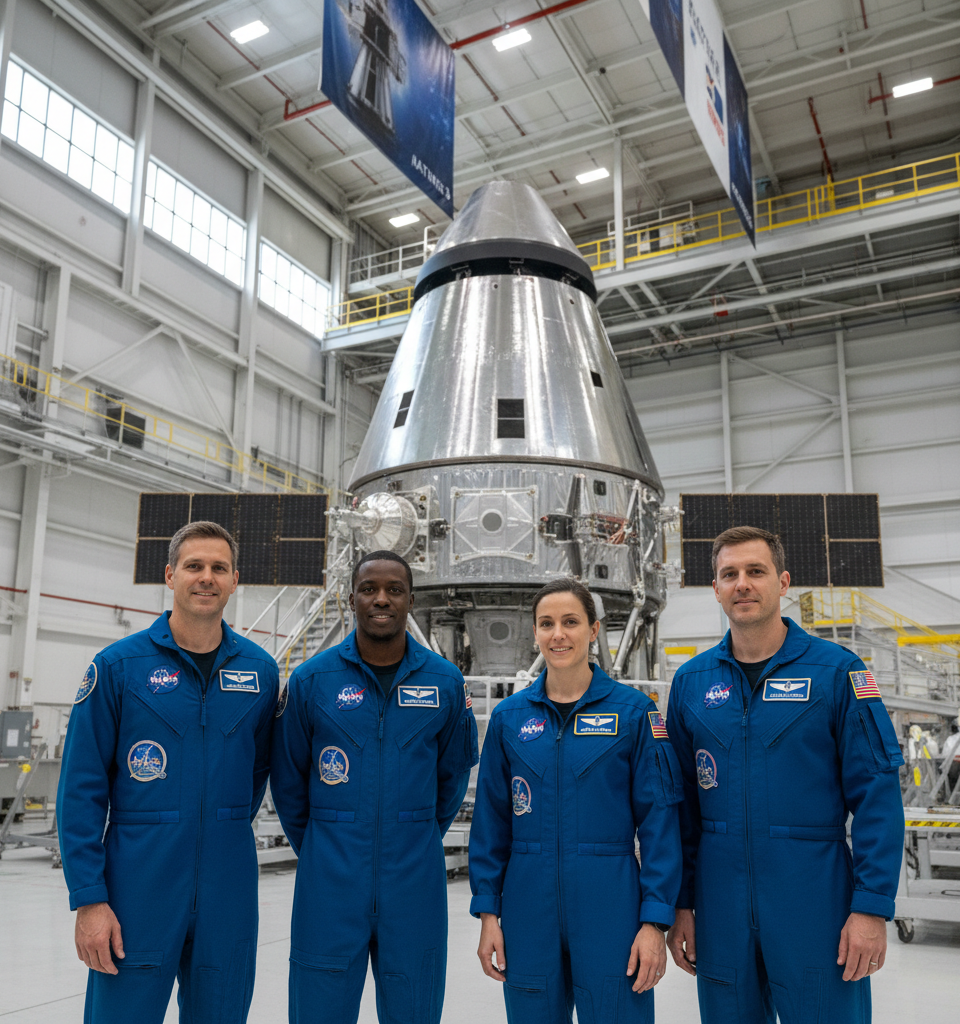
HOUSTON, TX – April 10, 2023 – Houston, Texas, a city indelibly linked to humanity's most ambitious spacefaring achievements, is experiencing a profound resurgence of its 'Space City' identity following the momentous announcement of the Artemis II lunar mission crew. The assignment of four astronauts – NASA’s Reid Wiseman, Victor Glover, Christina Koch, and the Canadian Space Agency’s Jeremy Hansen – to the pioneering circumnavigation of the Moon has elicited deep-seated pride and renewed purpose across the metropolitan area, reaffirming Houston's pivotal role in the future of space exploration. This critical step in NASA's Artemis program aims to pave the way for sustained human presence on the lunar surface, directly channeling the spirit and operational prowess housed within Houston's Johnson Space Center.
A Legacy Rekindled: From Apollo to Artemis
For generations, Houston has been synonymous with mission control, a reputation forged during the thrilling and often perilous Apollo era. The iconic phrase, "Houston, we have a problem," became a global touchstone, encapsulating the city's central role in guiding humanity's first steps on the Moon. However, in the decades following the Apollo program, and particularly after the Space Shuttle's retirement in 2011, Houston's public perception as the undisputed 'Space City' arguably waned. The Artemis II mission, a critical preparatory flight for future lunar landings, dramatically reverses this trend. It underscores a strategic pivot towards international collaboration and long-term lunar habitation, building directly on the technical and operational expertise cultivated in Houston for over half a century. This mission isn't just about reaching the Moon; it's about reasserting American leadership in space with Houston at the helm.
Key Details: Artemis II's Crew and Objectives
The Artemis II mission, currently slated for a late 2024 launch, will see its four-person international crew embark on a journey around the Moon aboard NASA's Orion spacecraft, propelled by the formidable Space Launch System (SLS) rocket. This 10-day mission will not land on the Moon but will test Orion's critical systems, life support, and reentry procedures in a deep-space environment, traveling approximately 230,000 miles from Earth. The selection of a diverse international crew highlights the collaborative nature of modern space exploration, with Canada becoming only the second nation to send an astronaut beyond low Earth orbit. "This is not just a mission," remarked a NASA official at Johnson Space Center, "this is a statement of intent, and Houston is where that intent becomes reality."
Economic and Industrial Revitalization
Beyond the scientific and exploratory implications, the Artemis program, and specifically Houston's central role, is poised to deliver significant economic dividends to the region. The space industry, including propulsion, robotics, and advanced materials, is experiencing a renaissance. Companies like Axiom Space, headquartered in Houston, are at the forefront of commercial space station development, directly benefiting from the renewed push for lunar and deep-space missions. Local universities are seeing increased enrollment in aerospace engineering programs, and the demand for skilled technicians and engineers is projected to surge. A recent economic impact study from the Greater Houston Partnership estimates that the broader aerospace industry already contributes over $2.9 billion annually to the Houston economy and supports more than 23,000 jobs. With Artemis, these figures are expected to rise by at least 15% over the next five years as private sector investment aligns with NASA's ambitious goals.
Expert Perspectives: A New Era of Exploration
Space industry analysts universally view Artemis II as a pivotal moment, not just for NASA but for the global space economy. Dr. Laura Jenkins, an aerospace economics professor at Rice University, stated, "The Artemis program represents a paradigm shift from governmental monopolies to a more integrated public-private ecosystem. Houston, with its deep talent pool and established infrastructure, is uniquely positioned to capitalize on this. It's not just about government contracts; it's about attracting venture capital and fostering innovation that cascades into other high-tech sectors." She further emphasized that the long-term goal of sending humans to Mars, leveraging lunar infrastructure, positions Houston as a critical hub for deep-space logistics and mission planning.
What's Next: Lunar Gateway and Martian Horizons
The successful completion of Artemis II is a crucial preface to Artemis III, which aims to land astronauts on the lunar South Pole by mid-decade, marking humanity's return to the Moon after over 50 years. Following these initial landings, NASA plans to establish the Lunar Gateway, a space station orbiting the Moon, intended as a waypoint for future lunar surface missions and a staging point for potential Martian expeditions. Houston's Johnson Space Center will continue to serve as the nerve center for these increasingly complex missions, from astronaut training to mission control operations. The long-term vision positions Houston not merely as the 'Space City' of the past, but as the 'Deep Space City' of the future, orchestrating humanity's boldest steps beyond Earth orbit and truly setting sights on the Red Planet.