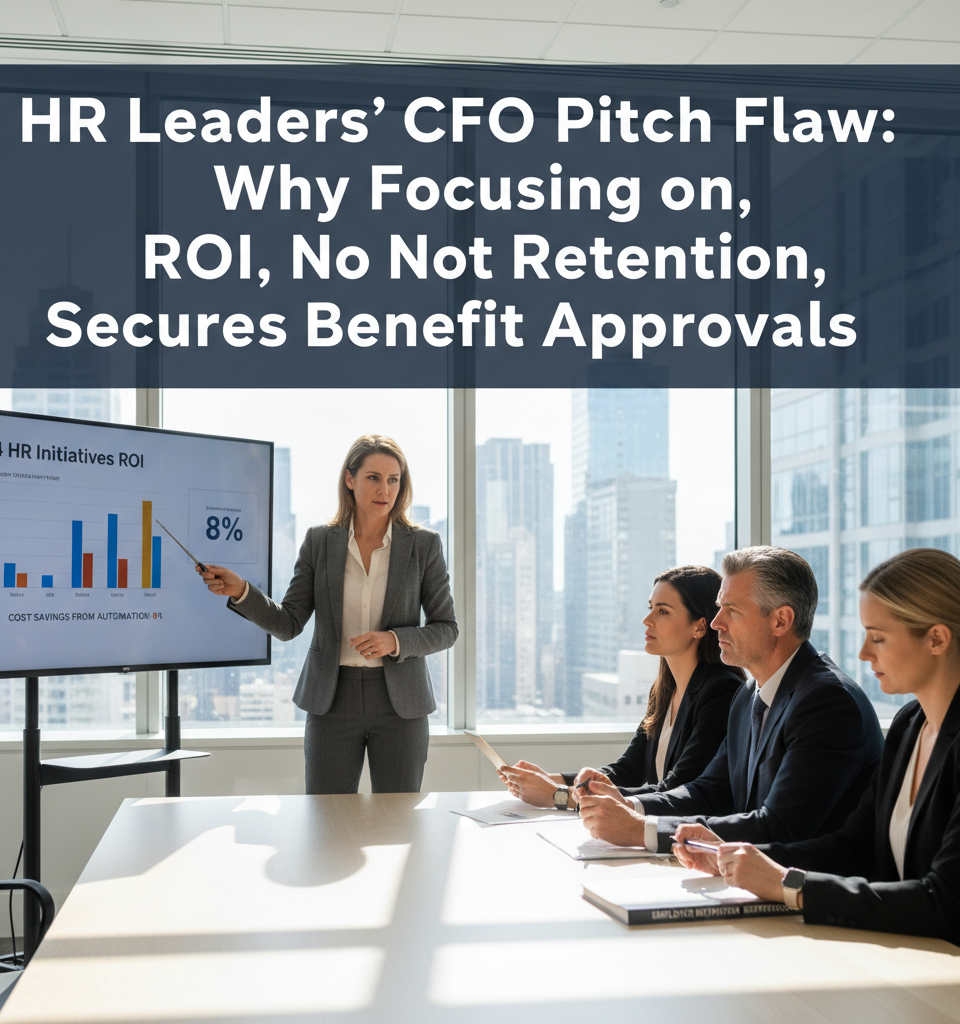
New York, NY – October 26, 2023 – Human Resources leaders are frequently miscalibrating their proposals for new employee benefits, often to the detriment of their organizations and workforce. According to a growing consensus among financial executives and industry analysts, the prevailing strategy of emphasizing employee retention as the primary justification for benefits packages is failing to resonate with CFOs. Instead, financial chiefs are increasingly demanding concrete, quantifiable return on investment (ROI) and direct financial impact before approving new HR initiatives.
The Misguided Retention Argument
For years, the HR playbook has championed the virtues of robust benefits — from enhanced health coverage to professional development programs — as essential tools for attracting and retaining top talent. While employee retention remains a critical business objective, the argument often presented to CFOs lacks the rigorous financial modeling required for significant capital allocation. "HR still often walks in with a 'do good' story that lacks a clear financial justification," explains Elizabeth Grant, a veteran CFO at a Fortune 500 technology firm. "A vague promise of 'better retention' doesn't translate into a line item in the budget without a clear calculation of cost savings or revenue generation." This disconnect often results in promising initiatives being shelved despite their potential long-term value.
The ROI Imperative: What CFOs Want
Financial decision-makers are primarily concerned with the bottom line. When evaluating new expenses, especially those as significant as employee benefits, they seek proposals that articulate a clear path to financial return. This includes demonstrable reductions in recruitment costs, decreased training expenditures due to lower turnover, increased productivity from a healthier and more engaged workforce, or even direct revenue uplifts stemming from improved employee performance. For instance, a proposal for a new mental health benefit might include data projecting a 15% reduction in absenteeism, translating to an estimated $250,000 in saved productivity losses annually for a mid-sized company. This type of financial projection moves the conversation from a qualitative discussion to a compelling quantitative argument.
Shifting Industry Landscape and Data-Driven HR
The broader business landscape is increasingly data-driven, and HR is no exception. Companies are investing heavily in HR analytics platforms capable of tracking everything from engagement scores to turnover costs. This technological evolution provides HR leaders with an unprecedented opportunity to back their benefit proposals with hard data. A recent survey by Deloitte found that 78% of CFOs believe HR proposals would be more effective if they included detailed financial projections and ROI analyses, yet only 35% of HR leaders consistently present such data. This gap highlights a critical area for improvement within the HR function, pushing towards a more strategic and financially literate approach.
Expert Perspective: Connecting People to Profit
"The most effective HR leaders are those who can bridge the gap between people strategy and financial outcomes," states Dr. Alan Prescott, a Professor of Organizational Behavior at the Wharton School. "They understand that investing in employees isn't just a cost center; it's a strategic investment in human capital that yields measurable returns. Presenting data that shows how reducing attrition for a specific role saves $X in hiring costs, or how improved health benefits decrease healthcare premiums by Y%, transforms the conversation entirely." Dr. Prescott emphasizes the need for HR professionals to speak the language of finance, translating human capital metrics into financial impacts.
Future Implications: Strategic HR as a Business Partner
This shift portends a more strategic and influential role for HR within organizations. As HR leaders become more adept at quantifying the financial impact of their initiatives, they will evolve from administrative operators to indispensable business partners. The future of HR will involve leveraging advanced analytics to identify benefit gaps, design programs with clear ROI targets, and present these proposals in a way that directly addresses a CFO's financial imperatives. Companies that successfully adopt this approach are likely to see better employee engagement, stronger financial performance, and a more integrated business strategy, ultimately leading to a more resilient and competitive workforce in an ever-evolving market. The onus is now on HR to refine their pitch, transforming potential costs into proven investments.