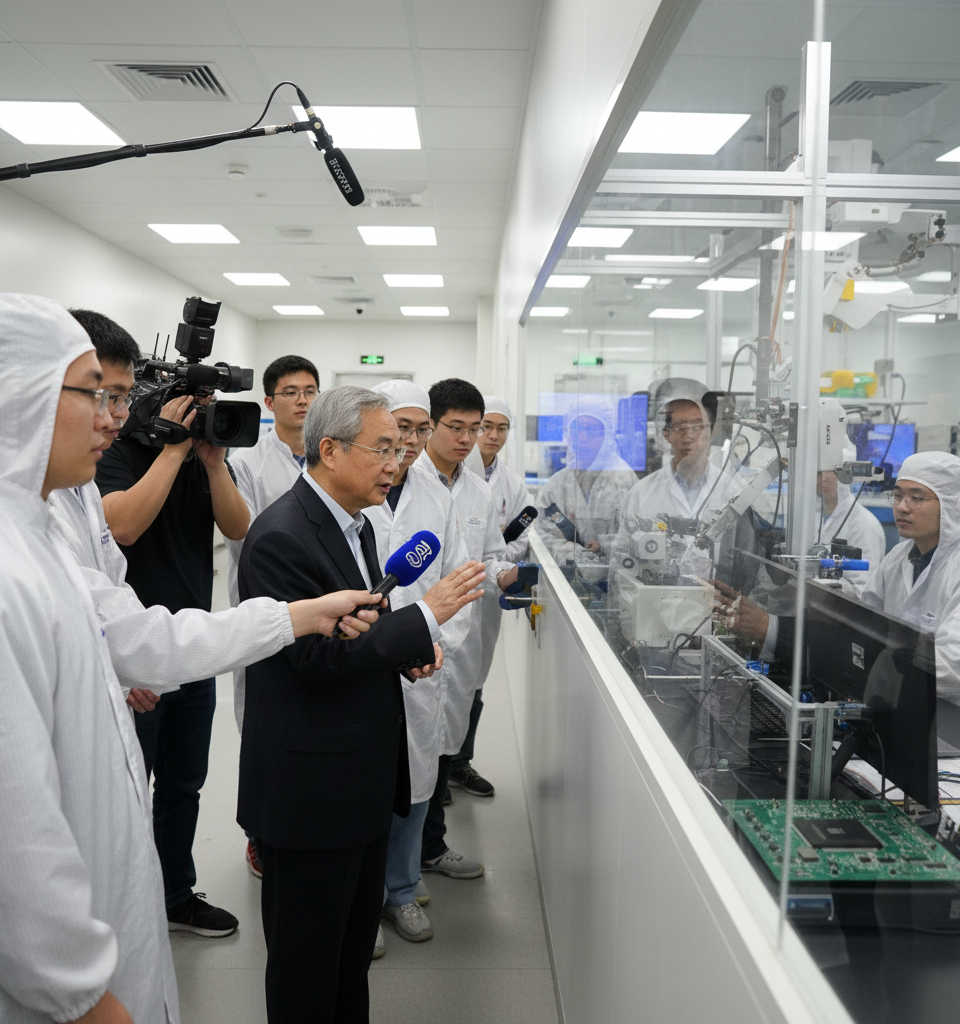
In a highly choreographed move, China Central Television (CCTV) aired never-before-seen footage of Huawei Technologies Co. Ltd.'s clandestine Chip Fundamental Technology Research Laboratory in Shanghai. The segment, broadcast on the widely watched Xinwen Lianbo news program — reaching over 200 million nightly viewers — showcased Huawei founder Ren Zhengfei hosting a delegation, two days prior to a high-stakes visit by then-President Donald Trump. This public unveiling of a facility central to Huawei's semiconductor ambitions was widely interpreted as a deliberate signal regarding China's domestic technological prowess amidst escalating trade tensions with the United States.
Contextualizing the Revelation
The timing of the broadcast was crucial. It occurred in the lead-up to a period of intense economic and political strain between Washington and Beijing, with technology, particularly semiconductors, at the heart of the dispute. The US had already begun imposing restrictions on Huawei, citing national security concerns and effectively cutting off its access to crucial American-made components and software. By showcasing a research lab dedicated to fundamental chip technology, China was subtly but firmly communicating its commitment to overcoming these foreign dependency challenges and cultivating an indigenous semiconductor industry. Ren Zhengfei's presence underscored the strategic importance of this endeavor to Huawei and, by extension, to the Chinese state.
Key Details and Strategic Messaging
The CCTV report provided a rare glimpse into Huawei's efforts to develop its own chip capabilities, a critical component of its vertically integrated strategy. While specific technical details of the lab’s projects were not disclosed, its very existence and public display conveyed a powerful message of resilience and self-sufficiency. Analysts believe the broadcast was not primarily aimed at a domestic audience, who are already steeped in narratives of national technological aspiration. Instead, it was a direct communication to the international community, and specifically to Washington, indicating that US efforts to cripple Chinese tech giants would only accelerate Beijing's push for technological independence. The segment framed Huawei's work as a national priority, aligning its corporate ambitions with broader state objectives.
Industry and Market Implications
This public assertion of chip development capabilities has significant repercussions for the global technology landscape. For one, it intensifies the ongoing decoupling narrative, where China actively seeks to reduce its reliance on Western technology. This could lead to a fragmented global tech ecosystem, with potentially higher costs and slower innovation as parallel supply chains develop. For semiconductor manufacturers outside China, particularly those heavily reliant on the Chinese market, it signals a potential long-term reduction in demand as domestic alternatives mature. Furthermore, it could spur increased investment in domestic R&D within China, shifting substantial capital flow towards indigenous hardware and software solutions.
Expert Perspectives
Industry analysts widely viewed the broadcast as a strategically calculated move. "This wasn't just a news report; it was a political statement dressed as a technological update," commented one Asia-based technology consultant, preferring anonymity due to the sensitivity of the topic. "It signaled China's resolve to defy US sanctions and accelerate its 'Made in China 2025' ambitions, particularly in critical technologies like semiconductors." Others noted that while a secret lab's public debut might seem counterintuitive for proprietary research, the strategic communication value outweighed the risk of revealing too much. "They are projecting confidence and determination, hoping to deter further punitive measures by demonstrating their capacity for self-reliance," stated a geopolitical strategist from a leading think tank.
The Road Ahead
Moving forward, the unveiling of Huawei’s chip lab underscores a persistent drive within China to achieve technological sovereignty. This will likely translate into continued aggressive investment in areas like advanced manufacturing, material science, and design tools crucial for chip fabrication. Expect to see increased collaboration between government, academia, and industry within China to foster a robust domestic semiconductor ecosystem.
While full self-sufficiency is a long and arduous path, potentially spanning decades and requiring hundreds of billions of dollars in investment, the public display of Huawei's lab signals that China is committed to this trajectory, irrespective of international pressure or diplomatic overtures. The international community will be closely watching for tangible breakthroughs that solidify China's position as a formidable player in the global semiconductor arena.