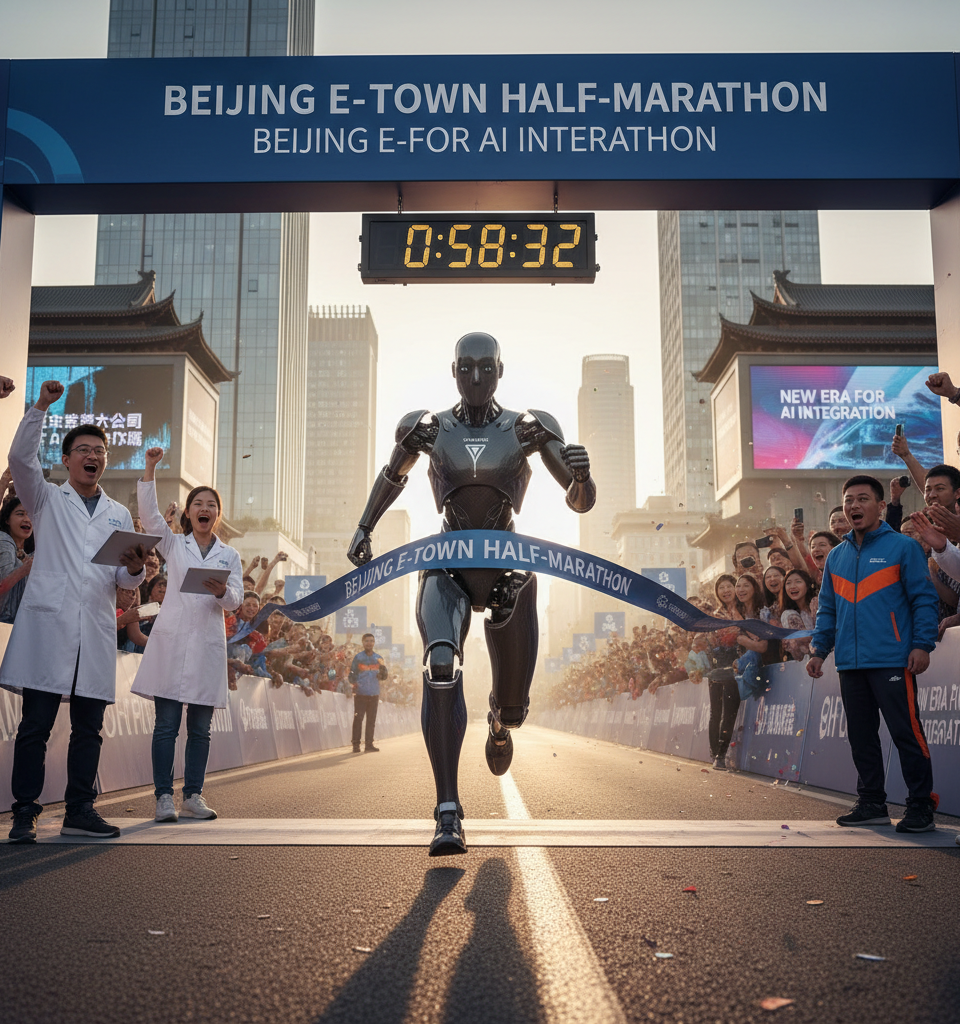
A New Benchmark in Autonomous Robotics
The significance of Lightning's achievement extends far beyond mere speed. It represents a critical milestone in the development of truly autonomous humanoid robots capable of complex, sustained physical tasks in dynamic environments. Traditionally, robotic locomotion, especially over long distances and varied terrains, has been a significant engineering hurdle. This successful half-marathon completion underscores a dramatic advancement in kinematic control, energy management, and environmental interaction, pushing the boundaries of what was previously thought possible for bipedal machines. The event also featured a second Lightning unit performing simultaneous data collection and operational observation, highlighting the robustness of the platform.
Technological Prowess and Performance Metrics
Lightning's performance was the culmination of years of research and development, integrating cutting-edge technologies. The robot's navigation system utilizes a sophisticated array of sensors, including LiDAR, high-resolution cameras, and inertial measurement units (IMUs), to create a real-time, high-fidelity map of its surroundings. Its proprietary real-time decision-making algorithms enable it to analyze terrain, anticipate obstacles, and optimize its stride and pace dynamically, ensuring efficient energy consumption throughout the challenging course. The robot maintained an average pace of approximately 2 minutes and 24 seconds per kilometer (approximately 3 minutes and 52 seconds per mile), a speed that consistently outmatched previous human records.
Industry Impact and Future Market Implications
This breakthrough holds profound implications for the robotics industry and various market sectors. Beyond sports, the successful deployment of an autonomous bipedal robot over such a distance suggests immense potential for applications in logistics, disaster response, hazardous environment exploration, and even personal assistance. Companies and investors are likely to take renewed interest in humanoid robotics, forecasting an acceleration in research and development funding. The capacity for sustained, agile, and autonomous operation could unlock new service models and significantly enhance productivity in labor-intensive industries, potentially impacting a global robotics market projected to reach over $170 billion by 2027.
Expert Perspectives on the Robotic Revolution
Robotics experts and AI ethicists are weighing in on the implications of Lightning's record-breaking run. Dr. Anya Sharma, a leading AI researcher at the Global Robotics Institute, commented, “This isn't just about speed; it's about robust autonomy and resilience. It signals a paradigm shift in robot design, moving from controlled factory environments to complex, unstructured outdoor settings. While the immediate comparison is athletic, the underlying technological advancements will ripple through industrial and public service applications.” Concerns, however, also arise regarding the future of human employment in sectors where such robots could be deployed and the ethical frameworks governing increasingly autonomous machines.
The Road Ahead: From Marathon to Mainstream
The team at Shenzhen Honor Smart Technology Development Co. has indicated that this half-marathon is just the beginning. Future plans include testing the robot's capabilities over full marathon distances and in more varied and extreme environmental conditions. The data collected from this event will be critical for refining Lightning's algorithms, improving its energy efficiency, and enhancing its adaptability. Further research will also focus on human-robot interaction and the integration of these advanced bipedal systems into existing infrastructure, paving the way for a future where autonomous humanoid robots could play a ubiquitous role in various aspects of daily life and industry.
Implications for Human Performance and Augmentation
Beyond direct competition, Lightning's performance offers invaluable insights for sports science and human performance optimization. By studying the robot's biomechanics, energy expenditure patterns, and dynamic adaptation strategies, researchers could potentially develop new training methodologies or assistive technologies for human athletes. The era of human-robot collaboration in sports science, rather than just competition, could emerge, pushing the boundaries of human potential through engineered insights derived from advanced AI and robotics.