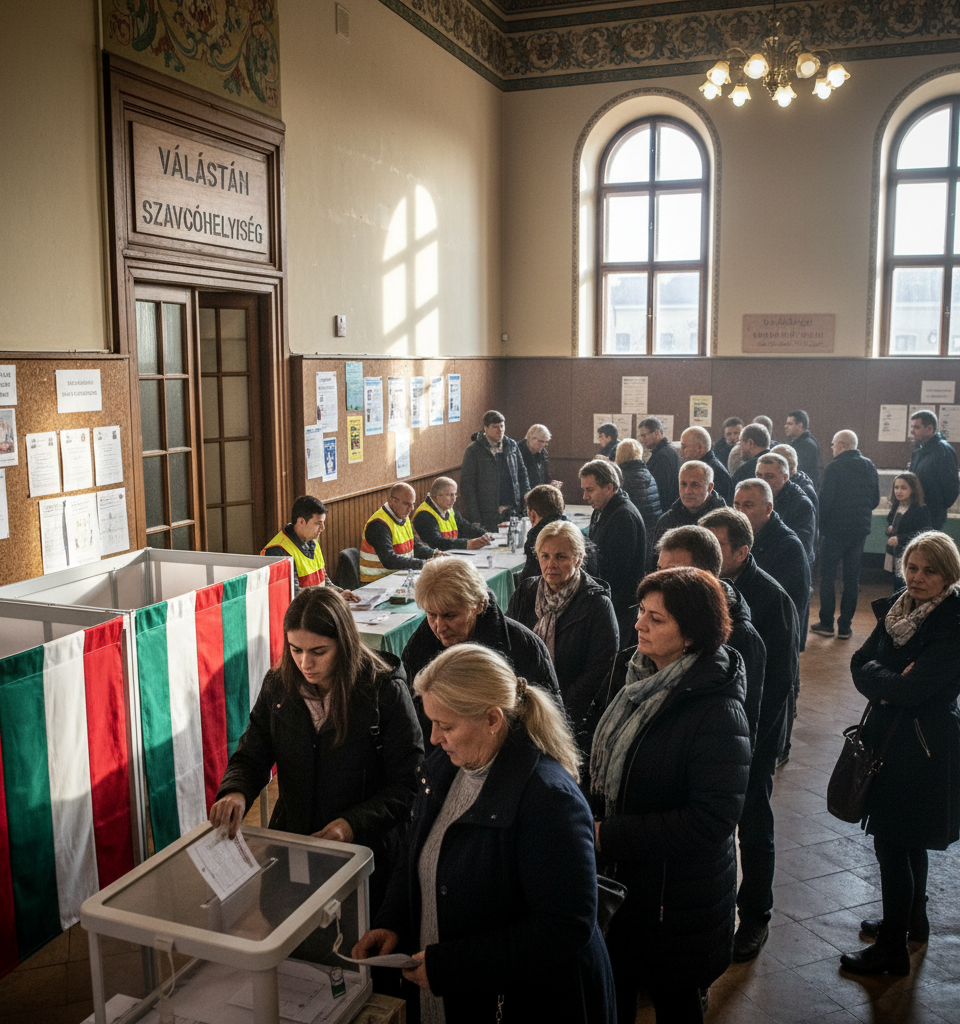
Hungarians head to the polls today in a watershed election that could mark the end of Prime Minister Viktor Orbán's near two-decade grip on power, as a burgeoning grassroots movement led by Péter Magyar presents a formidable challenge. With early indications pointing to an unusually high voter turnout across the nation, the contest is widely seen as a referendum on Orbán's populist Fidesz party and its increasingly autocratic governance. This election, coming amidst a backdrop of economic disgruntlement and societal fatigue with the status quo, is poised to reshape Hungary's political landscape significantly.
A Nation's Pivotal Moment and Historical Context
This election transcends a mere change in leadership; it represents a critical juncture for Hungary's democratic trajectory and its relationship with the European Union. Viktor Orbán, in power since 2010 (and previously from 1998-2002), has systematically consolidated power, reforming the judiciary, media, and electoral systems in ways that critics argue undermine democratic checks and balances. His 'illiberal democracy' model has frequently clashed with Brussels, leading to disputes over rule of law, migration, and foreign policy. The current election is a direct testament to a growing internal desire for a different path, challenging a narrative of national sovereignty that has often come at the expense of European integration.
Péter Magyar: The Unlikely Catalyst for Change
Péter Magyar, a former government insider and estranged husband of former Justice Minister Judit Varga, has emerged as the surprising standard-bearer for change. His rapid ascent began earlier this year with accusations of government corruption and a call for a more transparent and accountable political system. Leading the 'Respect and Freedom' (TISZA) party, Magyar has successfully tapped into a vein of public discontent, particularly among younger voters and those alienated by both Fidesz and the traditional opposition. Polls conducted in the weeks leading up to the vote indicated that Magyar's party, initially a dark horse, had garnered significant support, threatening Fidesz's long-held dominance. His campaign, emphasizing anti-corruption and a return to European norms, has resonated strongly, manifesting in large-scale rallies and an energetic online presence.
The Economic and Societal Undercurrents
The election is being fought against a backdrop of considerable economic challenges. Hungary has grappled with high inflation, a weakening Forint, and concerns over the transparency and distribution of EU funds. While the Orbán government has highlighted robust economic growth in certain sectors and its family-support policies, many Hungarians feel the pinch of rising living costs and perceive a system rife with patronage. Socially, there's a growing divide between those who embrace Orbán's conservative, nationalist agenda and those who advocate for greater social liberalism, minority rights, and deeper integration with Western European values. These societal fissures are playing a crucial role in mobilizing voters on both sides.
Expert Insights on the Political Landscape
Political analysts are closely watching the results, with many describing this election as the most unpredictable in recent memory. Dr. Anna Kovács, a political science professor at Eötvös Loránd University, notes, "Magyar's appeal lies in his ability to present himself as an outsider, despite his past connections to the Fidesz establishment. He offers a fresh face and a narrative of systemic change that even traditional opposition parties have struggled to articulate." She adds, "The sheer volume of rally attendees and the early turnout figures suggest a deeply engaged electorate, weary of political stagnation and hungry for a genuine alternative." Concerns remain, however, about the long-term viability of a new, relatively untested political force in a system extensively shaped by Fidesz.
Broader Implications for Europe and Beyond
A potential shift in Hungarian leadership carries significant implications not just domestically, but for the wider European Union. Orbán has been a prominent figure in the 'Visegrád Group' (V4) and a vocal critic of EU policies on migration, rule of law, and sanctions against Russia. A new government might signal a recalibration of Hungary's foreign policy, potentially leading to a more collaborative stance with Brussels and other EU member states. This could alter the balance of power within the bloc, strengthening the pro-EU consensus and perhaps reducing internal friction. Furthermore, it could serve as a case study for populist movements across Europe, demonstrating that established power, however entrenched, is not immune to public discontent.
What Lies Ahead: An Uncertain Future
The immediate aftermath of the vote will be crucial. Should Péter Magyar's party perform exceptionally well, potentially denying Fidesz a parliamentary majority or even securing a plurality, coalition negotiations would likely be complex and protracted. The formation of a stable government would be a priority, but the ideological gaps between Hungary's various political factions remain wide. Regardless of the outcome, this election has undeniably injected a fresh dynamic into Hungarian politics, forcing a re-evaluation of national identity, democratic principles, and the country's place within Europe. The coming days and weeks will reveal whether Hungarians have chosen continuity or charted a radically new course for their nation.