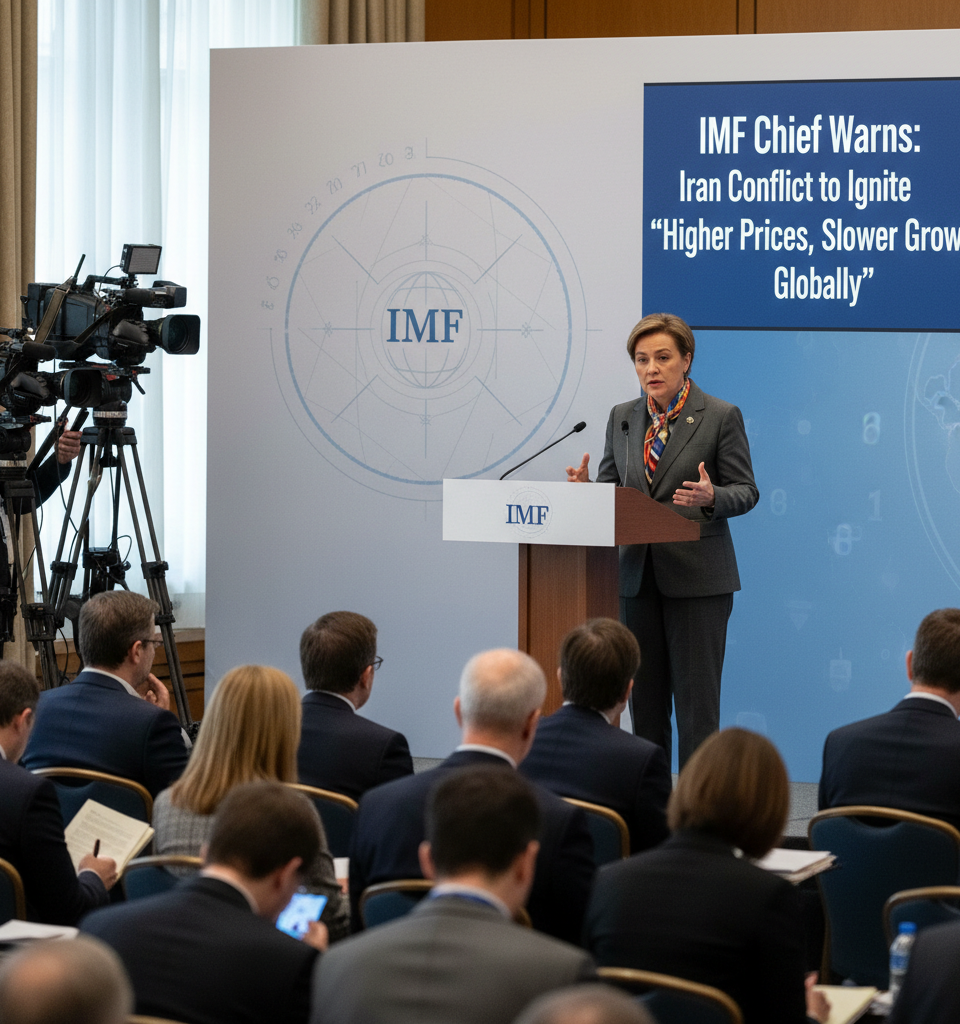
Washington D.C. – The International Monetary Fund (IMF) Managing Director, Kristalina Georgieva, has issued a stark warning regarding the global economic outlook, attributing an anticipated surge in prices and a deceleration in growth directly to the escalating conflict between Iran and Israel. Speaking from Washington D.C., Georgieva underscored the interconnectedness of geopolitical stability and economic prosperity, asserting that the current Middle East crisis is a critical determinant of the world's financial trajectory. Her pronouncement reflects mounting concerns among international financial institutions about the far-reaching economic consequences of regional instability.
This dire forecast arrives at a precarious moment for the global economy, which has only recently begun to show tentative signs of recovery from the compounded shocks of the COVID-19 pandemic and the war in Ukraine. The Middle East, a pivotal region for global energy supplies, has historically influenced oil prices and trade routes. Previous conflicts, such as the 1973 oil crisis or the 1990 Gulf War, illustrate the profound and immediate impact regional instability can have on global commodity markets and economic sentiment. The current tensions are particularly alarming due to their potential to disrupt vital shipping lanes and energy infrastructure, amplifying existing inflationary pressures and supply chain vulnerabilities.
Georgieva's assessment is rooted in the expectation of increased energy costs and heightened supply chain disruptions. While specific figures were not provided in her initial statement, analysts are already modeling scenarios where crude oil prices could spike by 15-20% if the conflict broadens, potentially pushing Brent crude beyond $100 a barrel. Such a rise would translate into higher transportation costs, increased manufacturing expenses, and ultimately, elevated consumer prices across a spectrum of goods and services. The IMF's recent World Economic Outlook had already projected a modest global growth rate of around 3% for 2024, a figure now under considerable downward revision pressure.
The reverberations of this geopolitical tremor are expected to be felt across virtually all sectors. Energy-intensive industries, including manufacturing, transportation, and agriculture, will face immediate cost pressures, potentially leading to reduced output and job losses. Global trade flows could be significantly hampered by disruptions in key maritime passages like the Strait of Hormuz, through which a substantial portion of the world's oil transits. Financial markets have already reacted with increased volatility, as investors seek safe havens, retreating from riskier assets and potentially tightening global credit conditions. Emerging markets, particularly those heavily reliant on imported energy, are most vulnerable to these economic headwinds.
Economists and geopolitical strategists largely echo the IMF chief's concerns, albeit with varying degrees of severity in their predictions. Dr. Elena Petrova, a Senior Economist at the Council on Foreign Relations, commented, "The risk premium on oil is now baked into the market. Even without direct supply disruptions, the uncertainty itself is a powerful inflationary force. Central banks, which have been navigating complex paths towards interest rate normalization, now face renewed pressures that could force them to maintain higher rates for longer, thereby stifling investment and growth." Others point to the potential for a surge in defense spending, reallocating resources away from productive economic activities.
Looking ahead, the immediate future hinges heavily on the trajectory of the Iran-Israel conflict. De-escalation efforts, spearheaded by international diplomatic initiatives, remain paramount to averting a full-blown economic crisis. However, should hostilities intensify, global central banks may find their policy options constrained, potentially facing the unenviable choice between curbing inflation through aggressive rate hikes – at the risk of inducing a recession – or accommodating higher inflation, which could erode purchasing power and destabilize financial systems. The IMF itself is preparing to reassess its global economic projections, with an update expected in the coming weeks, that will undoubtedly reflect these new and profound geopolitical risks.
International cooperation will be crucial in mitigating the fallout. Measures such as coordinated releases from strategic petroleum reserves, enhanced efforts to secure shipping routes, and financial aid packages for the most vulnerable economies might become necessary to stabilize markets and prevent a cascading economic downturn. The world economy stands at a critical juncture, with geopolitical events now holding an unprecedented sway over its immediate prospects.