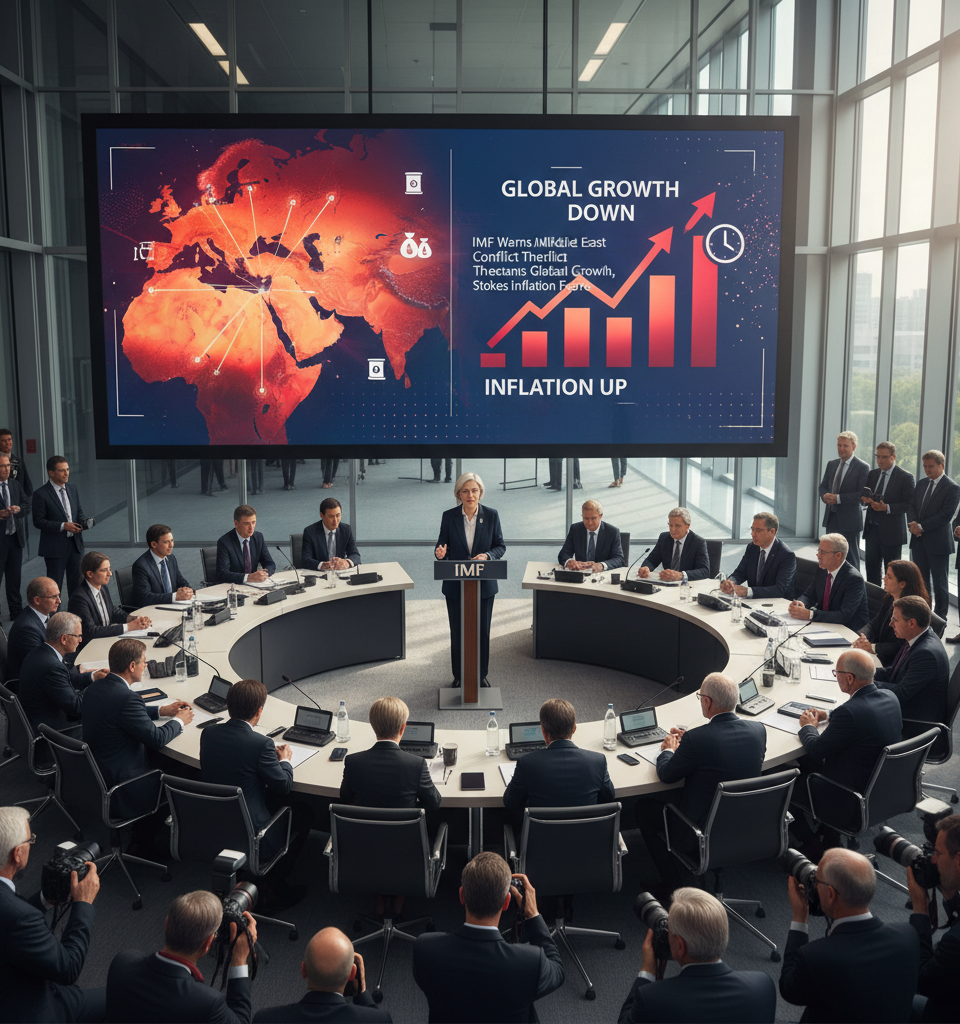
**Washington D.C., ** – The International Monetary Fund (IMF) has issued a dire warning that the intensifying conflict in the Middle East poses a substantial threat to the global economy, potentially triggering a slowdown in economic growth and fueling a fresh surge in inflation. In its latest pronouncement, the multilateral financial institution underscored the precarious nature of the global economic recovery, which now faces significant headwinds from geopolitical instability in a critical region.
The Geopolitical Echoes of Economic Instability
This alarming assessment from the IMF arrives at a juncture when the global economy is still grappling with the lingering effects of the COVID-19 pandemic, supply chain disruptions, and the war in Ukraine. The Middle East, a pivotal region for global energy markets and trade routes, adds a complex layer of risk. History has repeatedly demonstrated that geopolitical tensions in this area can send ripple effects across international markets, impacting everything from oil prices to investor confidence. The current crisis, involving major regional and international players, threatens to disrupt these vital arteries of global commerce.
Escalating Risks: Energy, Trade, and Investor Confidence
Kristalina Georgieva, the Managing Director of the IMF, highlighted the dual threat of reduced global growth and resurgent inflation. While specific percentage points of growth reduction were not immediately provided, the IMF's preliminary analysis suggests a material impact. The most immediate concern revolves around energy markets, with oil prices exhibiting significant volatility since the conflict's escalation. A sustained rise in crude oil benchmarks, potentially pushing prices above $100 per barrel depending on the conflict's intensity and duration, would directly feed into higher transportation costs, manufacturing expenses, and ultimately, consumer prices. Furthermore, disruptions to crucial shipping lanes, such as the Suez Canal, could severely impact global supply chains, mirroring the challenges seen during the pandemic. The uncertainty generated by the conflict could also deter foreign direct investment into emerging markets and lead to a flight to safe-haven assets, tightening global financial conditions.
Broader Economic Repercussions Across Sectors
The ripple effects of this conflict extend far beyond energy. Industries heavily reliant on global trade, such as manufacturing, automotive, and retail, face increasing logistical challenges and potential cost escalations. Businesses already struggling with elevated interest rates and persistent inflation could see their margins squeezed further, leading to reduced investment and hiring. Developing economies, particularly those that are net importers of oil, are especially vulnerable to the double whammy of higher energy costs and a stronger U.S. dollar, which makes their foreign currency-denominated debt more expensive to service. The tourism sector, a cornerstone of many Middle Eastern economies and a significant contributor to global GDP, is also expected to suffer a severe downturn.
Expert Consensus on Downside Risks
Economists and market analysts broadly concur with the IMF's pessimistic outlook. Dr. Eleanor Vance, Chief Global Economist at Stratum Capital, remarked, "The Middle East conflict introduces a non-linear risk to the global economy. While the immediate economic impacts, such as oil price spikes, are evident, the long-term effects on investor sentiment and the re-alignment of global trade routes could be far more profound and difficult to quantify." Many experts fear that persistent geopolitical instability could entrench higher inflation expectations, making it more challenging for central banks to achieve their inflation targets without triggering deeper economic contractions. The prospect of stagflation, a period of high inflation coupled with stagnant growth, looms larger.
The Path Forward: Monitoring, Mitigation, and Uncertainty
The immediate focus for global policymakers, according to the IMF, will be intense monitoring of the conflict's trajectory and its cascading economic effects. Central banks may face difficult decisions regarding interest rates, balancing the need to control inflation against the imperative to support economic growth. International cooperation will be crucial in mitigating the humanitarian and economic fallout. However, the inherent unpredictability of geopolitical events makes forecasting incredibly challenging. The length and breadth of the conflict's economic impact will largely depend on its containment, the extent of supply disruptions, and the policy responses of governments and central banks around the world. The specter of a prolonged period of global economic deceleration, exacerbated by inflationary pressures, now firmly casts a shadow over the immediate future.