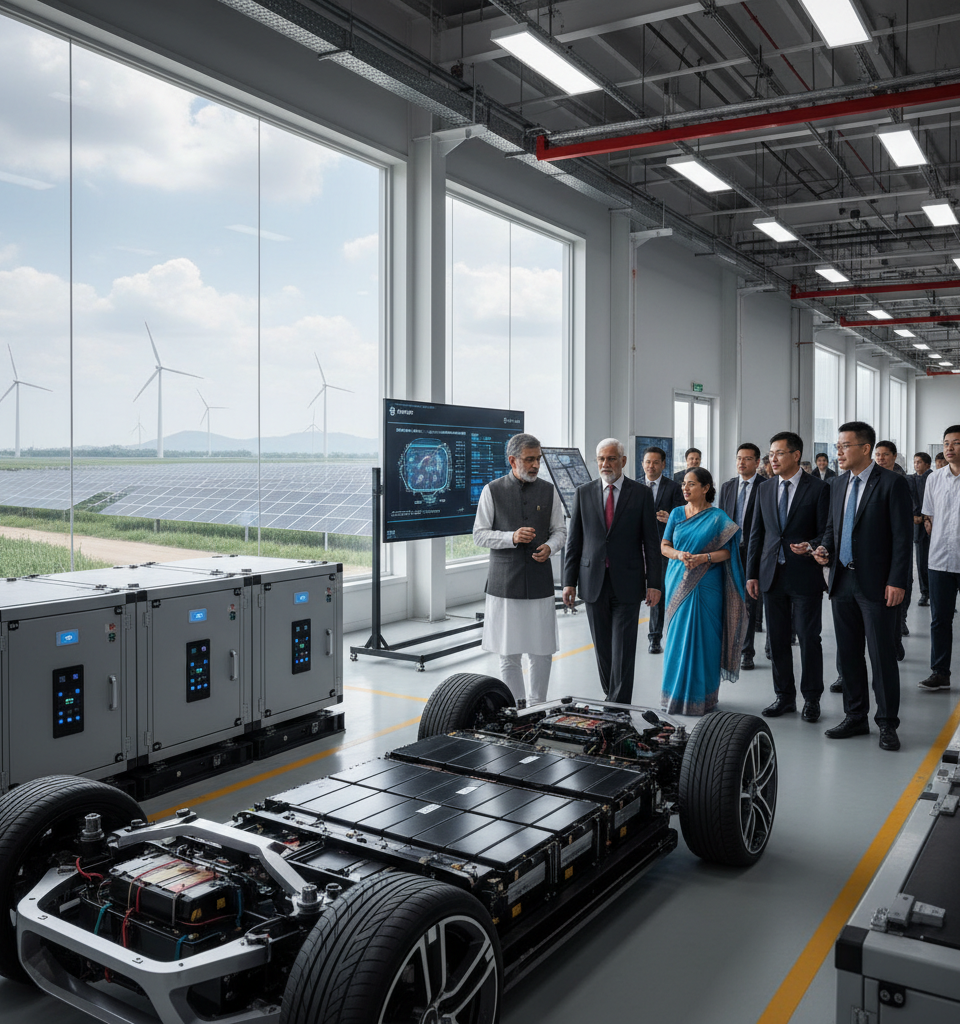
Shanghai, China – November 2, 2023 – A high-level Indian business delegation has completed a pivotal visit to China, marking the first such direct engagement in nearly five years, amid heightened geopolitical tensions and global energy recalibrations. The delegation, comprised of representatives from key Indian industries, engaged with Chinese counterparts on potential collaborations in electric vehicles (EVs), advanced battery manufacturing, and renewable energy technologies. This strategic outreach underscores India's proactive approach to diversifying its industrial partnerships and securing vital supply chains, particularly as global energy markets face disruptions stemming from the ongoing conflict in Iran.
This re-engagement transpires against a complex backdrop of strained bilateral relations since the 2020 Galwan Valley border skirmish, which severely curtailed diplomatic and economic exchanges. However, pragmatic economic realities appear to be taking precedence. India, the world's third-largest energy consumer, is actively seeking to reduce its reliance on fossil fuels and accelerate its clean energy transition. China, a global leader in EV production, battery technology, and renewable energy infrastructure, presents an undeniable and often indispensable partner for achieving these ambitious goals, despite political friction. The current volatility in oil prices and supply chain vulnerabilities exacerbated by the Iran conflict has undoubtedly added impetus to India's push for energy independence and alternative technology sourcing.
The visiting delegation reportedly held extensive discussions with major Chinese EV manufacturers, battery technology firms, and renewable energy solution providers. Sources familiar with the meetings indicate a particular interest in technology transfer, joint ventures in battery cell manufacturing, and sourcing of critical components for India's burgeoning EV market. India's aggressive goals include achieving 30% EV penetration in private cars by 2030, a target that necessitates robust manufacturing capabilities and access to advanced battery technologies, an area where Chinese companies like CATL and BYD hold significant global market share. The discussions also touched upon investments in solar and wind energy projects, aligning with India's target of 500 GW of renewable energy capacity by 2030.
The potential for renewed economic collaboration between India and China carries significant implications for the broader Asian and global industrial landscape. For India, leveraging China's manufacturing prowess and technological advancements in clean energy sectors could dramatically accelerate its decarbonization efforts and strengthen its position in the global EV supply chain. For China, renewed access to the vast Indian market offers significant growth opportunities, particularly as some Western markets become more protectionist. This pragmatic economic thaw could also serve as a template for other nations seeking to balance geopolitical rivalries with economic necessities, potentially reshaping regional trade dynamics and fostering greater technological interdependence in critical sectors.
Industry analysts and geopolitical experts are closely watching these developments. Dr. Arvind Kumar, an economist specializing in Indo-Sino relations, noted, "This visit is a clear indication that economic imperatives are overriding political friction, at least in certain strategic sectors. India recognizes that a complete decoupling from China, particularly in areas like EV batteries and solar equipment, is neither feasible nor desirable in the short to medium term due to cost efficiencies and technological maturity." However, he cautioned that any long-term partnership would need to address underlying trust deficits and ensure balanced economic benefits for both nations, with a focus on 'Make in India' initiatives to avoid over-reliance.
The implications for this rapprochement extend beyond immediate economic gains. A more stable economic relationship could, in the long term, foster a more constructive dialogue on broader geopolitical issues, though significant hurdles remain. Future developments are expected to include further delegation exchanges, potential investment announcements in India's battery and EV ecosystem, and possibly enhanced cooperation on renewable energy projects. India's 'Production Linked Incentive' (PLI) schemes for advanced chemistry cell manufacturing and automobile components are poised to attract substantial Chinese investment, further cementing these new ties. The coming months will reveal the tangible outcomes of this delicate yet vital re-engagement, as both nations seek to navigate a new global order defined by energy transition and strategic competition.
Data Points & Figures:
- India's EV Target: 30% EV penetration in private cars by 2030.
- India's Renewable Energy Target: 500 GW of renewable energy capacity by 2030.
- Global Battery Market: China accounts for over 70% of global battery manufacturing capacity.
- Bilteral Trade (2022-23): Approximately $113.8 billion, with a significant trade deficit favoring China.
- Investment Climate: India's PLI schemes offer incentives of up to $2.3 billion for advanced chemistry cell manufacturing and $3.5 billion for the auto sector.
Conclusion:
This Indian delegation's visit to China represents a crucial step in recalibrating bilateral economic relations, driven by pressing needs for energy security and clean energy transition. While political tensions persist, the pragmatic pursuit of mutual economic interests, particularly in the high-growth sectors of EVs, batteries, and renewables, suggests a maturing foreign policy approach from both nations. The success of this 'thaw' will depend on navigating geopolitical sensitivities while maximizing shared economic opportunities.