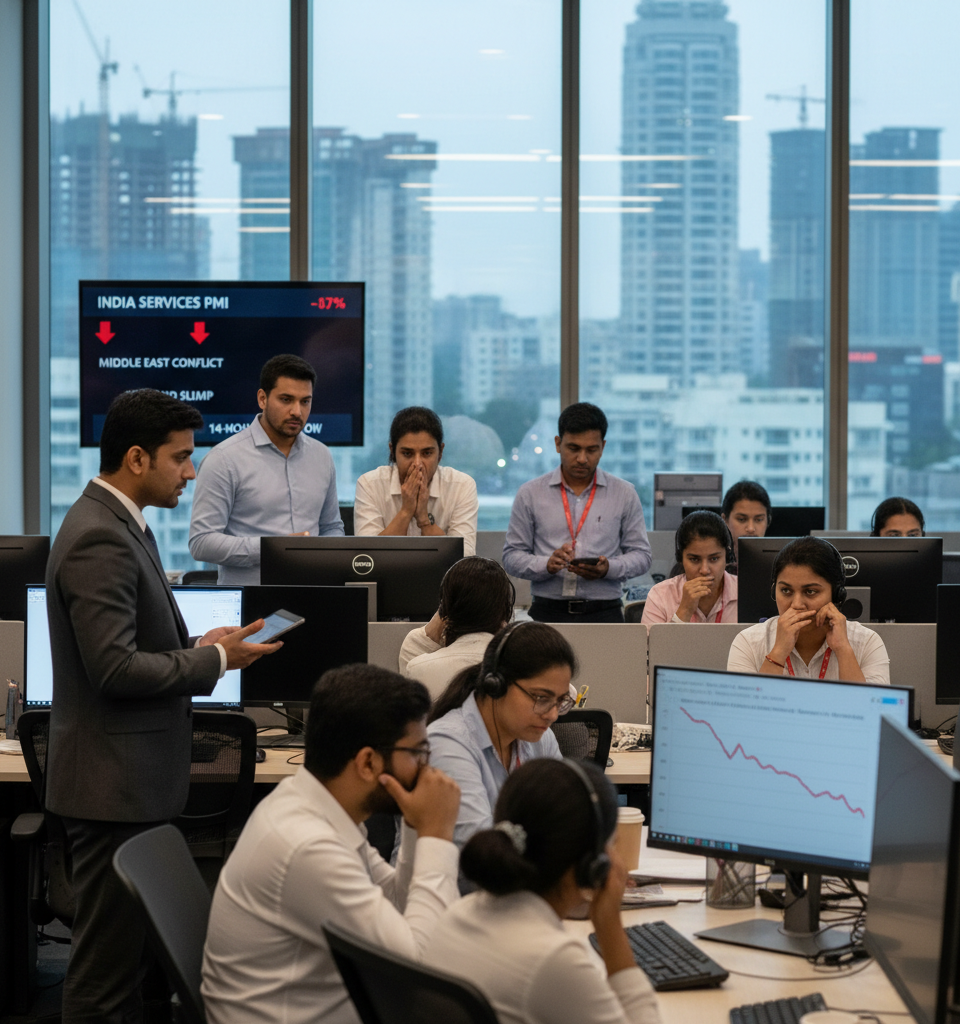
India's services sector, a vital component of its rapidly expanding economy, has registered its slowest growth in 14 months, according to recently released Purchasing Managers' Index (PMI) data. The downturn is largely attributed to a discernible hit in demand, a direct consequence of the ongoing conflict in the Middle East. This development marks a notable shift for a sector that has consistently contributed robustly to India's overall economic performance.
Geopolitical Tensions Dampen Economic Momentum
The deceleration underscores the increasing interconnectedness of global economies and the tangible impact that geopolitical instabilities can have on otherwise resilient markets. The Middle East conflict, while geographically distant, appears to have created a ripple effect, translating into reduced demand for Indian services. This can manifest in various ways, from dampened business confidence and investment flows to disruptions in supply chains and consumer spending patterns influenced by global economic uncertainty.
The PMI, a crucial economic indicator derived from monthly surveys of private sector companies, provides an early insight into current business conditions. A slowdown to a 14-month low suggests a substantial moderation from previous growth trends, raising questions about the near-term trajectory of the services industry. The sector encompasses a wide array of activities, including IT, finance, hospitality, and transportation, all of which are susceptible to fluctuations in global demand.
Broader Economic Implications
The services sector typically accounts for more than half of India’s gross domestic product (GDP) and has been a significant driver of job creation and economic growth. A sustained slowdown in this area could have broader implications for India's overall economic outlook. It might pressure policymakers to assess internal strategies to mitigate external shocks, particularly as the nation aims for higher growth trajectories.
Industries heavily reliant on international trade and global capital flows could be particularly affected. For instance, sections of the IT and business process outsourcing (BPO) sectors, which have strong linkages to global clients, may witness reduced new orders or project delays. Similarly, international tourism and aviation, though not explicitly detailed in the source, are commonly sensitive to geopolitical instability and could indirectly contribute to the services sector's slump.
Impact on Demand Dynamics
The core issue identified by the PMI data is a hit to demand. This could stem from several factors related to the Middle East conflict. Higher energy prices, often a consequence of regional instability, can increase operational costs for businesses and reduce disposable income for consumers globally, thereby curbing demand for non-essential services. Furthermore, uncertainty can lead businesses to postpone expansion plans and consumers to delay discretionary spending.
While the source does not provide specific data points on which sub-sectors within services are most affected, the general slowdown suggests a broad-based impact rather than an isolated incident. Businesses may be reporting lower new orders, slower project pipelines, or increased cautiousness among clients. The 14-month low indicates that the current environment is more challenging than any period experienced in over a year.
Looking Ahead: Navigating Global Headwinds
Moving forward, the Indian government and businesses will likely be closely monitoring the evolving situation in the Middle East and its continued impact on global economic sentiment. The ability of the services sector to rebound will depend on a combination of factors, including the resolution or de-escalation of geopolitical tensions, stable global commodity prices, and sustained domestic demand. Policymakers may need to consider measures to bolster domestic infrastructure and incentives to attract and retain investment within the services industry to cushion against external shocks.
The coming months will be critical in determining whether this slowdown is a temporary blip or the beginning of a more prolonged period of moderated growth for India's services sector. Businesses will need to adapt to potentially volatile demand environments, while the government will face the challenge of fostering an economic landscape resilient to international disruptions. The immediate focus will be on understanding the full scope of the demand hit and formulating responsive strategies.