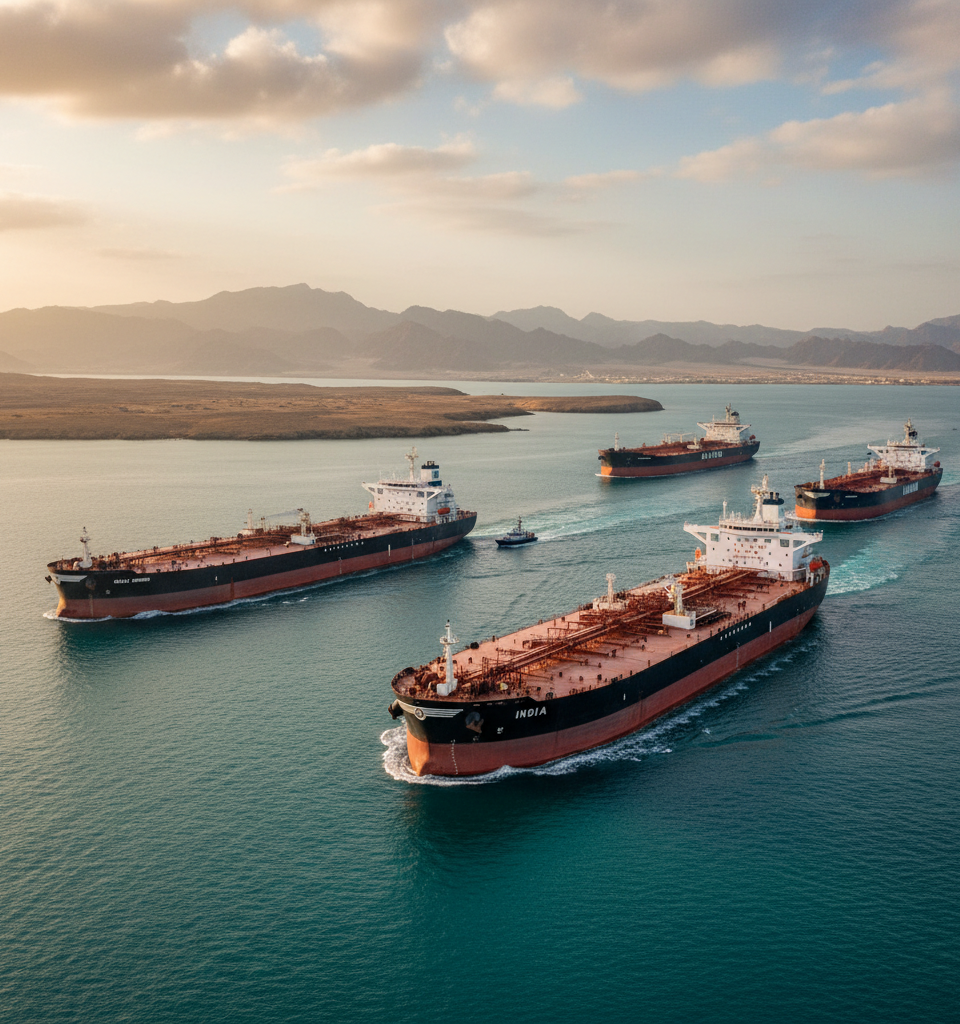
The maritime landscape of the Gulf of Oman has recently witnessed the re-emergence of three fully laden supertankers, each with demonstrable links to India, signaling a broader trend of increased shipping activity in the region. Their reappearance contributes significantly to heightened observed bi-directional traffic along both the northern and southern routes of the strategically vital Strait of Hormuz. This uptick in vessel movements is unfolding even as the maritime industry grapples with persistent, and at times conflicting, narratives concerning the safety and regularity of transits through the narrow strait.
Context of Hormuz Transit
The Strait of Hormuz remains unequivocally one of the world's most critical choke points for global energy supplies, with an estimated one-fifth of the world's total petroleum liquids consumption, or about 21 million barrels per day, passing through it annually. Its significance as a conduit for oil and gas from the Persian Gulf to international markets makes any fluctuation in its traffic patterns a subject of intense scrutiny. The re-emergence of these Indian-linked tankers underscores the continued reliance of major economies, like India, on this conduit for their energy security, despite geopolitical tensions and occasional disruptions that have historically plagued the region.
Observation and Traffic Patterns
The observation of these three specific supertankers — each fully laden, indicating a complete cargo — provides tangible evidence of active shipping operations. Their presence in the Gulf of Oman, a crucial staging area just outside the strait, positions them either for imminent entry into the Persian Gulf or recent exit. This movement complements broader intelligence suggesting an escalation in the overall volume of vessels navigating the Strait of Hormuz. Observers have noted increased activity across both conventional routes, spanning the waters between Oman and Iran's southern coast, suggesting a robust flow of goods and raw materials in both directions (inbound to the Gulf and outbound to global markets).
Conflicting Narratives and Perceptions
Compounding the analysis of these traffic increases are the lingering, often contradictory, reports and statements regarding the security and normalcy of transits. While some stakeholders may highlight uninterrupted passage as business-as-usual, others continue to articulate concerns about potential threats or operational challenges. This divergence in perception often colors market responses and insurance premiums, even as physical maritime activity, as demonstrated by the re-emergence of these tankers, appears to be accelerating. The exact nature of these conflicting narratives, whether stemming from geopolitical posturing or genuine security assessments, remains a complex aspect of the current maritime environment.
Broader Industry Implications
The increased movement of supertankers, particularly those laden with cargo, directly impacts global commodity markets, shipping logistics, and insurance sectors. For the energy market, a sustained increase in outbound traffic from the Persian Gulf suggests stable or rising demand, or a strategic effort to move available crude. For the shipping industry, higher traffic volumes, even amid conflicting security assessments, can influence charter rates, vessel availability, and even port congestion. Insurers, always sensitive to regional instability, will closely monitor these developments, potentially adjusting premiums based on perceived risk levels, which can in turn affect the cost of goods for end consumers.
India's Strategic Interests
As a rapidly growing major economy, India's energy import requirements are substantial and predominantly met via sea lanes traversing the Persian Gulf and the Strait of Hormuz. The visibility of India-linked vessels at this critical juncture not only highlights their active participation in the global energy trade but also underscores India's strategic interest in the unimpeded flow of maritime commerce through the region. Any disruption to this flow could have significant economic repercussions for the nation, solidifying its geopolitical stake in regional stability and maritime security initiatives.
Outlook on Regional Dynamics
Looking ahead, the observation of sustained or increased traffic through the Strait of Hormuz will be a key indicator for assessing regional stability and the effectiveness of maritime security measures. The interplay between physical shipping movements and the prevailing geopolitical rhetoric will continue to shape perceptions of risk and opportunity in the energy and shipping sectors. Stakeholders will undoubtedly continue to monitor vessel tracking data, alongside official statements and intelligence reports, to form a comprehensive picture of the evolving situation in this crucial maritime corridor. The current re-emergence of the Indian tankers provides a tangible data point within this broader, dynamic assessment.