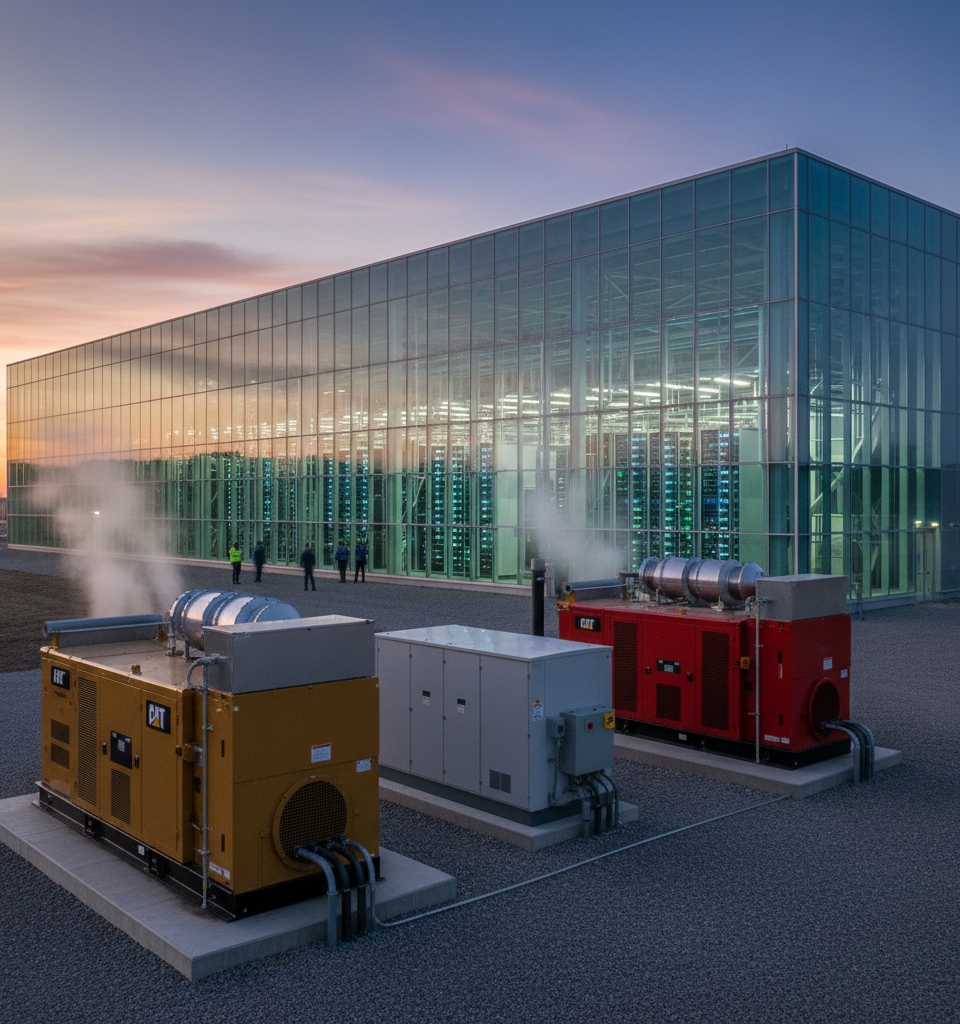
The strategic realignment of major industrial players to serve the AI data center market underscores a critical shift for global businesses reliant on sophisticated supply chains and cross-border trade. As these established manufacturers redirect capacity and focus, it impacts the availability and cost of industrial equipment worldwide, influencing sectors from construction to agriculture, and highlighting a new competitive front for global sourcing and operational efficiency.
Traditional manufacturing powerhouses such as Caterpillar and Cummins are strategically shifting their focus to meet the burgeoning demand for essential, yet often overlooked, machinery vital for the exploding artificial intelligence data center sector. This pivot signifies a significant adaptation within heavy industry, as companies known for construction equipment and engine manufacturing begin to cater to the specialized needs of high-tech infrastructure. The move highlights a foundational truth: the digital age, particularly the AI revolution, is deeply rooted in physical infrastructure, requiring robust and reliable power generation, cooling systems, and specialized equipment to operate.
The Unseen Backbone of AI
The AI data center boom is not merely about semiconductors and software; it necessitates a vast, often underappreciated, array of industrial equipment to function. Companies like Caterpillar and Cummins are positioned to supply critical components, including massive generators for uninterrupted power supply, sophisticated cooling systems to manage immense heat loads, and other heavy-duty machinery essential for constructing and maintaining these energy-intensive facilities. The continuous operation and rapid expansion of AI data centers depend on these industrial products, creating a new, lucrative market for manufacturers who can adapt their offerings.
Strategic Reorientation and Market Impact
This strategic reorientation by industrial giants has significant implications across multiple sectors. For one, it validates the long-term growth trajectory of the AI industry, suggesting that its infrastructural demands will continue to escalate. For the manufacturers themselves, it represents a diversification away from traditional cyclical markets, providing a stable, high-growth revenue stream tied to technological advancement. Their deep engineering expertise and global manufacturing capabilities make them ideal partners for hyperscalers and cloud providers building out their AI infrastructure.
Moreover, the entry of such large-scale players into the AI data center supply chain could lead to increased standardization and reliability of equipment in a rapidly evolving field. Their ability to produce at scale and provide global service networks offers a level of assurance that newer, smaller specialized suppliers might struggle to match. This could accelerate the deployment of AI infrastructure worldwide, further embedding AI capabilities into global commerce and industry.
Future Implications for Global Supply Chains
The strategic focus of these manufacturers on AI data centers is likely to reshape global supply chains for industrial equipment. As resources and production lines are increasingly dedicated to this high-priority sector, it could potentially impact lead times and pricing for other industries that rely on similar machinery. Businesses involved in global trade and manufacturing will need to monitor these shifts closely, adapting their procurement strategies to account for the increased demand emanating from the AI sector. The move underscores how deeply interconnected various industries are, with technological breakthroughs in one area creating profound ripple effects across seemingly unrelated manufacturing and logistics networks.
This pivot is expected to drive innovation in power efficiency and cooling technologies within heavy industry, as AI data centers are notoriously energy-hungry. Manufacturers will likely invest heavily in R&D to develop more sustainable and efficient solutions, which could then benefit their broader product portfolios and other industrial applications. The competitive landscape for industrial equipment is thus being reshaped by the foundational requirements of the artificial intelligence age, pointing to a future where heavy machinery plays an ever more critical role in enabling advanced digital technologies.
What's Next: A Continuing Evolution
The trajectory for these manufacturing powerhouses suggests a continuing evolution of their product lines and strategic partnerships. As AI technologies advance, so too will the demands on their supporting infrastructure, requiring ongoing innovation in terms of power density, reliability, and environmental sustainability. This ongoing adaptation positions these traditional industrial leaders as critical enablers of the global AI ecosystem, solidifying their role in the next wave of technological transformation. The sustained investment and strategic commitment indicate that this is not a transient trend, but a fundamental realignment to a new, enduring market opportunity.