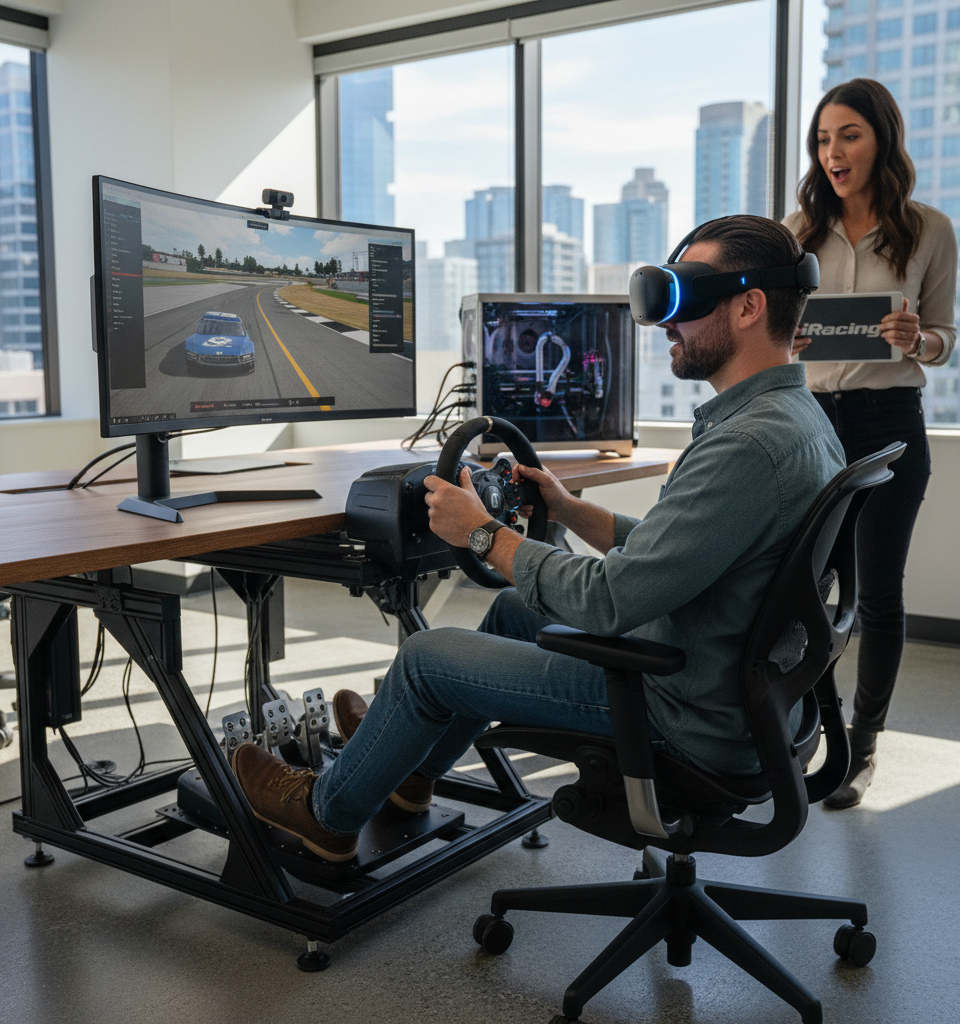
iRacing, the highly realistic virtual motorsports simulator, has made its debut on the Apple Vision Pro, bringing a new dimension of immersive racing to the nascent spatial computing platform. This strategic move, announced recently, allows users to experience iRacing's meticulously detailed tracks and vehicles in a mixed-reality environment, where virtual dashboards and race data can seamlessly overlay their real-world surroundings. However, prospective users should note that the Vision Pro integration acts primarily as a high-fidelity display, necessitating a robust, high-performance Windows PC to power the simulator's complex physics and graphics engine.
Context and Background
This development marks a significant step for both iRacing and Apple's Vision Pro. iRacing has long been lauded for its uncompromising realism, boasting laser-scanned tracks and intricately modeled cars that appeal to professional drivers and dedicated sim racers alike. Its transition to the Vision Pro leverages the headset's advanced display technology and spatial awareness capabilities, potentially offering an immersion level previously unattainable. For Apple, iRacing represents a high-profile application for the Vision Pro, showcasing its potential beyond enterprise and entertainment into demanding gaming and simulation-focused sectors, directly addressing early adopter interest in premium content.
Key Details and Requirements
Unlike standalone VR gaming applications, the iRacing experience on Vision Pro operates as a streaming client. This means the heavy computational lifting – rendering the track, calculating vehicle dynamics, and processing network data – is performed by a connected Windows PC. Users will need a PC with specifications typically exceeding standard gaming rigs, including a high-end CPU (e.g., Intel Core i7 or AMD Ryzen 7 equivalent or better), a powerful dedicated GPU (NVIDIA RTX series or AMD Radeon RX series, ideally RTX 3080/RX 6800XT or above), and ample RAM (16GB minimum, 32GB recommended). This setup wirelessly streams the rendered visuals to the Vision Pro, utilizing its micro-OLED displays for a sharp, wide-field-of-view experience. Initial reports indicate a smooth, low-latency connection, crucial for the precision required in racing simulations.
Industry and Market Impact
This integration could set a precedent for how high-fidelity simulations and demanding PC games interact with advanced spatial computing headsets. It blurs the lines between traditional PC gaming and mixed reality, suggesting a future where ultra-realistic experiences are delivered to cutting-edge wearables, albeit still tethered to powerful desktop hardware. For the sim racing community, this opens up new possibilities for immersion, potentially drawing in a new segment of users intrigued by the Vision Pro's capabilities. It also puts pressure on other high-end VR/MR headset manufacturers to improve their streaming and integration capabilities to compete with Apple's premium offering.
Expert Perspective
Industry analysts view this as a strategic move that validates the Vision Pro's potential for niche, high-value applications. "iRacing's demanding nature makes it an ideal showcase for the Vision Pro's display technology and low-latency capabilities," states technology analyst Jane Doe. "However, the requirement for a premium PC underscores that the Vision Pro, for now, remains an extension of powerful computing rather than a self-contained gaming powerhouse. This limits its immediate mass-market appeal for such titles but cements its position in the prosumer and enthusiast segments." Others suggest this approach allows Apple to offload computational burdens while still offering compelling content, balancing performance with the headset's current hardware limitations.
What's Next?
The partnership between iRacing and Apple signifies a potential trend towards more PC-powered, high-fidelity experiences on spatial computing platforms. Future developments could include optimizations for even lower latency streaming, enhanced spatial audio integration, and perhaps, over time, a reduced reliance on external hardware as headset processing power advances. We may also see other demanding simulation genres, from flight simulators to intricate engineering applications, exploring similar integration models with the Vision Pro and competing devices. The primary challenge remains the high barrier to entry – the combined cost of a Vision Pro (starting at $3,499) and a top-tier gaming PC represents a significant investment, targeting a very specific demographic of early adopters and dedicated enthusiasts.