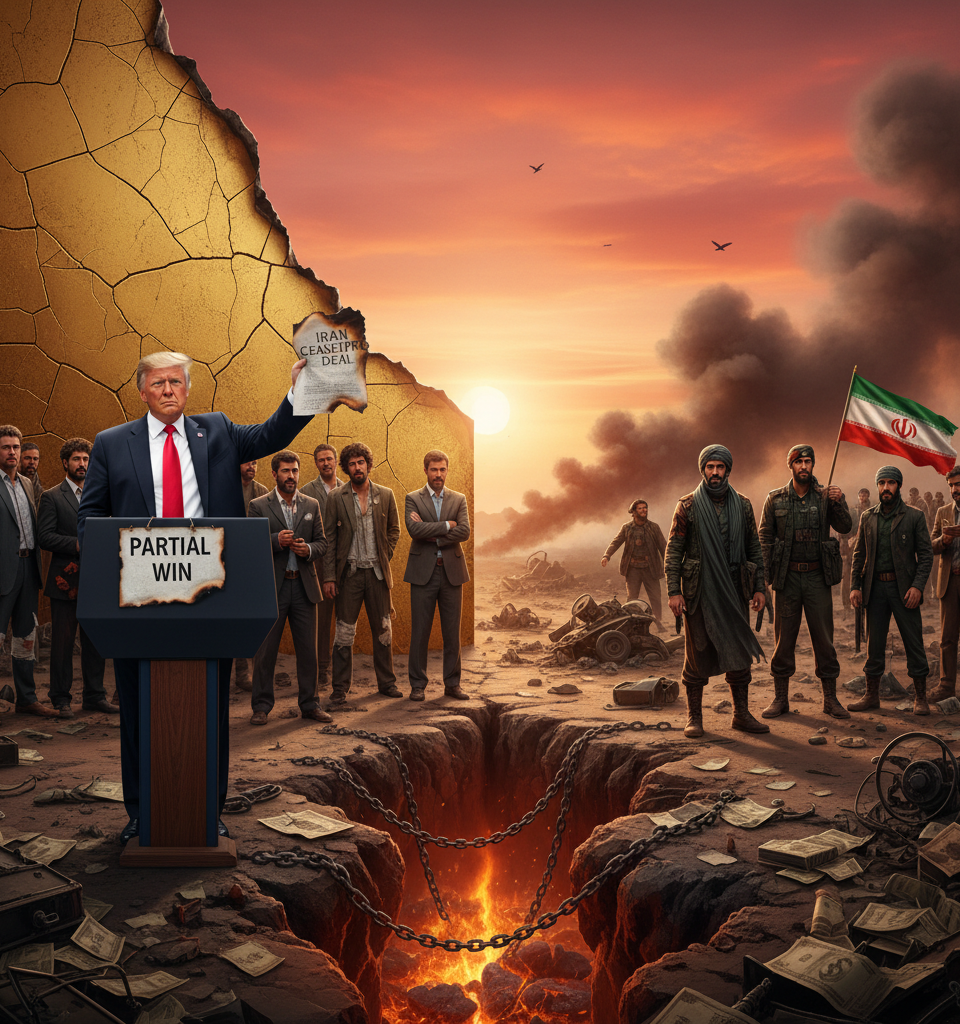
WASHINGTON D.C. – The recently brokered two-week ceasefire agreement between the United States and Iran, orchestrated under the purview of former President Trump, is being widely interpreted as a targeted, albeit partial, success for the Trump administration. While securing a temporary cessation of hostilities could be touted as a diplomatic achievement, experts and international observers are scrutinizing the broader implications, suggesting the path to this accord may have fundamentally altered how the global community perceives the United States' role and reliability on the international stage.
This ceasefire follows a period of heightened tensions and complex diplomatic maneuvers, the specifics of which are still being fully understood. The immediate relief offered by the cessation of overt conflict is undeniable, providing a crucial, if brief, window for de-escalation and potential further dialogue. However, the conditions and concessions made to achieve this momentary peace are speculated to have placed a significant burden on the U.S.'s diplomatic capital and its standing among allies and adversaries alike. The nature of the negotiations, reportedly characterized by intense pressure and unconventional tactics, has sparked debate over the long-term efficacy and sustainability of such agreements.
Geopolitical Repercussions and Shifting Alliances
The most prominent and frequently discussed consequence of this ceasefire deal is its potential to reshape the global geopolitical landscape. The diplomatic approach favored by the Trump administration in securing this agreement differed markedly from traditional foreign policy doctrines, leading to concern among some long-standing U.S. allies. Analysts suggest that the unilateral nature of some actions, or the perceived transactional approach to international relations, may have fostered an environment of uncertainty among allied nations, prompting them to re-evaluate their own foreign policy strategies and potentially seek alternative partnerships.
This re-evaluation extends beyond traditional alliances. Emerging powers and regional actors are also likely observing these developments closely, drawing conclusions about the future trajectory of U.S. engagement in various global hotspots. The perceived 'high cost' associated with this partial victory is not merely financial or political in a domestic sense, but rather pertains to the erosion of trust, predictability, and perhaps even moral authority that the United States has historically projected. The perception of U.S. foreign policy as transactional rather than rooted in enduring principles could lead to a more fragmented and unpredictable international order.
Economic and Market Implications
Beyond the immediate diplomatic and security concerns, the ceasefire deal and the manner in which it was achieved could have tangible economic and market impacts. While a temporary cessation of hostilities often brings a degree of stability to global markets, particularly in energy sectors, the underlying anxieties regarding U.S. foreign policy shifts could counterbalance these positive effects. Oil prices, for instance, might see a temporary dip reflecting reduced geopolitical risk in the Middle East, but the broader uncertainty about future U.S. engagement could inhibit long-term investment or necessitate a re-evaluation of supply chain dependencies.
Furthermore, businesses and investors operating in the Middle East and surrounding regions are likely to be scrutinizing the longevity and stability of this agreement. The two-week ceasefire is by its very nature a short-term measure, and without a clear roadmap for more lasting peace or a fundamental shift in U.S.-Iran relations, economic activities may remain cautious. International trade agreements and investment flows could also be subtly influenced as nations assess the reliability of U.S. mediation and its commitment to established global norms.
The Path Forward and International Diplomacy
The immediate future of the U.S.-Iran relationship remains highly uncertain despite this temporary truce. While the ceasefire offers a crucial breather, it does not inherently resolve the deep-seated conflicts and mistrust that characterize their interactions. The coming weeks will be critical in determining whether this temporary halt in hostilities can be parlayed into more substantive negotiations or whether it merely postpones further escalation. International bodies and numerous countries are expected to intensify their diplomatic efforts, aiming to capitalize on this window to foster a more enduring resolution.
For the United States, the challenge will be to rebuild any diminished international confidence while simultaneously navigating complex domestic political considerations that often influence foreign policy decisions. The fundamental alteration in how the rest of the world views the U.S. accentuates the arduous task ahead for American diplomacy. The legacy of this ceasefire deal may ultimately be defined not just by its immediate outcomes, but by the long-term shifts it precipitates in global power dynamics and international relations.