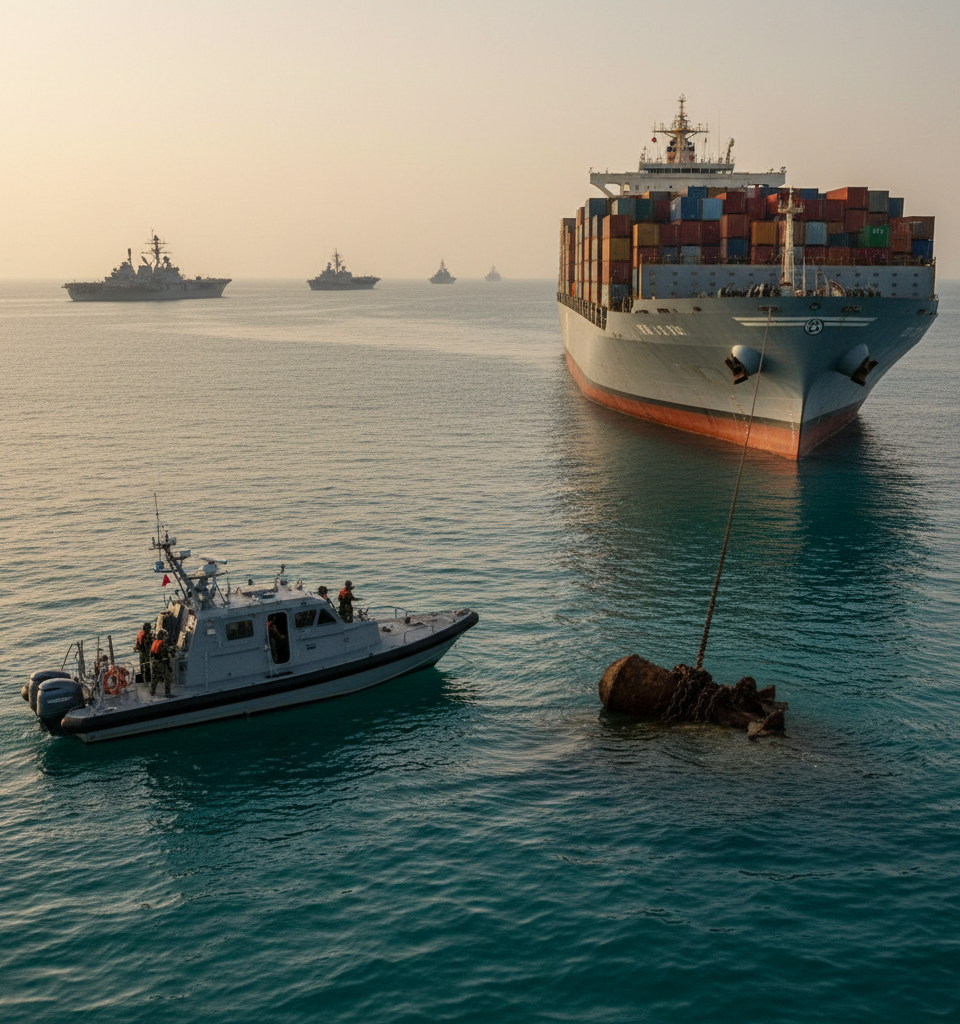
WASHINGTON, D.C. — A previously undisclosed US intelligence report suggests Iran is grappling with a significant operational setback: the inability to locate its own naval mines strategically placed within the Strait of Hormuz. This unexpected challenge has directly impeded Tehran's capacity to swiftly adhere to President Donald Trump's directives to facilitate unimpeded maritime traffic through the world's most vital oil chokepoint. The revelation underscores the complexities and potential miscalculations inherent in the volatile geopolitical landscape of the Persian Gulf.
This development comes amidst heightened tensions between Washington and Tehran, following the Trump administration's withdrawal from the 2015 Iran nuclear deal, the re-imposition of stringent sanctions, and repeated warnings from both sides regarding free passage in the Strait. The Strait of Hormuz, a narrow waterway connecting the Persian Gulf with the open ocean, is an indispensable artery for global commerce, with an estimated 21 million barrels of oil, or roughly 21% of global petroleum liquids consumption, transiting its waters daily. Any disruption, perceived or actual, sends immediate ripples through energy markets and geopolitical alliances.
According to officials privy to the intelligence, who spoke on condition of anonymity due to the sensitive nature of the information, Iranian naval forces had deployed an unspecified number of mines in specific areas of the Strait during earlier periods of heightened alert. However, subsequent internal assessments by Iranian military planners have reportedly indicated a failure to accurately chart or retrieve these emplacements. This operational deficiency throws into question Iran's strategic ability to either threaten or secure the waterway, depending on its tactical objectives.
The inability to account for these mines presents a multifaceted problem for Iran. On one hand, it undermines any potential deterrent effect meant by their deployment. On the other, it creates an unpredictable hazard for all maritime traffic, including Iran's own, contradicting President Trump's demand for unhindered passage. The US Fifth Fleet, headquartered in Bahrain, continuously monitors the Strait and has reiterated its commitment to ensuring freedom of navigation, often deploying advanced mine-countermeasure vessels and technologies to safeguard commercial shipping.
Energy market analysts are closely watching the situation. "The Strait of Hormuz is the quintessential geopolitical premium driver for oil prices," stated Dr. Sarah Jenkins, an energy security expert at the Atlantic Council. "While Iran's stated inability to locate its mines might, in isolation, seem like a diminishment of threat, it actually introduces a new layer of chaotic risk. An unforeseen incident involving an unchartered mine could be catastrophic, irrespective of intent. This 'known unknown' might keep market volatility high, as insurers and shippers will factor in this new layer of risk and uncertainty."
Shipping companies and international maritime organizations are likely to become increasingly apprehensive. The cost of insuring vessels transiting the Strait could see further increases, adding to operational expenses for oil and gas exporters. This could, in turn, be passed on to consumers globally. The International Maritime Organization (IMO) has previously issued warnings regarding potential navigation hazards in the region, and this latest intelligence will undoubtedly precipitate further advisories and heightened vigilance.
The immediate implications of this intelligence are significant. It places Iran in a peculiar bind, unable to fully meet external demands while also facing an internal operational challenge that could jeopardize its own regional standing. For the United States and its allies, it validates concerns about the unpredictable nature of regional actors but also paradoxically highlights a potential weakness in Iran's previously assumed readiness.
Looking ahead, the situation demands careful monitoring. While President Trump's immediate demand for increased shipping may be complicated by this discovery, the broader regional dynamics remain fraught. The US will likely continue its naval presence and surveillance, potentially offering technical assistance for mine countermeasures, albeit under strict conditions. Iran, meanwhile, faces the difficult task of either recovering its lost assets or publicly acknowledging a significant operational lapse, both of which carry considerable political and strategic costs amidst the ongoing standoff with the West.