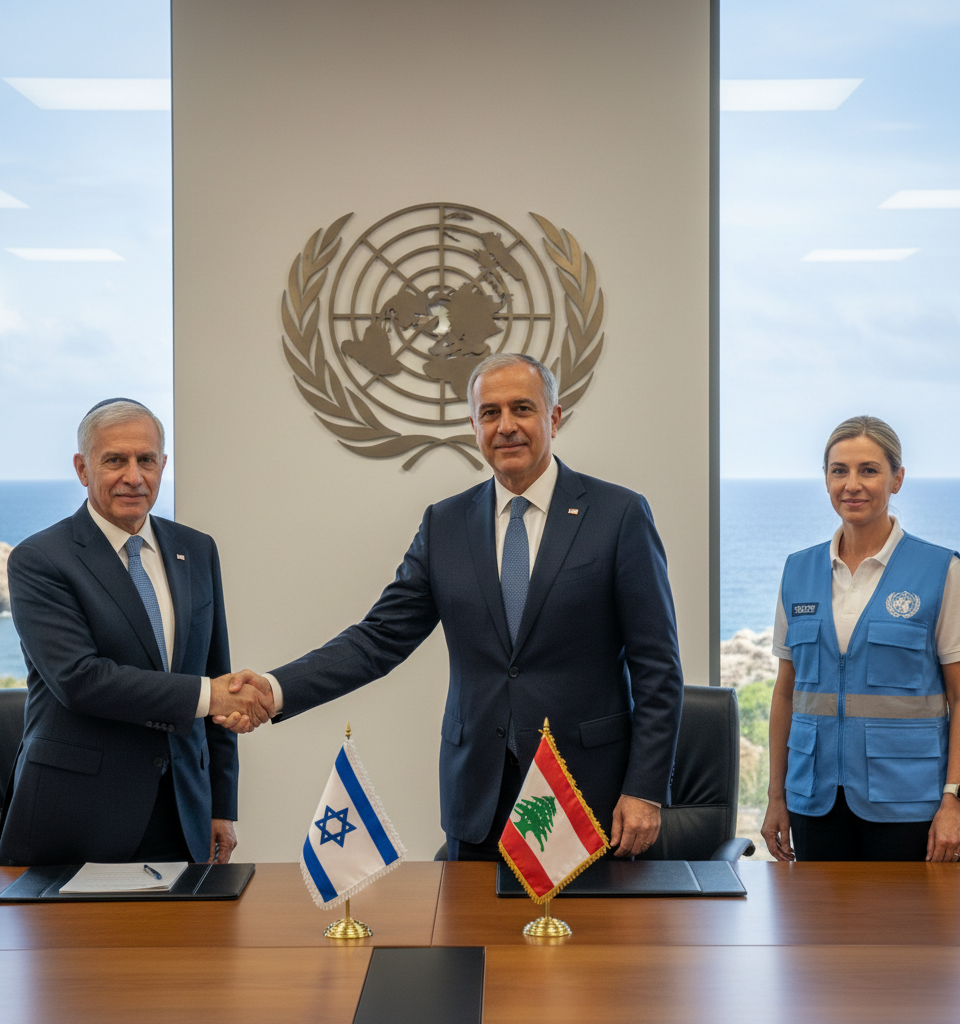
NAQOURA, Lebanon / JERUSALEM, Israel – October 1, 2020 – In a notable diplomatic overture, Israel and Lebanon have agreed to commence indirect negotiations over their contested maritime border, a development facilitated by the United States and the United Nations. The historic decision, announced by both nations on Thursday, sets the stage for a rare dialogue between countries that technically remain in a state of war, with talks expected to be held at the UN Peacekeeping Force's headquarters in Naqoura, Lebanon.
The agreement represents a cautious but significant step towards de-escalation in a volatile region. For decades, the absence of a delineated maritime boundary has created a persistent flashpoint, particularly as both nations seek to explore potentially lucrative offshore natural gas fields. The initiation of these talks, under the auspices of US Assistant Secretary of State David Schenker, underscores a concerted international effort to foster stability and economic opportunity in the Eastern Mediterranean.
Historical Context and Geopolitical Significance
The disputed maritime area encompasses approximately 860 square kilometers, an area slightly larger than Bahrain, which both countries claim as their exclusive economic zone (EEZ). This territorial overlap has stymied significant offshore energy exploration, specifically impacting Lebanon's Block 9 and Israel's Block 72, which are believed to hold substantial natural gas reserves. Previous attempts at mediation have faltered, making this current agreement particularly noteworthy. The backdrop of this diplomatic push includes ongoing tensions along their land border, a historical legacy of conflicts, and Lebanon's severe economic crisis, which has amplified the urgency for new revenue streams.
Key to this agreement was intensive shuttle diplomacy by US officials, including Schenker, who has been instrumental in bridging the deep mistrust between the two states. While the talks are specifically focused on the maritime boundary, some analysts hope they could eventually pave the way for broader de-escalation or even discussions on the contentious land border, though such aspirations remain highly speculative at this nascent stage.
Key Details and Framework of the Talks
The negotiations are structured as indirect talks, meaning Israeli and Lebanese delegations will not sit face-to-face but will communicate via a UN mediator. This format aims to circumvent the political complexities of direct engagement between enemy states. Lebanese Parliament Speaker Nabih Berri, a powerful Shiite leader, announced the framework of the agreement, stating that the discussions would be held under the aegis of the UN and with US mediation. Israeli Energy Minister Yuval Steinitz confirmed Israel's participation, emphasizing that the focus would strictly be on the maritime boundary and not political normalization. Sources indicate the talks are likely to commence within the next few weeks, with preliminary meetings expected to iron out logistical details and set an agenda.
Crucially, both sides have maintained their red lines regarding sovereignty. Lebanon insists on discussing all outstanding maritime claims based on international law, particularly the UN Convention on the Law of the Sea (UNCLOS), while Israel remains firm on its established claims. The involvement of the UN Interim Force in Lebanon (UNIFIL) at Naqoura provides a neutral ground, reinforcing the strictly technical and non-political nature of these initial discussions.
Regional and Economic Implications
Beyond resolving a border dispute, successful negotiations could unlock significant economic potential for both nations. For Lebanon, which is grappling with its worst economic crisis in decades – a currency collapse, soaring inflation, and high unemployment – access to offshore gas reserves could offer a vital lifeline. Estimates for the value of gas in the disputed area vary widely, but even modest discoveries could inject billions into the struggling Lebanese economy over time, attracting much-needed foreign investment. For Israel, already an emerging energy exporter in the region, a clearly defined border would provide certainty for existing and future exploration projects, further solidifying its position as a key energy player in the Eastern Mediterranean.
The agreement also has broader regional implications, potentially setting a precedent for resolving other long-standing border disputes. It comes amidst shifting alliances and energy geopolitics in the Eastern Mediterranean, with the formation of frameworks like the East Med Gas Forum (EMGF), which includes Israel, Egypt, Greece, and Cyprus, but notably excludes Lebanon and Turkey. A resolution could thus impact the region's energy architecture and stability.
Expert Perspectives
Analysts are cautiously optimistic about the breakthrough, though many stress the difficult path ahead. Dr. Emma Smith, a Middle East policy expert at Chatham House, commented, "While this is a significant diplomatic achievement to get both sides to the table, the negotiations themselves will be fraught with technical and political challenges. Success hinges on a clear agenda and a willingness from both parties to find pragmatic solutions, rather than adhering rigidly to maximalist claims." She added, "The US role as a neutral facilitator will be critical in navigating these complex discussions and ensuring progress." Others point to Lebanon's internal political fragility and the influence of Hezbollah, which has historically resisted normalization efforts with Israel, as potential stumbling blocks.
Former Israeli diplomat, Ambassador David Cohen, acknowledged the difficulty but highlighted the necessity: "This isn't about peace treaties; it's about practical issues that affect national interests. Both sides have compelling economic reasons to resolve this. The diplomatic heavy lifting will be in managing expectations and finding technical compromises that both governments can present as victories to their respective publics."
What Lies Ahead: Challenges and Prospects
The immediate focus will be on the procedural aspects and the actual commencement of talks in Naqoura. The first few sessions are expected to be lengthy, with technical teams presenting detailed maps and legal arguments. Key challenges include agreeing on a baseline for measurement, the impact of existing gas fields, and potential compromises on specific segments of the disputed line. The indirect nature of the talks, while enabling engagement, can also slow down progress as proposals and counter-proposals are shuttled between delegations.
Future implications could extend beyond the maritime border. Some hope that if successful, these technical talks could lay a foundation for confidence-building measures and, eventually, a broader re-evaluation of the land border. However, most experts caution against overly optimistic predictions, emphasizing that decades of animosity and entrenched political positions mean any significant warming of relations remains a distant prospect. Nevertheless, the agreement to talk itself is a testament to the power of persistent diplomacy and the shared recognition of mutual economic interests in a region often defined by conflict.