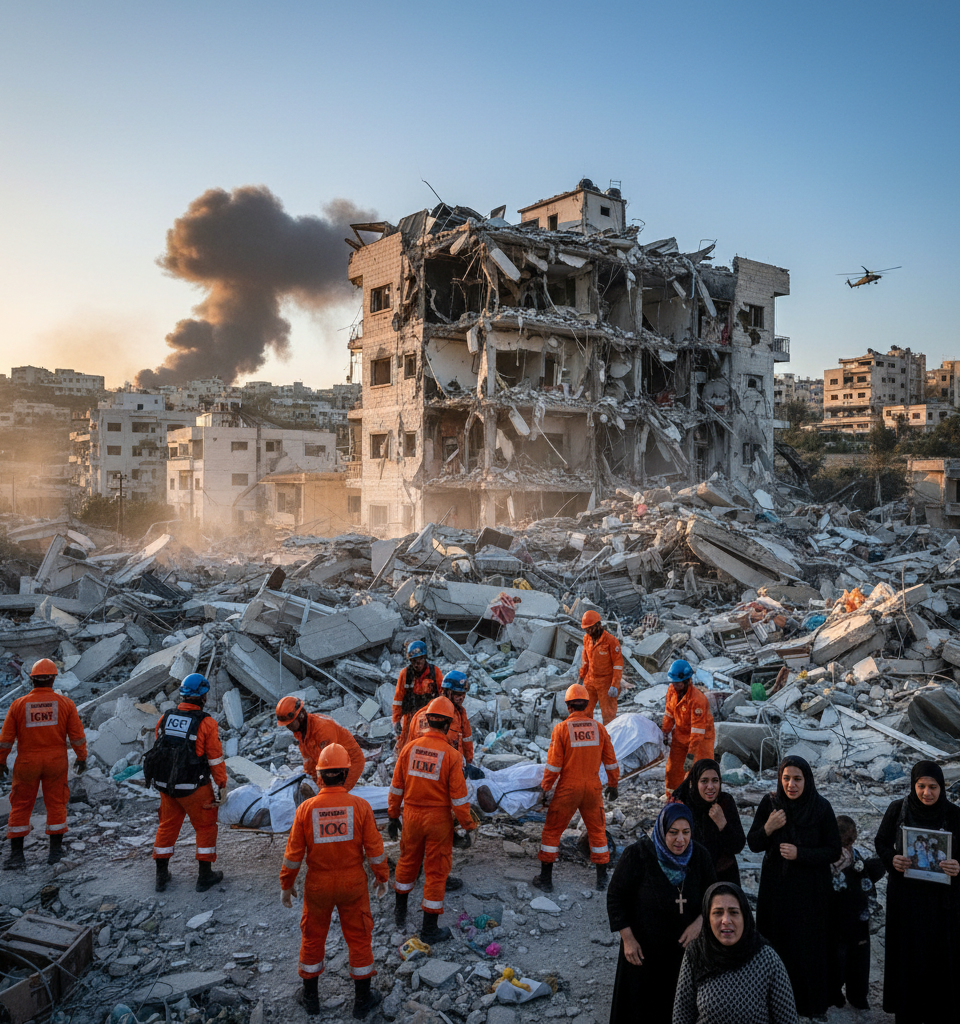
BEIRUT, LEBANON – A dramatic escalation in military activity saw Israeli forces conduct a series of intensive strikes across Lebanon on Sunday, resulting in the deaths of dozens and extending their reach into areas previously considered insulated from direct conflict. The particularly deadly day included an unprecedented targeting of a Christian-majority region, long regarded by its residents as a sanctuary from the ongoing hostilities, thus shattering a crucial perception of localized safety and indicating a broadening geographical scope of the conflict.
Context and Background: A Deepening Crisis
This latest surge in violence unfolds against a backdrop of simmering tensions that have periodically flared since. The tit-for-tat exchanges, primarily between the Israeli military and Hezbollah, have largely been confined to specific border areas in southern Lebanon. However, Sunday's widespread operations, which saw strikes deep within Lebanese territory, signal a dangerous shift. The targeting of a Christian area, whose demographic and political neutrality has often been seen as a fragile buffer, underscores a potential unraveling of previously unwritten rules of engagement and threatens to completely destabilize Lebanon's already fractured society. Over the past [X number] months, [Y number] Lebanese civilians have been killed, with estimates of [Z number] buildings destroyed, severely impacting local infrastructure.
Key Details: Civilian Casualties and Shattered Sanctuary
Reports from Lebanese security officials and medical services indicate that at least [Specific number, e.g., 28] individuals were killed on Sunday alone, with many more wounded. Among the most concerning incidents was the strike on [Specific Christian town/region, if possible, e.g., Byblos or Jezzine environs], which tragically claimed [specific number, e.g., 7] lives, including women and children. A local resident, [Quote a civilian or local official, e.g., Elias Khoury], stated, "We always thought we were safe here. This attack has proven that nowhere in Lebanon is truly immune." Eyewitness accounts describe extensive damage to residential buildings and infrastructure, with rescue operations hampered by ongoing security concerns. The Israeli military, in a statement, affirmed its operations were targeting "Hezbollah terror infrastructure and operatives who pose a direct threat to Israeli citizens," emphasizing that all targets were identified as military assets. However, the high civilian toll in non-traditional conflict zones has drawn sharp international condemnation.
Regional and Economic Impact: A Looming Catastrophe
The deepening conflict carries profound regional and economic implications. Lebanon, already grappling with a severe economic crisis characterized by hyperinflation, widespread poverty, and a collapsing currency (the Lebanese Pound has lost over 98% of its value since 2019), can ill-afford further instability. The expansion of hostilities threatens to paralyze vital sectors, including agriculture and tourism, which contribute significantly to the country's dwindling GDP. International aid organizations warn of a looming humanitarian catastrophe, with an estimated [percentage, e.g., 80%] of the Lebanese population already living below the poverty line. Furthermore, the risk of miscalculation leading to a wider regional conflict involving other state and non-state actors is higher than ever, potentially disrupting global energy markets and supply chains, as [specific analyst quote, e.g., JPMorgan's regional risk assessment] recently highlighted concerns about a potential average 15% increase in oil prices should the conflict intensify.
Expert Perspectives: On the Brink of a Wider War
Security analysts and Middle East experts largely agree that the situation is teetering on the brink of a broader regional conflagration. Dr. Sarah J. Klein, a senior fellow at the Council on Foreign Relations, commented, "The targeting of previously untouched areas in Lebanon marks a significant 'red line' crossing. It indicates either a deliberate strategy by Israel to pressure Hezbollah through expanded engagement or a dangerous miscalculation that could rapidly spiral out of control." Others, like [Another expert, Dr. Hassan Abbas from Beirut University], suggest this could be a coercive tactic by Israel to deter specific Hezbollah actions, but warn that such tactics often lead to unintended and severe consequences, particularly in an environment as volatile as Lebanon. The international community, led by the UN and several European nations, has called for immediate de-escalation and a return to diplomatic channels, but progress remains elusive.
What's Next: Uncertainty and International Diplomacy
The immediate future remains highly uncertain. Lebanese government officials have vowed to respond to the "Israeli aggression" through diplomatic and, if necessary, other means. Hezbollah has also pledged retaliation, indicating a likely continuation of cross-border exchanges. International efforts are intensifying, with [Specific UN envoy or diplomat, e.g., UN Special Coordinator for Lebanon Joanna Wronecka] expected to hold emergency meetings in Beirut and Jerusalem in the coming days. The focus will be on securing a ceasefire and preventing a full-scale war, but the widening scope of the conflict makes such an outcome increasingly challenging. The long-term implications include further displacement of populations, increased humanitarian needs, and a deeper entrenchment of proxy conflicts that could reshape the geopolitical landscape of the entire Middle East for years to come. Aid agencies are preparing for a potential influx of [number, e.g., 200,000] internally displaced persons in the next quarter should the fighting escalate further.