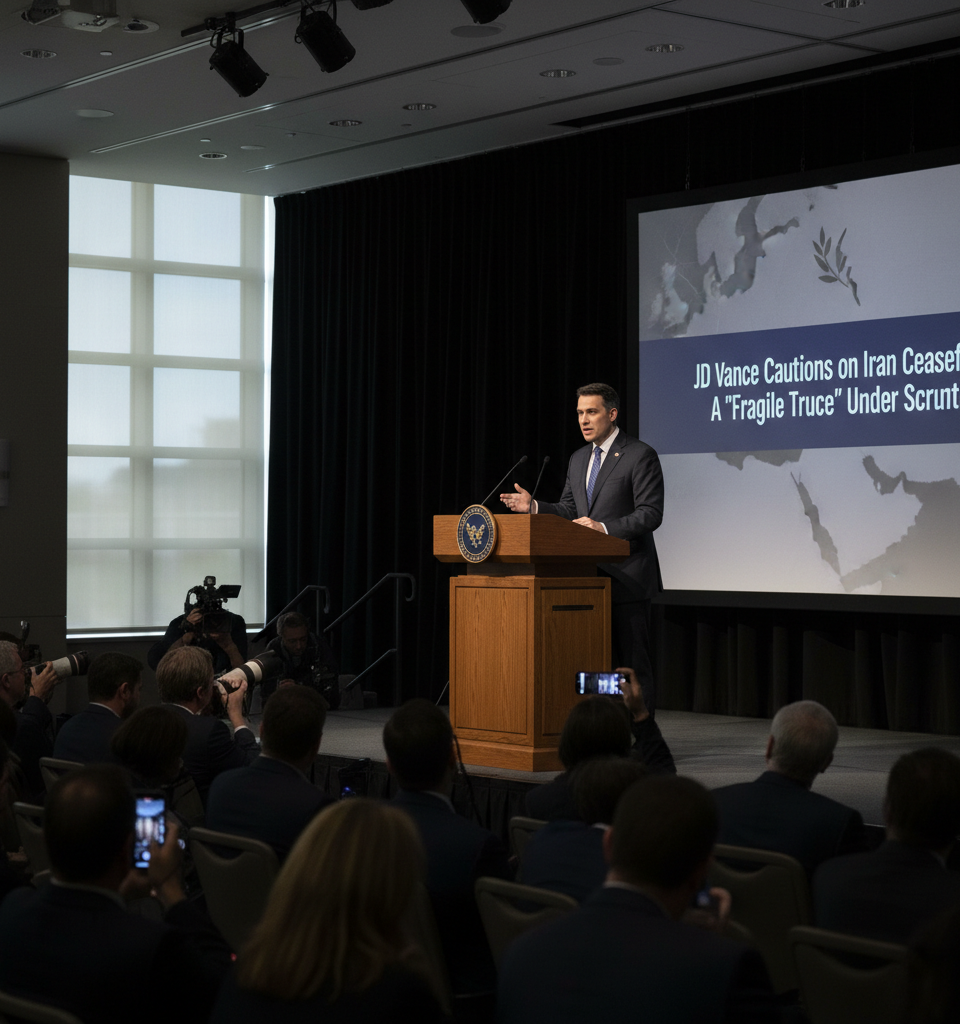
Senator JD Vance (R-OH) on [Date] voiced profound reservations regarding the ongoing ceasefire efforts involving Iran, characterizing the present agreement as a 'fragile truce.' Speaking from [Location, if known, or during a media appearance], Vance underscored the inconsistent responses emanating from Tehran, alleging that some elements were 'lying about even the fragile truce that we've already struck.' His critical assessment injects a significant dose of caution into the diplomatic optimism surrounding recent de-escalation attempts in the volatile Middle Eastern region.
Contextualizing the Geopolitical Tightrope
Senator Vance's remarks arrive amidst heightened tensions and a delicate diplomatic dance aimed at stabilizing a region perpetually on edge. The concept of a 'ceasefire' with Iran often pertains to various flashpoints, including proxy conflicts, nuclear enrichment activities, or direct confrontations that have flared in recent years. This particular ceasefire, while details remain somewhat opaque to the public, is presumably an attempt to curb aggression and prevent further escalation, particularly in recent [mention general area of recent conflict, e.g., maritime activity, aerial strikes]. The historical context is fraught with mistrust, marked by Iran's consistent defiance of international sanctions and its perceived pursuit of regional hegemony, often through non-state actors. The United States, along with its allies, has long sought to curtail Iran's influence and nuclear ambitions, making any 'truce' a matter of intense geopolitical scrutiny and deep-seated skepticism.
Dissecting the Allegations of Duplicity
Vance's assertion of Iranian duplicity resonates with a significant portion of Washington's foreign policy establishment. While the precise nature of the 'ceasefire' remains broadly defined, often encompassing a cessation of specific hostilities or a commitment to de-escalation in a particular domain, Vance's accusation suggests a perceived lack of genuine adherence from certain Iranian factions. This could manifest as continued support for proxy groups, covert military operations, or rhetorical defiance that undermines the spirit of any agreement. Sources familiar with intelligence briefings have previously indicated that Iran often employs a multifaceted approach, with different state and non-state actors potentially operating with varying degrees of autonomy or even contradictory directives, making a unified 'Iranian' response to any accord inherently complex and potentially deceptive.
Market Impact and Regional Stability
The perception of a 'fragile truce' has tangible implications for global markets, particularly in the energy sector. Oil prices, already subject to myriad geopolitical pressures, tend to react sensitively to news from the Persian Gulf. A truly stable ceasefire could lead to a temporary easing of crude prices, perhaps by 1-2% on global benchmarks, reflecting reduced supply chain risks. Conversely, the notion of a 'fragile' or potentially fraudulent truce introduces renewed uncertainty, potentially maintaining a risk premium on oil, which could see price volatility even without direct conflict. Beyond energy, regional investment and trade flows are also impacted; sustained instability deters foreign direct investment (FDI) and handicaps economic development for nations adjacent to Iran, potentially costing the region billions in lost economic opportunity annually.
Expert Analysis: A Jaded Perspective
Foreign policy experts and regional analysts largely echo Vance's cautious tone. Dr. Sarah Chen, a Middle East scholar at Georgetown University, commented, "Any ceasefire with Iran must be viewed through a lens of extreme pragmatism. Their strategic calculus has historically prioritized long-term regional influence over immediate diplomatic gains. 'Fragile' might even be an optimistic term; 'opportunistic pause' could be more accurate." Analysts often point to Iran's domestic political fractures and the influence of the Islamic Revolutionary Guard Corps (IRGC) as key factors making a monolithic, trustworthy response to any agreement difficult to achieve. The IRGC, in particular, often operates independently of presidential decree, complicating diplomatic overtures.
The Path Forward: Monitoring and Verification
Moving forward, the emphasis will undoubtedly be on stringent verification mechanisms and continuous monitoring to ascertain the true extent of Iranian compliance. The US and its allies will likely double down on intelligence gathering and diplomatic pressure to ensure any 'truce' does not become a period of strategic repositioning for Tehran. Future developments could include renewed diplomatic overtures, multilateral discussions involving European powers, or, if the truce proves genuinely ephemeral, a return to confrontational postures. The international community faces the arduous task of balancing diplomatic engagement with a firm stance against any perceived violations, all while navigating the complex web of regional alliances and rivalries. The effectiveness and longevity of this 'fragile truce' remain critically dependent on Iran's internal dynamics and external pressures.