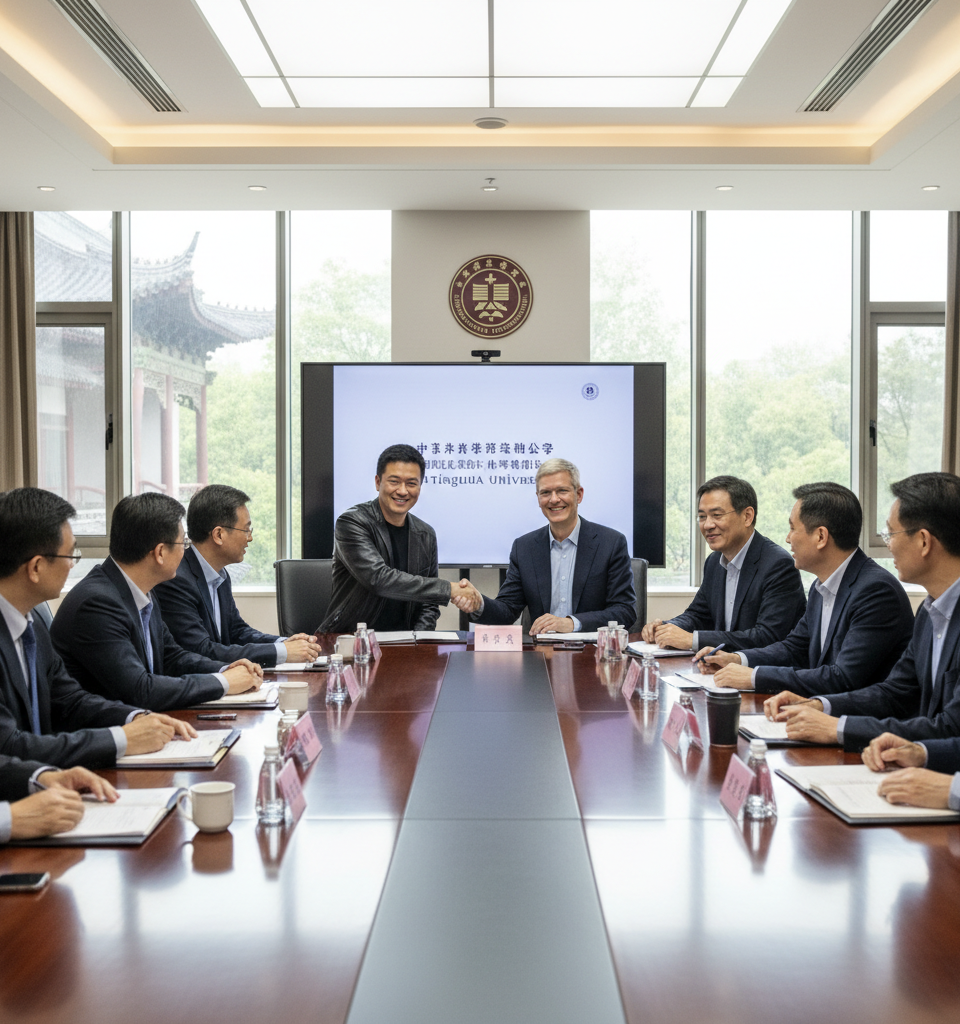
Jensen Huang, the influential CEO of Nvidia, has been appointed to the advisory board of Tsinghua University’s School of Economics and Management (SEM), a development that underscores the growing intersection of global tech leadership and prominent Chinese academic institutions. The news, initially reported by the Financial Times, situates Huang on a formidable board chaired by Apple CEO Tim Cook, and featuring a roster of leading figures from the technology and finance sectors. This appointment is particularly notable as it occurs shortly after Huang's reported journey to China alongside former U.S. President Donald Trump.
This move by Tsinghua University, one of China's most prestigious academic institutions, to bring such a high-profile figure onto its SEM advisory board highlights its ambition to foster connections with global industry leaders. The board's composition reflects a strategic effort to integrate international perspectives and expertise into its educational and research objectives. Such appointments are often viewed as a mechanism for elite universities to strengthen their networks, attract talent, and enhance their global standing by leveraging the insights of top executives.
Huang joins an already star-studded advisory board. Chaired by Tim Cook, the board includes an array of highly influential executives such as Elon Musk of Tesla and SpaceX, Michael Dell of Dell Technologies, Satya Nadella of Microsoft, Mark Zuckerberg of Meta Platforms, Jamie Dimon of JPMorgan Chase, and Larry Fink of BlackRock. The addition of the Nvidia CEO, whose company is a dominant force in artificial intelligence and semiconductor technology, brings significant expertise in rapidly evolving and strategically important sectors. His presence is expected to offer invaluable guidance on technological advancements and their economic implications.
From an industry perspective, Huang’s involvement could signify an increased focus on the intersection of deep technology and economic policy within Tsinghua’s curriculum and research. Nvidia's pivotal role in AI development, coupled with its substantial global market influence, means that Huang's insights would be particularly relevant for students and faculty grappling with the socio-economic impacts of emerging technologies. The semiconductor industry, in particular, is central to geopolitical and economic discussions, making his input highly valuable.
While the original report does not detail specific future initiatives or the immediate scope of Huang's role, such advisory positions typically involve offering strategic advice, participating in high-level discussions, and occasionally delivering lectures or engaging with students. The collective wisdom of this board, with its diverse range of industry leaders, provides a unique resource for Tsinghua SEM as it navigates the complexities of global business and technological innovation. It also implicitly reinforces the importance of international collaboration, even amidst prevailing geopolitical tensions.
Looking ahead, Huang's presence on the Tsinghua SEM board, coupled with the continued involvement of other tech titans, suggests that the university aims to remain at the forefront of global discourse on business, economics, and technology. The ongoing engagement of such influential figures could pave the way for future partnerships, research collaborations, and an enhanced exchange of ideas between Silicon Valley and Beijing, potentially shaping the next generation of business and technological leaders emerging from Tsinghua.