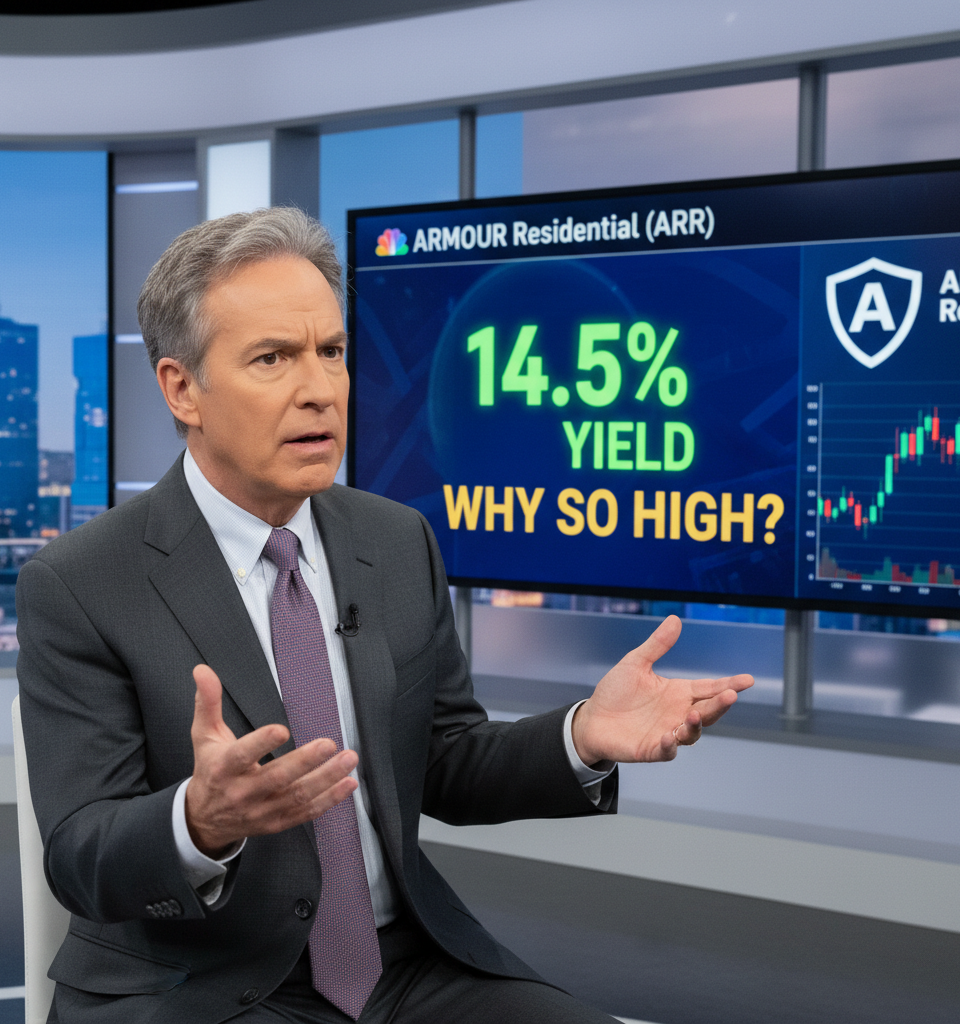
Financial commentator Jim Cramer of CNBC's 'Mad Money' fame recently voiced his confusion over ARMOUR Residential REIT's (NYSE: ARR) significantly elevated dividend yield, stating on air, "I Don't Understand Why the Yield's so High." Cramer's uncharacteristic public questioning of a security's metrics immediately drew attention to the mortgage real estate investment trust (mREIT) sector and the perceived disconnect between ARR's valuation and its high payout relative to current market conditions. This statement prompts a deeper examination of the factors contributing to ARR's yield and the broader implications for mREIT investors in a dynamic interest rate environment.
Cramer's remarks underscore a prevalent concern among dividend-focused investors: distinguishing between a genuinely attractive yield and a 'value trap' where a high payout signals underlying distress. For ARR, a company that primarily invests in agency residential mortgage-backed securities (RMBS), its yield has consistently been among the highest in the mREIT space. The inherent complexity of mREIT business models, which rely on borrowing short-term to invest in longer-term mortgage-backed securities, makes them particularly sensitive to interest rate fluctuations and yield curve shifts. When the yield curve flattens or inverts, as it has done periodically, it compresses the net interest margin for mREITs, impacting their profitability and dividend sustainability.
Dissecting ARMOUR's Payouts
As of recent reports, ARMOUR Residential REIT has maintained a monthly dividend, translating to an annualized yield that has frequently surpassed 15%, often reaching into the high teens. This stands in stark contrast to the average yield of the broader market and even many other high-dividend sectors. The company's financial disclosures indicate a mix of taxable income distribution requirements for REIT status and management's discretion. However, the source and sustainability of these payments are frequently scrutinized. Critics often point to mREITs' reliance on leverage and their vulnerability to book value erosion during periods of market stress, such as significant increases in interest rates or widening credit spreads. For example, during periods of rapid Federal Reserve rate hikes, the value of their mortgage-backed security portfolios can decline, demanding mark-to-market adjustments that affect equity.
Broader Market Implications
Cramer's question extends beyond just ARMOUR to the entire mREIT sector. Persistent high yields across several mREITs often signal perceived risk by the market. Investors demand higher compensation for holding these securities due to their sensitivity to interest rate risk, prepayment risk, and extension risk. The sector has also been characterized by a tendency for share prices to fluctuate significantly, often resulting in dividend cuts if earnings cannot support the payout. This volatility makes mREITs attractive to some for their income potential but daunting for others due to their inherent leverage and exposure to complex financial instruments.
Several leading financial analysts have offered varied perspectives on the mREIT sector. Some argue that current high yields are a rational response to increased macro uncertainty, including inflation concerns and hawkish central bank policies. They view the discounts to book value at which many mREITs trade as justified compensation for elevated risk. Others suggest that while risks are present, some mREITs are undervalued, presenting opportunistic entry points for income-seeking investors who understand the intricacies of hedging strategies employed by these companies. Analysts at firms like J.P. Morgan and Morgan Stanley have frequently highlighted interest rate sensitivity as the paramount factor dictating performance.
The Future of High-Yield REITs
Looking ahead, the sustainability of ARMOUR Residential's high yield, and indeed the yields of many mREITs, will largely depend on the trajectory of interest rates and the overall stability of the housing market. If the Federal Reserve continues with its hawkish stance or maintains higher-for-longer interest rates, mREITs could face ongoing challenges in maintaining their net interest margins. Conversely, a stable or declining interest rate environment could provide a more favorable operating landscape, potentially stabilizing book values and supporting dividend payouts.
Near-term implications for ARMOUR Residential include continued scrutiny from investors and analysts, particularly concerning its dividend coverage ratio and net asset value (NAV). The company's management will likely face questions regarding their hedging strategies and portfolio composition to mitigate interest rate risks. For investors, Cramer's commentary serves as a critical reminder to conduct thorough due diligence, looking beyond just the headline yield to understand the underlying business model, financial health, and risk factors associated with high-yield investments, especially in niche sectors like mREITs. The ongoing macroeconomic uncertainty means that vigilance will be key for navigating this complex segment of the market.