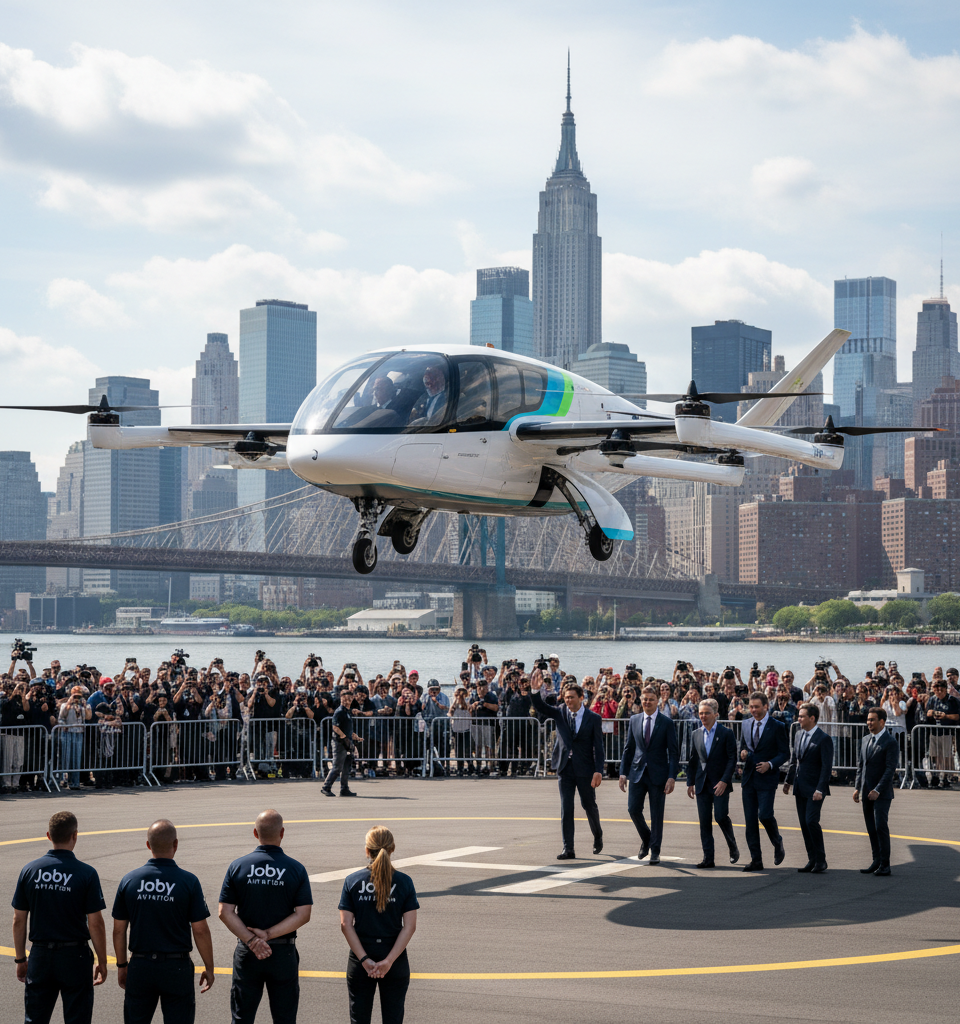
Joby Aviation on Friday conducted a pivotal demonstration, successfully completing an all-electric air taxi flight covering the approximately 15-mile route from John F. Kennedy International Airport to the East 34th Street Heliport in Midtown Manhattan. The journey, which typically consumes between 60 and 120 minutes by car depending on traffic conditions, was accomplished in a mere seven minutes. This milestone represents a tangible step towards commercializing eVTOL technology for passenger transport in one of the world's busiest airspaces and urban centers, laying the groundwork for future route commercialization.
A New Chapter in Urban Mobility
This demonstration flight is not merely a technical achievement but a symbolic one, heralding a potential paradigm shift in urban mobility. For decades, the aspiration of flying cars and personal aerial vehicles has remained largely within the realm of science fiction. However, advancements in battery technology, electric propulsion systems, and sophisticated flight control software have converged to make eVTOL aircraft a near-term reality. The New York metro area, known for its severe traffic congestion and robust transportation infrastructure, presents an ideal, albeit challenging, proving ground for such innovative solutions. The successful flight underscores New York City's long history as a leader in aviation, from pioneering heliport operations to now embracing electric air travel.
Key Details and Strategic Partnerships
The aircraft used for the demonstration was Joby's production prototype, an all-electric, five-seater air taxi designed for quiet operation and zero operating emissions. The flight was a core component of a demonstration hosted in conjunction with the city authorities and industry partners. Joby Aviation has been aggressively pursuing certification with the Federal Aviation Administration (FAA), aiming for commercial operations as early as 2025. A critical element of Joby's strategy includes a significant partnership with Delta Air Lines, which has invested up to $200 million in the eVTOL company. This partnership aims to integrate Joby's air taxi service into Delta's premium travel offerings, providing seamless last-mile connectivity for passengers to and from major airports.
Impact on the Aviation and Transportation Industries
The implications of Joby's successful flight extend far beyond New York City. The broader aviation and transportation sectors are observing closely as eVTOL technology matures. Urban Air Mobility (UAM) is projected to become a multi-billion-dollar industry over the next decade, with various estimates placing its market value potentially exceeding $30 billion by 2030. This development signals a competitive race among several companies, including Archer Aviation, Lilium, and Volocopter, all vying to be leaders in this nascent market. Should Joby's operations prove commercially viable and scalable, it could trigger significant infrastructure investments in vertiports, charging stations, and air traffic management systems globally, fundamentally reshaping how people commute and travel in high-density areas.
Expert Analysis and Market Outlook
Industry analysts and transportation experts generally view Joby's progress with cautious optimism. Dr. Michael O'Hanlon, an aerospace engineering professor, noted, “The technical hurdles are significant, but Joby's recent flight is compelling evidence that these can be overcome. The next frontiers are regulatory approval, public acceptance, and scaling operations efficiently and safely. Noise pollution and visual impact will also be key considerations for widespread urban adoption.” From an investment perspective, venture capital and private equity continue to flow into the eVTOL sector, attracted by the potential for disruptive innovation and high-growth returns. The successful demonstration also provides a tangible proof point that could unlock further funding and strategic alliances.
The Road Ahead: Certification, Infrastructure, and Expansion
The immediate next steps for Joby Aviation involve securing full FAA type certification and production certification, which are rigorous multi-year processes. Concurrently, the company will need to develop robust operational models for commercial service, including pilot training programs, maintenance protocols, and precise scheduling. Infrastructure development, particularly the expansion and modernization of existing heliports into "vertiports" capable of handling increased electric air traffic, is also crucial. Joby's strategy includes focusing initially on high-value, time-sensitive routes, such as airport transfers, before potentially expanding into broader inter-city travel. The successful JFK-Midtown flight serves as a powerful validation of their vision and a critical milestone on the path to widespread commercial adoption.