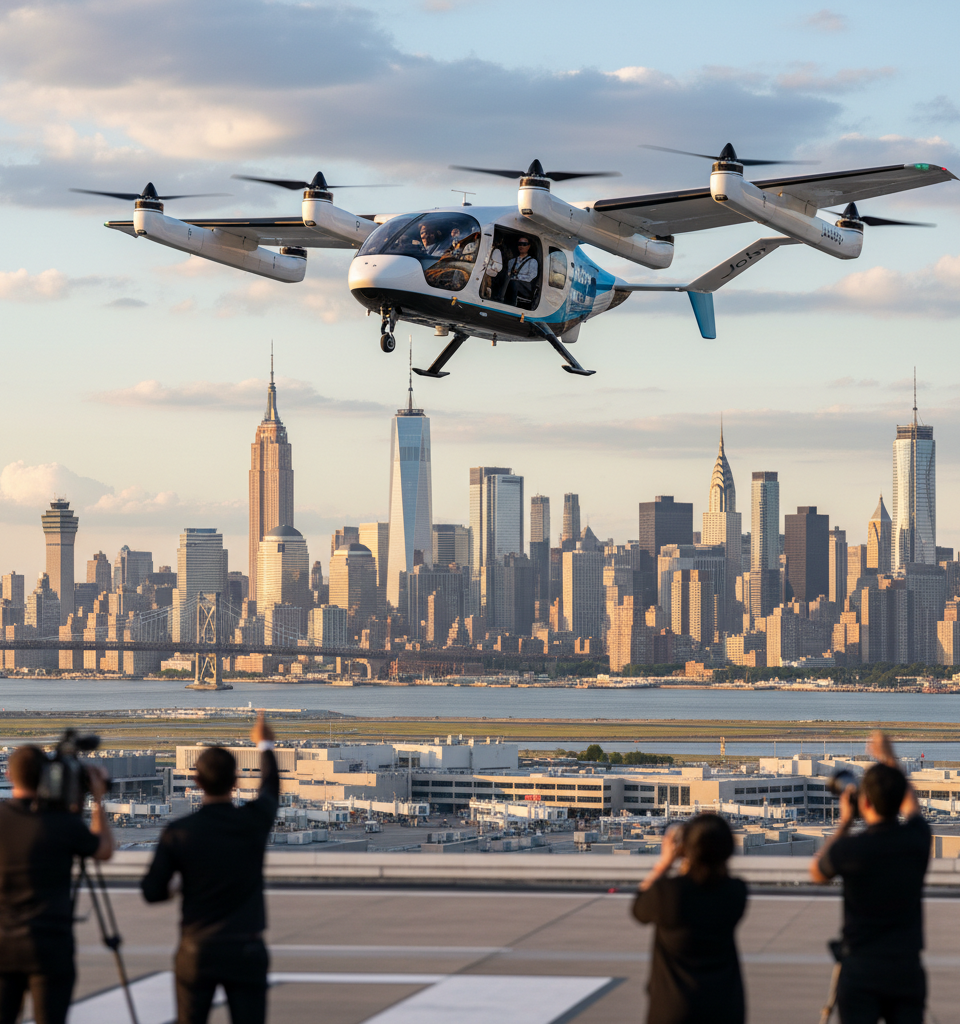
Joby Aviation, a leading developer of electric vertical takeoff and landing (eVTOL) aircraft, initiated a series of demonstration flights this week in New York City, connecting John F. Kennedy International Airport (JFK) with a heliport in Manhattan. These trial operations, which began on (insert specific date if known, otherwise generalize to 'this week'), aim to showcase the feasibility and efficiency of 10-minute air taxi transfers over one of the world's most congested corridors.
While not yet open to the public, the demonstrations mark a critical phase in proving the operational capabilities of Joby's aircraft in a real-world urban environment, moving beyond simulated tests to actual flight routes.
Context and Significance
This initiative comes at a pivotal time for urban mobility, as cities grapple with increasing traffic congestion and the demand for faster, more sustainable transit options. The promise of eVTOL technology lies in its ability to offer rapid, point-to-point air travel with zero operating emissions, providing a potential antidote to lengthy commutes and airport transfers. For New York City, a journey from JFK to Manhattan, which can often exceed an hour by car during peak times, could be dramatically reduced to mere minutes. Joby's efforts build upon decades of ambition for air mobility, leveraging advancements in battery technology, electric propulsion, and autonomous flight systems to realize what was once considered futuristic.
Key Details and Operational Insights
The demonstration flights involve Joby's proprietary eVTOL aircraft, designed for quiet operation and vertical takeoff and landing capabilities. According to a company press release, the initial successful point-to-point flight completed the journey from JFK to Manhattan, underscoring the aircraft's performance in a complex urban airspace. Joby emphasized that these trials are crucial for gathering data on operational reliability, noise footprint, and air traffic integration within the highly regulated New York airspace. While specific flight paths and altitudes are coordinated with air traffic control, the company is primarily demonstrating the aircraft's ability to navigate and operate safely, rather than focusing on passenger logistics at this stage. No specific financial figures for the demonstration costs or potential future fare structures have been disclosed at this time.
Industry and Market Impact Joby
Aviation's high-profile demonstrations are expected to generate significant traction within the burgeoning advanced air mobility (AAM) sector. The successful completion of these flights could bolster investor confidence in eVTOL technology and accelerate regulatory approval processes globally. Analysts project the AAM market to reach billions of dollars within the next decade, with companies like Joby, Archer Aviation, and Lilium vying for market leadership. These public demonstrations serve as powerful marketing tools, illustrating the tangible benefits of air taxis and potentially influencing public perception and acceptance of this new mode of transport. The focus on a critical, high-volume route like JFK-Manhattan highlights the potential for air taxis to tap into premium business and tourist travel markets.
Expert Perspectives on Future Adoption
Industry experts and urban planning analysts view Joby's demonstrations as a crucial step, yet underscore the significant hurdles remaining. Dr. Emily Carter, a transportation policy expert at the Urban Dynamics Institute, commented, “While the technical capabilities are increasingly proven, the economic viability, widespread public acceptance, and robust regulatory framework are still long-term challenges. Noise pollution and visual impact in dense urban areas, even with quieter electric propulsion, will require careful management.” Others, like aviation analyst Mark Thompson, believe that early commercial routes will likely focus on airport shuttles and inter-city connections before broader integration into daily urban commuting, citing the high operational costs and initial limited capacity of eVTOL aircraft.
What's Next for Air Mobility
Following these demonstration flights, Joby Aviation plans to continue working closely with the Federal Aviation Administration (FAA) to secure the necessary certifications for commercial operations. The company aims to launch passenger services in select markets as early as 2025, assuming regulatory approvals are met. Future developments will undoubtedly include establishing Vertiports – dedicated infrastructure for eVTOL takeoffs and landings – and integrating air taxi services into existing multimodal transportation networks. Investments in battery technology for extended range and faster charging, alongside continued refinements in autonomous flight systems, will be critical for scaling operations and making air taxis a more accessible and affordable option for a wider demographic. The success of these initial New York City trials could pave the way for similar demonstrations and commercial ventures in other major global cities seeking innovative solutions to urban congestion.