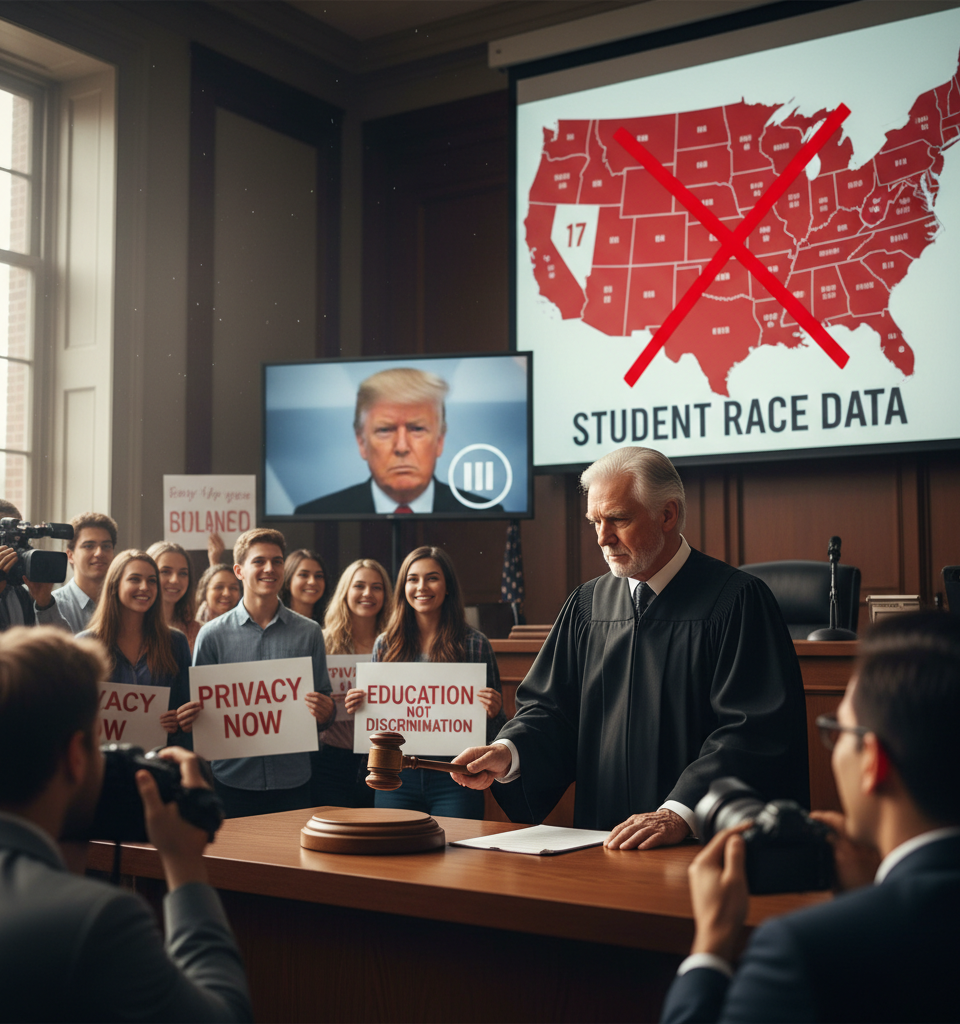
A federal district court has temporarily suspended the Trump administration's controversial demand for institutions of higher education across 17 states to furnish detailed student race data. The judicial order, issued on 2026-05-19, marks a significant development in the ongoing legal and political debate surrounding racial considerations in college admissions, particularly in the wake of the Supreme Court's landmark decision curtailing affirmative action.
The White House, under the Trump administration, had previously articulated its intention to leverage this data collection as a mechanism to ensure colleges and universities were adhering to the Supreme Court's ruling. This directive had drawn immediate scrutiny from civil rights advocates, educational organizations, and legal scholars who raised concerns about its scope, potential for misuse, and the administrative burden it placed on institutions. The temporary injunction effectively puts a pause on this data gathering effort, compelling the administration to reconsider its approach or defend it more vigorously in court.
Background to the Controversy
The impetus for the administration's data demand can be traced directly to the Supreme Court's pivotal ruling in Students for Fair Admissions v. Harvard/UNC. That decision, handed down earlier this year, fundamentally reshaped the landscape of college admissions by severely limiting, and in many interpretations, effectively ending the consideration of race as a factor in admissions processes. Following this ruling, the Trump administration quickly signaled its intention to take an active role in enforcement, viewing the collection of granular student race data as a necessary tool to identify and address any perceived non-compliance by educational institutions.
The administration's approach involved a direct request for specific demographic breakdowns from colleges and universities within the designated 17 states. While the precise nature of the requested data sets has not been fully disclosed, it is understood to include detailed racial and ethnic compositions of applicants, admitted students, and enrolled students, spanning various academic programs and potentially including information related to financial aid and other institutional support. Critics argued that such data, while seemingly neutral, could be used to justify further interventions or even punitive measures against institutions perceived to be failing to meet certain demographic benchmarks.
Implications for Higher Education and Civil Rights
The federal judge's intervention carries substantial implications for the higher education sector. Universities in the targeted states, many of whom were already grappling with the operational and legal complexities of implementing the Supreme Court's affirmative action ban, now face a temporary reprieve from this additional data reporting requirement. However, the underlying pressure to demonstrate compliance with the Supreme Court's ruling remains. The administration's efforts, even if temporarily stalled, highlight a persistent and heightened scrutiny over diversity initiatives and admissions practices.
From a civil rights perspective, the judge's decision is being closely watched. Advocates for racial equity had expressed worry that the data collection could become a tool for surveillance or for establishing quotas in reverse, rather than genuinely ensuring equitable access. Conversely, those who championed the end of affirmative action generally support greater transparency and accountability in university admissions, viewing the data as essential for monitoring adherence to the new legal standards. The tension between these two viewpoints underscores the deeply polarized nature of the debate.
What Comes Next?
The federal court's order is a temporary injunction, meaning it does not definitively resolve the legality of the administration's data request. The next phase will likely involve extensive legal arguments from both sides. The Trump administration will be challenged to demonstrate the legal basis and necessity of its data collection mandate, particularly in light of privacy concerns and the potential administrative burden on universities. Legal experts anticipate that this litigation could be protracted, potentially involving appeals that could elevate the matter to higher courts.
Colleges and universities in the affected states will now have to navigate this period of uncertainty. While freed from the immediate obligation to compile and submit the requested data, they must remain prepared for the possibility that the directive could be reinstated, modified, or challenged anew. The broader educational community will be observing closely, as the outcome of this legal battle could establish precedents for how federal agencies can monitor compliance with Supreme Court decisions, particularly those impacting sensitive areas like racial equality and access to education.