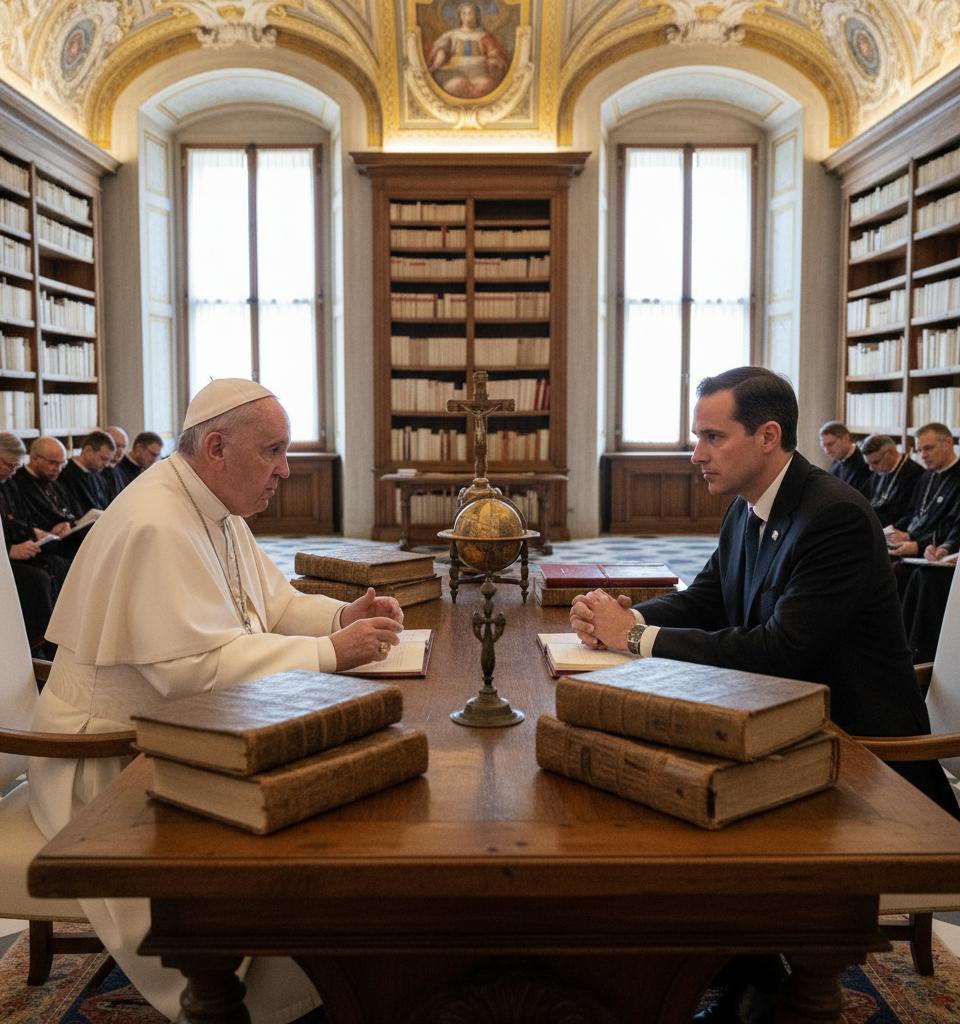
Former President Donald Trump’s recent remarks, which included a pointed criticism of Pope Leo XIII, have ignited a significant theological and strategic debate surrounding the centuries-old ethical framework known as the 'Just War' doctrine. The controversy has rapidly drawn in prominent political figures, most notably JD Vance, transforming a potentially obscure historical reference into a contemporary flashpoint regarding the justification and morality of military engagement. This unexpected catalyst has prompted both religious scholars and political commentators to revisit the foundational principles that delineate when a war can be considered morally permissible.
Historical Context and Modern Relevance
At the heart of the resurgence of this debate lies the 'Just War' doctrine, a complex philosophical and theological tradition with roots in ancient Greek philosophy and significantly developed by Christian thinkers like Augustine of Hippo and Thomas Aquinas. Pope Leo XIII, whose pontificate spanned from 1878 to 1903, contributed to this tradition through his encyclicals, which often addressed moral and social issues, including the conditions under which states might legitimately wage war. Trump's specific bone of contention with Pope Leo remains somewhat ambiguous in public discourse, yet its immediate effect has been to force a contemporary reckoning with these historical principles in an era marked by evolving geopolitical tensions and complex proxy conflicts. The doctrine typically outlines criteria including jus ad bellum (right to go to war) and jus in bello (right conduct in war), covering aspects such as just cause, legitimate authority, right intention, proportionality, and last resort.
Political Figures Enter the Fray
Senator JD Vance, a figure known for his incisive political commentary and alignment with a particular nationalist conservative viewpoint, has notably engaged with the theological implications of Trump's statements. While the precise nature of Vance's intervention has yet to be fully detailed, his involvement signals a broader trend of political leaders leveraging or explicitly referencing religious and ethical frameworks to bolster their foreign policy stances. This confluence of political rhetoric and spiritual doctrine suggests a deeper ideological struggle over America's role in global conflicts and the moral compass guiding its military actions. The debate extends beyond mere historical interpretation, touching upon contemporary issues such as interventionism, national sovereignty, and the use of military force in an increasingly interconnected world.
Broader Implications for Doctrine and Policy
The re-examination of the 'Just War' doctrine in light of Trump’s comments and Vance’s participation carries significant implications for both religious institutions and national foreign policy. For the Catholic Church, it serves as an opportunity to reiterate or re-contextualize its long-standing teachings on war and peace, potentially clarifying its stance on modern conflicts and humanitarian interventions. For policymakers, the resurgence of this framework could influence public discourse around military deployments, defense spending, and international alliances. The discussion may compel a more rigorous ethical scrutiny of military engagements, potentially leading to increased demands for transparency and accountability concerning the moral justifications for armed conflict.
The Ongoing Theological Discourse
Within theological circles, Trump's remarks have provided an unexpected platform for renewed academic and ecclesiastical debate. Scholars are dissecting Pope Leo XIII's actual contributions to 'Just War' theory, comparing them with the interpretations offered by contemporary political figures. This critical analysis aims to separate political rhetoric from authentic theological scholarship, ensuring that the historical integrity of the doctrine is maintained while also exploring its adaptability to 21st-century warfare, including cyber warfare and drone strikes. The complexity of these modern forms of conflict poses new challenges to traditional 'Just War' criteria, prompting questions about how concepts like proportionality and non-combatant immunity apply in an increasingly asymmetric battle space.
What Lies Ahead for the Debate
As the debate unfolds, observers anticipate continued robust engagement from both political commentators and religious leaders. The discourse is likely to extend beyond immediate reactions, potentially influencing future policy debates within Congress and shaping foreign policy platforms in upcoming election cycles. The public's engagement with these complex ethical questions underscores a desire for clearer moral guidelines in an unpredictable world. This episode highlights how even seemingly minor political clashes can reverberate through deep historical and theological channels, revealing the enduring relevance of ancient doctrines to contemporary global challenges. The spotlight will remain on how different factions ultimately interpret and apply these principles, with implications for international relations for years to come.