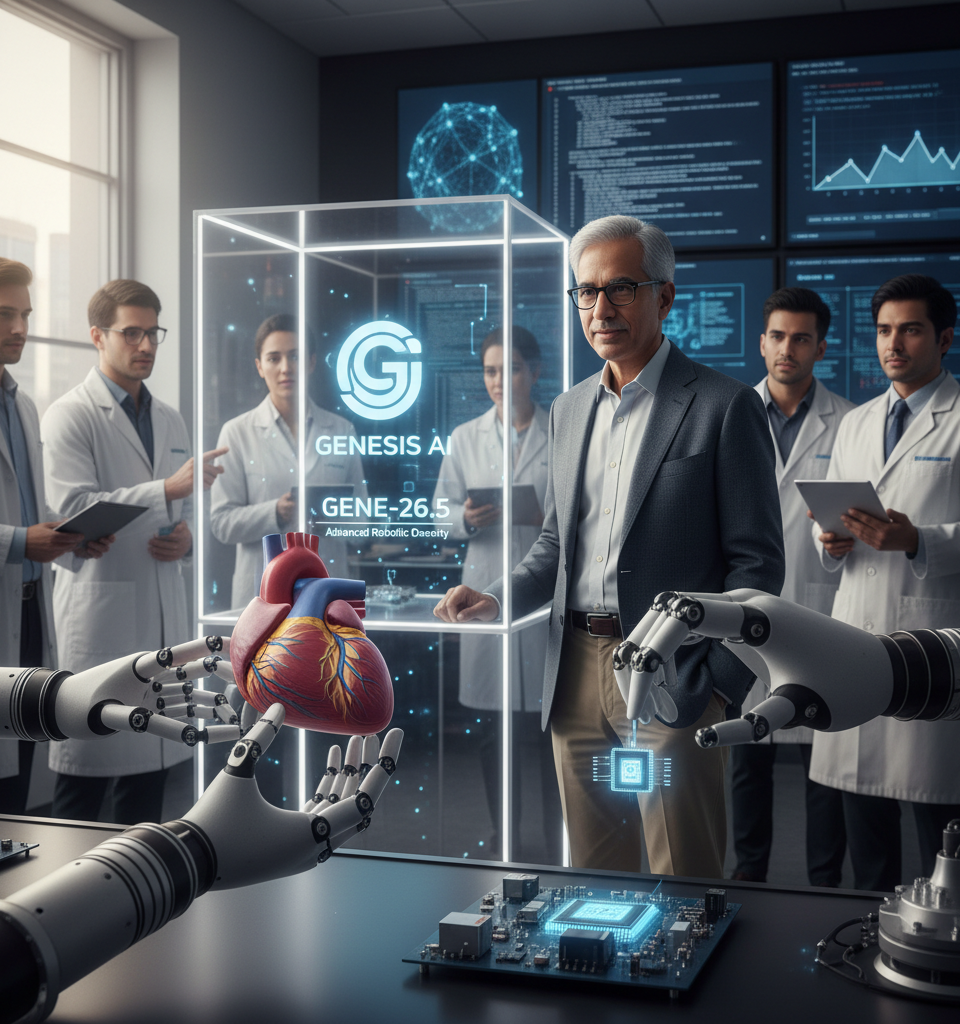
Genesis AI, a venture-backed robotics firm, has formally announced the public release of its flagship foundational AI model, GENE-26.5. This landmark unveiling was accompanied by a live demonstration illustrating the model's capabilities in controlling intricate robotic manipulators that performed a range of dexterous operations, underscoring the company's ambitious "full-stack" strategy to integrate advanced AI with robotic hardware. The revelation marks a pivotal moment for the startup, which had previously garnered considerable attention for its substantial seed funding round.
Context & Background
The emergence of Genesis AI's comprehensive offering is set against a backdrop of increasing investment and innovation in the robotics and artificial intelligence sectors. The company's impressive $105 million seed round, led by prominent venture capitalists including Khosla Ventures, immediately positioned it as a key player to watch. This level of early-stage funding highlighted investor confidence in its vision to overcome long-standing challenges in general-purpose robotics, particularly in tasks requiring high levels of adaptability and fine motor control. Previous attempts at foundational models for robotics often struggled with bridging the gap between simulated environments and real-world physical interactions, a lacuna Genesis AI aims to fill.
Key Details
5**, described by Genesis AI as a foundational AI model developed specifically for robotic applications. While specific technical details regarding its architecture and training regimen remain proprietary, the live demonstration provided compelling evidence of its prowess. The demo featured a set of robotic hands, believed to be proprietary hardware or highly customized off-the-shelf units, executing tasks with a fluidity and precision previously difficult to achieve without extensive, task-specific programming.
These tasks reportedly included complex object manipulation, fine motor assembly, and adaptive interaction with dynamic environments, suggesting a significant advancement in generalizable robotic intelligence. 5 leverages novel deep learning architectures combined with extensive real-world and synthetic data unique to robotic interaction.
Industry and Market Impact
This development has significant implications for the robotics industry, particularly for sectors reliant on automation, such as manufacturing, logistics, healthcare, and even domestic services. A truly "full-stack" solution, combining advanced AI with capable hardware, has the potential to accelerate the deployment of versatile robots beyond highly structured industrial environments. Competitors in the robotics and AI space will undoubtedly be dissecting Genesis AI's approach, potentially leading to a new wave of innovation focused on integrated hardware-software solutions. The success of GENE-26.5 could also unlock new market opportunities worth billions, by enabling robots to perform a wider array of unstructured and variable tasks, thereby driving down operational costs and increasing efficiency across various industries.
Expert Perspective
Industry analysts and robotics experts are largely viewing Genesis AI's announcement with cautious optimism. Dr. Elena Petrova, a leading researcher in AI for robotics, commented, "The ability to demonstrate such complex dexterity from a foundational model is a remarkable achievement. The challenge, as always, will be the scalability and robustness of this system in diverse, unpredictable real-world scenarios." Others point to the substantial investment as a testament to the belief in the team's long-term vision, noting that the seed funding enables the company to attract top talent and undertake high-risk, high-reward research. The integration of the model directly with robotic hardware suggests a commitment to practical application over purely theoretical advances, a strategy many believe is essential for widespread adoption.
What's Next
Looking ahead, Genesis AI is expected to focus on refining GENE-26.5, expanding its capabilities, and potentially developing more specialized versions for various applications. Future developments will likely include enhancing the model's ability to learn from fewer demonstrations, improving its adaptability to novel tasks, and ensuring its safe and reliable operation in real-world settings. The company has indicated plans for strategic partnerships with enterprise clients to pilot its integrated robotics solutions, moving from demonstrations to deployment. Furthermore, given the substantial initial investment, a Series A funding round is anticipated in the coming year, which would further fuel its research and development efforts, potentially bringing this advanced robotic intelligence closer to widespread commercial availability.