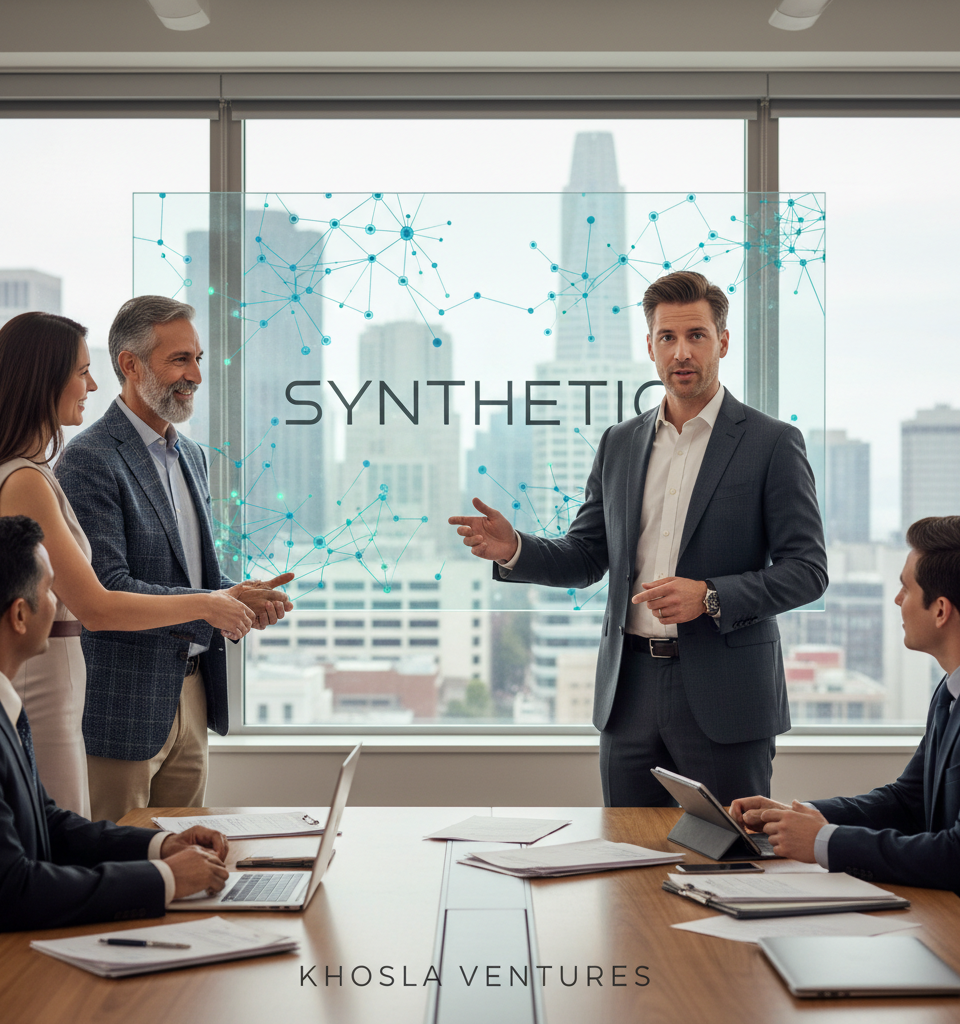
In a noteworthy development within the venture capital landscape, Khosla Ventures has committed a substantial $10 million investment to Synthetic, a nascent artificial intelligence-driven bookkeeping service founded by Ian Crosby. This latest funding round signals Khosla Ventures' confidence in Crosby's vision for fully autonomous financial management for startups, despite the checkered past of his previous company, Bench — a well-funded but ultimately troubled bookkeeping service that experienced significant operational difficulties and layoffs.
Context and Background
Ian Crosby is a familiar name in the startup world, known for co-founding Bench in 2012. Bench, an online bookkeeping service that combined software with human bookkeepers, initially garnered significant investment and attention, raising over $100 million. However, the company faced substantial challenges, including a significant restructuring in 2020 that saw a notable reduction in its workforce. This history makes Khosla's latest backing of Crosby and Synthetic particularly intriguing. It highlights a venture capital philosophy often focused on the entrepreneur's potential for future innovation, even in the wake of prior setbacks. The move demonstrates a belief in Crosby's ability to learn from past experiences and apply those lessons to an even more ambitious, technology-centric approach.
Key Details
Synthetic's core proposition is an entirely autonomous AI bookkeeping service designed specifically for other startups. This ambitious undertaking leverages advanced AI to handle complex financial transactions, reconciliation, and reporting without human intervention, a significant departure from Bench's hybrid model. The $10 million seed investment from Khosla Ventures, a firm renowned for its early-stage investments in disruptive technologies, provides Synthetic with crucial capital to develop its sophisticated AI infrastructure and penetrate the competitive startup services market. While specific performance metrics for Synthetic are not yet publicly available, the funding underscores investor confidence in the concept's potential to dramatically reduce costs and increase efficiency for burgeoning businesses.
Industry and Market Impact
The emergence of Synthetic could have a profound impact on the financial technology (FinTech) sector, particularly within the realm of small business accounting. The shift towards fully autonomous AI bookkeeping represents a significant threat to traditional accounting firms and existing hybrid models that still rely heavily on human oversight. If successful, Synthetic could drive down the cost of financial management services, making professional-grade bookkeeping accessible to an even wider range of startups. This could also accelerate the broader adoption of AI in administrative functions, pushing competitors to invest more heavily in automation and machine learning capabilities to remain competitive. The market for small business financial services is vast, estimated to be worth hundreds of billions of dollars annually, offering substantial room for disruption.
Expert Perspective
Industry analysts are divided on the implications of this investment. Some view Khosla Ventures' backing as a testament to the inexorable march of AI into every facet of business operations. "Khosla Ventures has a track record of identifying truly disruptive technologies," stated Dr.
Aris Thorne, a FinTech expert at the Blockchain Institute. "Their investment in Synthetic, despite Crosby's previous venture, signals a strong conviction in the viability of fully autonomous bookkeeping. " Others express caution, citing the inherent complexities of financial regulations and the need for human judgment in nuanced accounting situations.
"While AI can automate many tasks, the nuances of tax law and complex financial scenarios often require human insight," commented Sarah Jenkins, a certified public accountant and business consultant.
What's Next
With the $10 million in funding, Synthetic is poised to accelerate its product development and begin pilot programs with select startups. The immediate focus will likely be on demonstrating the AI's accuracy, scalability, and adherence to regulatory standards. Success for Synthetic could attract further rounds of investment and lead to rapid expansion, potentially solidifying its position as a leader in autonomous financial services.
Conversely, if the AI struggles with real-world complexities or fails to gain market traction, it could reflect poorly on the viability of entirely AI-driven bookkeeping solutions, prompting a re-evaluation of the role of human professionals in accounting. The coming months will be critical in determining whether Synthetic can fulfill its ambitious promise and whether Ian Crosby can successfully navigate the challenges that derailed his previous venture, cementing his reputation as an innovator in the FinTech space.