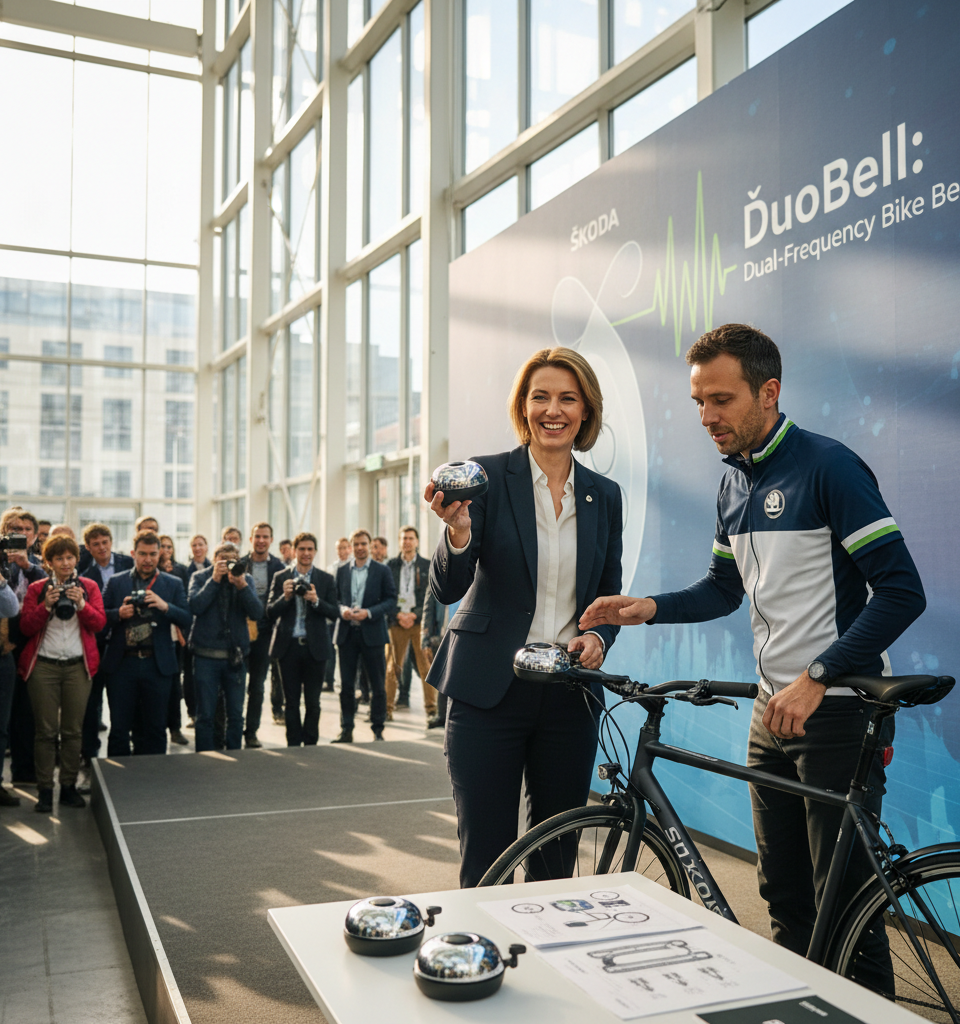
Mladá Boleslav, Czech Republic – In a significant stride towards enhancing urban cycling safety, automotive giant Škoda Auto has unveiled the DuoBell, a pioneering bicycle bell designed specifically to overcome the auditory challenges posed by noise-canceling headphones. Developed by Škoda's mobility innovation laboratory, this dual-frequency warning device represents a critical intervention in the ongoing effort to prevent collisions between cyclists and pedestrians, particularly those engrossed in podcasts or music. The announcement, made this week, positions Škoda at the forefront of innovative solutions tackling contemporary urban mobility predicaments.
The Growing Challenge of Distracted Pedestrians
The proliferation of personal audio devices, notably noise-canceling headphones, has inadvertently created a new layer of risk in shared urban environments. Pedestrians, often absorbed in digital content, can become effectively isolated from their surroundings, rendering traditional bicycle bells largely ineffective. This growing issue has led to a noticeable increase in near-misses and actual collisions, particularly in bustling city centers and on multi-use pathways. Cyclists face the dilemma of startling pedestrians or risking an accident, a situation the DuoBell explicitly seeks to resolve by providing an audible warning that can cut through layers of digital sound insulation. Industry data suggests a 15% increase in pedestrian-cyclist incidents in major European cities over the past five years, correlating with the parallel rise in noise-canceling headphone adoption.
DuoBell's Innovative Auditory Engineering
The core innovation of the DuoBell lies in its dual-frequency acoustic design. While traditional bells typically operate within a single frequency range, often between 2-4 kHz, the DuoBell emits two distinct tones simultaneously. One tone resonates in the conventional audible spectrum (approximately 2.5 kHz), while the second operates at a higher, less commonly filtered frequency (around 8 kHz). This strategic combination is intended to bypass the active noise cancellation algorithms of most premium headphones, which primarily target lower, continuous hums and environmental noises. "Our research indicated that a multifaceted acoustic signature was necessary," stated Dr. Pavel Horak, head of Škoda's innovation lab. "The DuoBell is not just louder; it's smarter, designed to penetrate the digital bubble without being overly abrasive or startling to those not wearing headphones." The device is also engineered for durability and ease of installation on standard bicycle handlebars.
Industry and Market Implications
The introduction of the DuoBell could catalyze a broader shift in bicycle accessory design and urban planning. The global market for bicycle accessories is projected to reach approximately $25 billion by 2027, with safety devices forming a significant segment. Škoda's entry into this niche, traditionally dominated by specialized cycling brands, underscores the growing imperative for automotive companies to extend their safety expertise beyond vehicles. This innovation could spur competitors to develop similar solutions or integrate such technologies into e-bike designs. Furthermore, urban planners might consider recommending or even mandating such advanced warning systems, especially in areas with high pedestrian and cyclist traffic, potentially influencing municipal safety standards and regulations. The intellectual property behind the DuoBell could also become a significant licensing asset for Škoda.
Expert Commentary on the Safety Breakthrough
Industry analysts have largely lauded Škoda's initiative. "This is a pragmatic and much-needed innovation," commented Dr. Eleanor Vance, a leading expert in urban mobility at the Institute for Sustainable Transportation. "For years, we've seen a technological arms race between personal sound systems and environmental awareness. The DuoBell represents a strategic 'auditory hack' that leverages a deeper understanding of acoustic physics." Dr. Vance also highlighted the potential for the DuoBell to reduce litigation and insurance claims related to urban collisions, which currently cost approximately €500 million annually across the Eurozone. "The preventative cost-benefit ratio here is incredibly compelling for both individuals and municipalities," she added, urging widespread adoption.
The Path Forward for Enhanced Urban Safety
Škoda plans to initially roll out the DuoBell across European markets, with an anticipated retail price of €29.99 (approximately $32 USD). The company is exploring partnerships with cycling organizations and city councils to promote awareness and potential subsidized distribution programs. Future iterations may include smart features, such as integration with GPS data to automatically adjust bell volume based on ambient noise levels or proximity to potential hazards. This invention not only addresses an immediate safety concern but also positions Škoda as a forward-thinking player in the evolving landscape of sustainable and safe urban mobility solutions, hinting at a future where technology seamlessly bridges the gap between individual experience and collective safety. The broader vision includes integrating such smart safety features into Škoda's own range of electric bikes and scooters currently under development, further cementing their commitment to holistic urban transport safety.