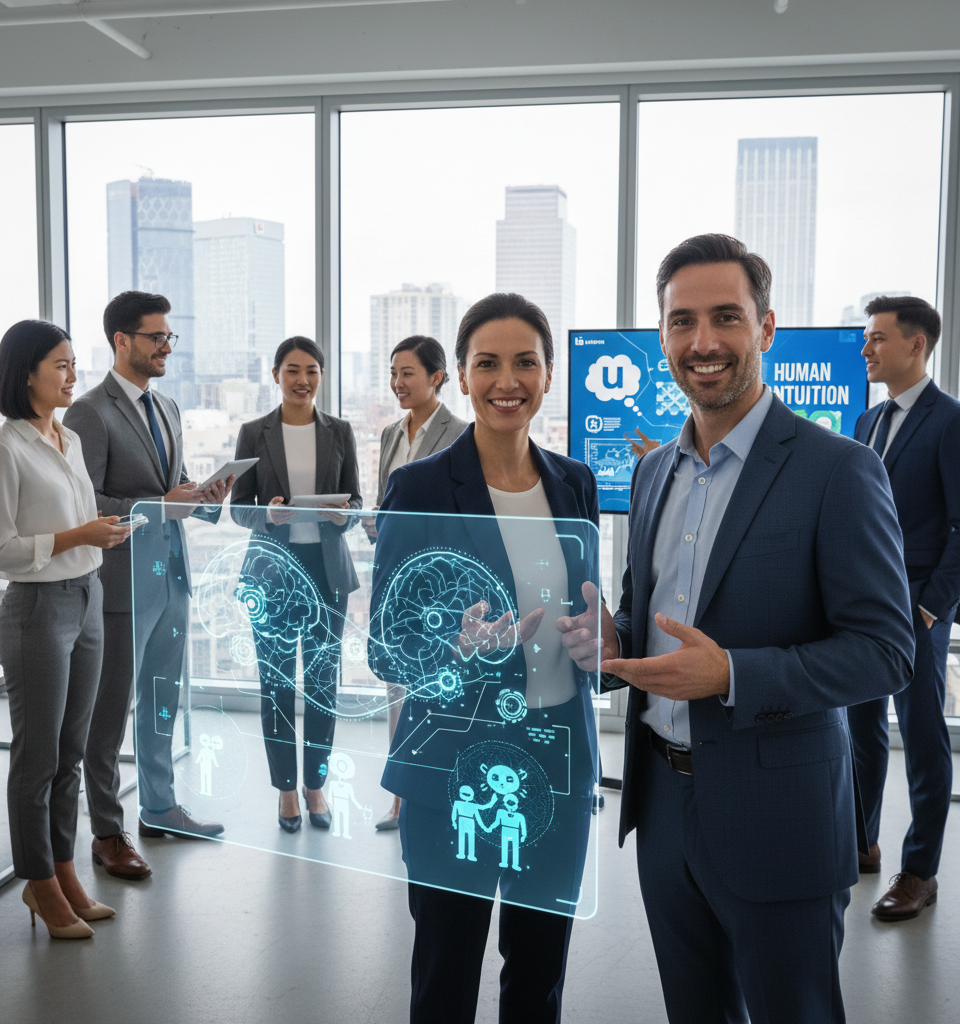
LinkedIn's Chief Economic Opportunity Officer Aneesh Raman and CEO Ryan Roslansky have unveiled a compelling new framework for navigating the evolving professional landscape, asserting that individual human differences are the paramount competitive advantage in an age increasingly shaped by AI. Speaking ahead of the release of their new book, Open to Work: How to Get Ahead in the Age of AI, the duo emphasized that the rapid integration of artificial intelligence into the workplace is creating an urgent need for individuals to leverage their unique human skills and perspectives. Their insights, drawn from LinkedIn's vast professional network data, signal a fundamental shift in how professionals should approach career development and skill acquisition.
Contextualizing the AI Revolution
The profound impact of artificial intelligence on the global workforce is unfolding at an unprecedented pace, challenging conventional notions of job security and career progression. Projections from PwC suggest that AI could contribute up to $15.7 trillion to the global economy by 2030, fundamentally reshaping industries from healthcare to finance. This technological wave, while promising increased efficiency and innovation, also raises concerns about job displacement and the widening skills gap. Raman, who previously advised on economic strategy for California and led economic impact at Facebook, and Roslansky, also EVP of Microsoft Office and Copilot, are uniquely positioned to offer guidance, having observed these trends from the front lines of the digital economy.
Key Insights from "Open to Work"
The authors distill five critical insights in their new publication, directly challenging the notion that AI will render human skills obsolete. Central to their argument is the idea that skills such as emotional intelligence, critical thinking, creativity, and complex problem-solving – traditionally considered 'soft skills' – will become increasingly valued. They stress that these are precisely the attributes AI struggles to replicate, making them critical differentiators. Furthermore, they highlight the importance of adaptability and continuous learning, encouraging professionals to embrace AI as a tool rather than fear it as a threat. The book also delves into the concept of "human-AI collaboration," where human ingenuity is augmented by AI's processing power, leading to enhanced productivity and innovation. For instance, Roslansky noted in a recent interview that LinkedIn data suggests professionals who actively use AI tools are seeing a 27% increase in productivity compared to their peers.
Industry and Market Implications
The implications of this perspective are far-reaching across industries. Companies are already grappling with how to integrate AI effectively without alienating their human workforce. LinkedIn’s leaders propose that organizations must shift their focus from simply automating tasks to augmenting human capabilities with AI. This entails significant investment in reskilling and upskilling initiatives, fostering a culture of lifelong learning, and redesigning job roles to maximize human-AI collaboration. For example, the healthcare sector could see AI handling diagnostic pre-screening, freeing up doctors to focus on complex cases and patient empathy—a distinctly human domain. Financial services could leverage AI for data analysis, while human advisors retain the critical role of client relationship management and ethical decision-making. Estimates from the World Economic Forum suggest that while 85 million jobs may be displaced by AI by 2025, 97 million new jobs could emerge that require hybrid skills.
Expert Perspectives Affirm Human Value
Independent industry experts and futurists largely echo the sentiments put forth by Raman and Roslansky. Dr. Kai-Fu Lee, a leading AI venture capitalist and author, has consistently championed the idea that AI will differentiate between routine tasks and tasks requiring compassion and creativity, emphasizing the enduring value of human-centric skills. Similarly, recent research from McKinsey & Company indicates that roles requiring advanced social-emotional skills are projected to grow by 25% to 30% by 2030, underscoring the strategic imperative for individuals and organizations to prioritize these capabilities. Analysts agree that the competitive advantage in the coming decades will lie not in merely adopting AI, but in intelligently integrating it to elevate unique human contributions.
What's Next: A Strategic Imperative
The roadmap for individuals and enterprises is clear: embrace continuous learning, cultivate uniquely human skills, and strategically integrate AI. LinkedIn, with its vast network of 930 million members, is actively rolling out new learning pathways and certifications focused on AI literacy and essential human skills. The company's "AI Proficiency Quotient" is an example of an emerging metric that could become crucial for job seekers globally. As AI continues its exponential growth, Roslansky and Raman's call to action serves as a vital reminder that our shared humanity, in its diverse forms, is not a vulnerability in the face of technology but our most profound and enduring strength. The emphasis will progressively shift from what you know to how uniquely you apply what you know in conjunction with advanced technologies.