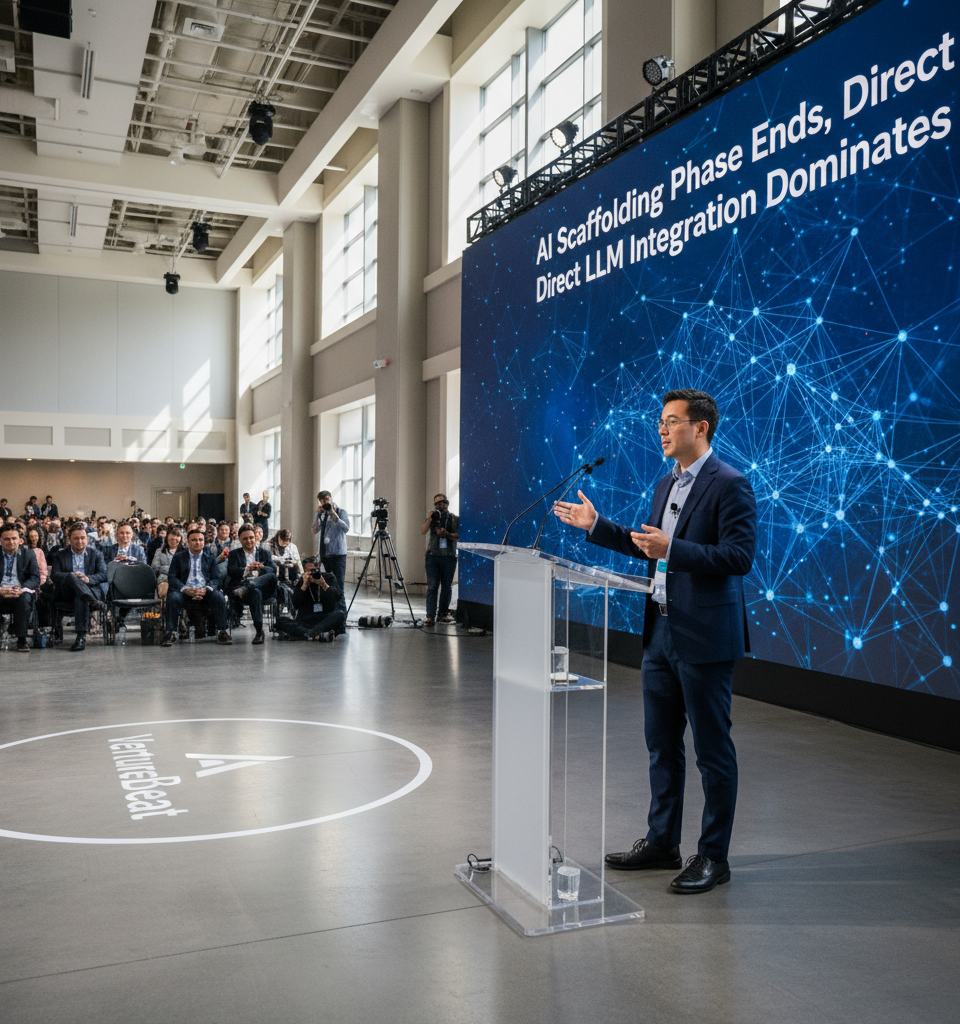
The foundational layers of abstraction and orchestration that once underpinned the development of Large Language Model (LLM) applications are increasingly becoming obsolete. This seismic shift, characterized by the collapse of what was once considered essential 'scaffolding'—including indexing layers, elaborate query engines, intricate retrieval pipelines, and painstakingly orchestrated agent loops—is not a setback but rather a natural evolution, according to Jerry Liu, co-founder and CEO of LlamaIndex. In a recent interview, Liu articulated that this simplification is the intended outcome of technological progress, signaling a move towards more direct and intuitive LLM integration rather than complex, framework-dependent workflows.
The Evolution of LLM Development
Historically, early-stage LLM development was akin to constructing a complex building with extensive temporary supports. Developers relied heavily on frameworks to manage the intricate dance between data ingestion, contextual retrieval, and model interaction. This was driven by the nascent state of LLMs, which often required significant external assistance to perform reliably and efficiently on specific tasks. The initial ecosystem saw a proliferation of tools designed to preprocess data, manage context windows, and structure interactions, thereby abstracting away the underlying complexities of LLM capabilities. This scaffolding was critical for proving generalized applicability and demonstrating initial value propositions across various industries.
Key Drivers of Simplification
Liu highlights that the improving capabilities of LLMs themselves are the primary catalyst for this simplification. As models become more powerful, adaptable, and self-sufficient, their need for external, custom-built support structures diminishes. "As a result, there's less of a need for frameworks to actually help users compose these deterministic workflows in a light and shallow manner," Liu explained. This implies that many tasks previously requiring sophisticated orchestration can now be handled more directly by the LLM, often through advanced prompt engineering or fine-tuning. The focus is shifting from building complex data pipelines to crafting effective linguistic instructions, marking a significant paradigm shift in developer strategy.
Industry and Market Implications
This trend has profound implications across the AI industry. For framework providers, it necessitates a pivot from comprehensive, all-encompassing solutions to more specialized, value-added services. The market will likely see a consolidation of tools, with only those offering unique benefits—such as enhanced security, specialized data handling, or novel interaction patterns—surviving.
For enterprises adopting AI, it promises a reduction in development complexity, potentially lowering entry barriers and accelerating deployment cycles. Startups, with their inherent agility, could benefit significantly, as they might no longer need to invest heavily in developing or integrating complex intermediary layers, thus freeing up resources for core innovation. Venture capital investments may also shift, favoring companies that build directly on improved LLM capabilities rather than those creating new layers of abstraction.
Expert Perspectives on the Shift
Industry analysts largely concur with Liu's assessment, viewing it as a natural progression in the software development lifecycle for emergent technologies. Dr. Anya Sharma, a principal AI researcher at GlobalTech Insights, commented, "This isn't just about simplification; it's about maturity. When a technology becomes robust enough to handle more of its own complexities, the middleware it required early on naturally fades. We're seeing LLMs move from needing intensive care to becoming independent actors." This sentiment suggests that the market for generic LLM orchestration tools will contract, while demand for specialized, domain-specific AI solutions will grow.
The Enduring Value
While the scaffolding may be collapsing, certain elements will not only survive but thrive. Technologies focusing on data quality and preparation, observability and monitoring, ethical AI governance, and specialized retrieval augmented generation (RAG) techniques will remain crucial. The emphasis will shift from broad-stroke orchestration to precision engineering—ensuring data integrity, tracking model performance, mitigating biases, and integrating LLMs with proprietary knowledge bases in a highly optimized manner. Frameworks that adapt to provide these nuanced, high-value services will secure their place in the evolving ecosystem.
Looking Ahead: A Leaner AI Development Landscape
The future of LLM application development appears set for a leaner, more direct approach. As LLMs continue to evolve rapidly, absorbing more functionalities into their core capabilities, developers will increasingly interact with these models closer to their raw form. This will empower them to build more innovative and efficient applications with fewer layers of abstraction, accelerating the pace of AI integration into mainstream products and services. The emphasis will be on leveraging the inherent intelligence of the LLMs themselves, rather than building extensive infrastructure around them, promising a more agile and powerful era for AI innovation.