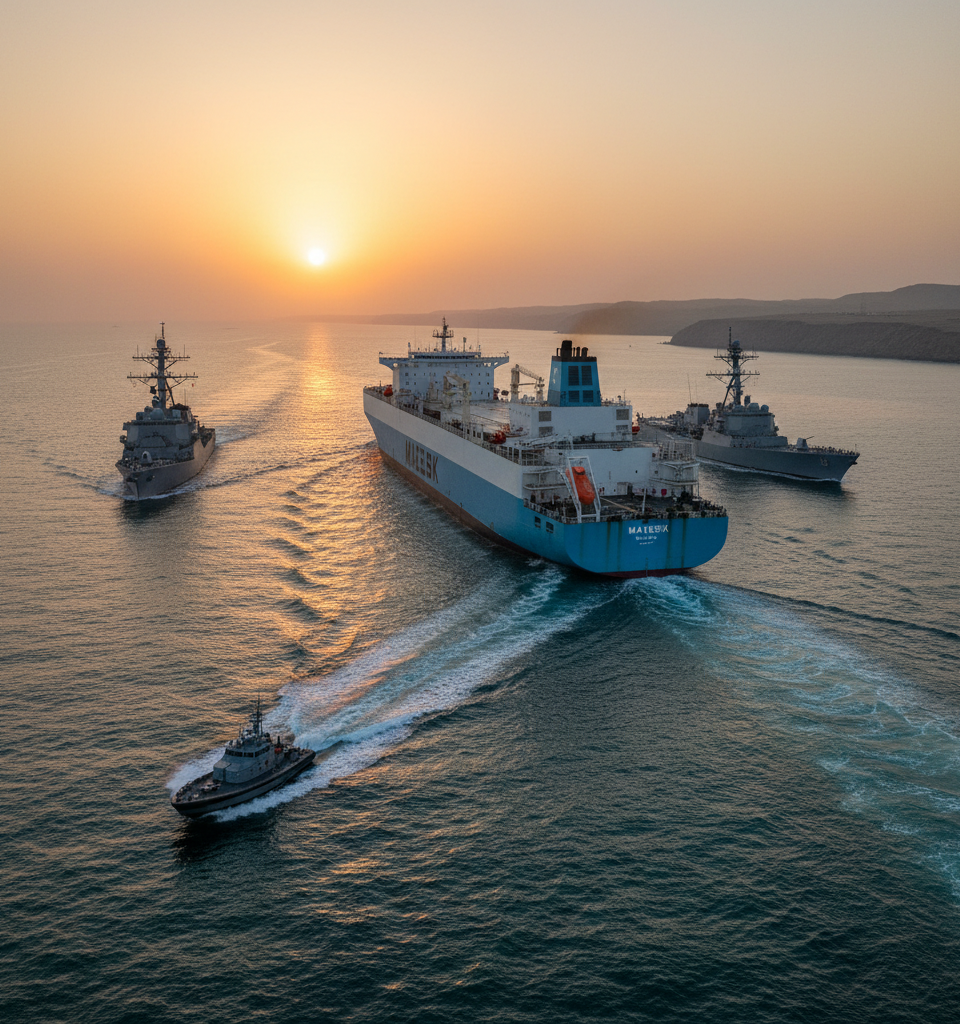
A Maersk-operated roll-on/roll-off (ro-ro) vessel, the MV Maersk Michigan, under contract to the U.S. military, successfully transited the Strait of Hormuz on Monday, departing the Persian Gulf escorted by warships of the United States Navy. This marks a significant development as it represents the first safe passage of a U.S.-flagged commercial vessel with a military escort since a series of escalating incidents in the vital shipping lane prompted concerns about maritime security. The vessel's uneventful journey provides a cautious sigh of relief for international shipping and underscores the immediate protective actions being taken by the U.S. to ensure freedom of navigation.
Context and Background
The Strait of Hormuz, a narrow choke point between the Persian Gulf and the Arabian Sea, is arguably the world's most critical oil transit chokepoint, with approximately one-fifth of global oil consumption and an increasing volume of liquefied natural gas (LNG) passing through it daily. Its strategic importance makes it a frequent flashpoint for regional geopolitical tensions. Recent weeks have seen an uptick in incidents, including vessel seizures and harassment by Iranian forces, particularly affecting vessels with perceived links to the U.S. or its allies. This heightened instability has prompted the U.S. military to bolster its presence and consider stronger protective measures for commercial shipping, especially for U.S.-flagged vessels or those contracted by the U.S. government transporting sensitive cargo.
Key Details of the Passage
The Maersk Michigan, a large ro-ro vessel capable of carrying a significant volume of military cargo, was reportedly under U.S. Military Sealift Command (MSC) contract at the time of its transit. The precise nature of its cargo was not disclosed, but MSC vessels routinely transport equipment and supplies for U.S. forces deployed in the Middle East. The U.S. Navy's Fifth Fleet, based in Bahrain, confirmed the escort operation, detailing that multiple naval assets provided a protective cordon around the commercial ship. This level of escort for a U.S.-flagged commercial vessel underscores the proactive posture adopted by the U.S. military in response to recent threats. No specific challenges or confrontations were reported during the passage, which lasted several hours as the convoy navigated the narrowest sections of the strait.
Industry and Market Impact
For the shipping industry, the successful passage offers a glimmer of stability amidst considerable uncertainty. While freight rates and insurance premiums for transit through the Strait of Hormuz have seen fluctuations due to geopolitical risks, a consistent pattern of safe passages under escort could help stabilize these costs. Major container lines and tanker operators have been closely monitoring the situation, with some altering routes or increasing security measures on their own. The involvement of a major player like Maersk, one of the world's largest integrated logistics companies, signals the continued necessity of operating in this region, despite the risks. Any sustained disruption to shipping in the Strait would have widespread implications for global supply chains and energy markets, potentially leading to significant price increases for oil and gas.
Expert Perspective
Maritime security analysts view this successful transit as a critical test of the U.S.'s resolve and capability to protect its commercial interests and maintain freedom of navigation in contested waters. Dr. Eleanor Vance, a senior fellow at the Maritime Geopolitics Institute, commented, "This escorted passage sends a clear message that the U.S. will not cede the Strait of Hormuz. It's a pragmatic necessity given the strategic importance of the waterway." She added, "However, it also highlights the increased burden on naval assets and raises questions about the long-term sustainability of such extensive escort operations for every U.S.-flagged vessel if tensions persist." The effectiveness of these escorts in deterring hostile actions will be a key metric for future policy decisions.
What's Next?
S. maritime security policy in the region. S.
-flagged commercial vessels deemed to be at risk, especially those carrying military-related cargo or operating in sensitive areas. Discussions are ongoing among international maritime organizations and naval forces about potentially establishing broader multinational escort operations or enhanced surveillance to ensure the safety of all commercial shipping. The long-term stability of the region, however, remains dependent on diplomatic efforts to de-escalate tensions and address the underlying geopolitical issues that frequently imperil this vital global artery.
The shipping industry will remain on high alert, adapting to evolving security landscapes and potentially incorporating higher operational costs into their business models.