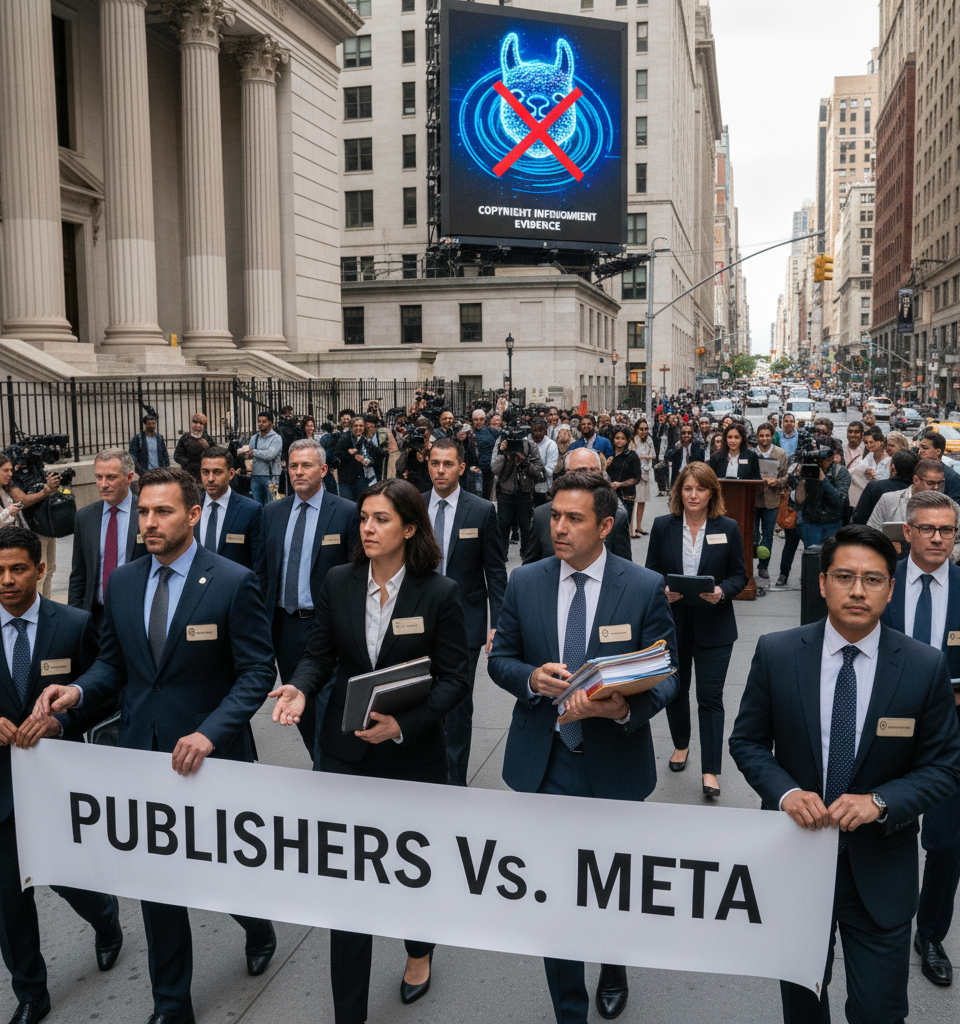
In a significant development for the burgeoning field of artificial intelligence and intellectual property law, a powerful consortium of five major publishers – Elsevier, Cengage, Hachette, Macmillan, and McGraw Hill – along with bestselling author Scott Turow, filed a proposed class-action lawsuit against Meta Platforms Inc. in a Manhattan federal court on Tuesday. The plaintiffs accuse Meta of systematically pirating millions of their copyrighted books and other literary works to illicitly train its large language models (LLMs) known as Llama, without permission or compensation. This legal action marks a critical escalation in the ongoing battle between content creators and AI developers, promising a thorough examination of fair use and copyright in the digital age.
Context and Significance
This lawsuit follows a series of earlier copyright infringement complaints against AI companies, notably those brought against OpenAI and others. However, the current action against Meta is poised to be particularly impactful due to the plaintiffs' assertion of possessing more robust evidence of "market harm," a critical factor in copyright litigation. The legal landscape surrounding AI training data was significantly shaped by a June 2025 ruling by Judge Chhabria, which highlighted the need for concrete proof of economic damage. Publishers and authors, armed with this precedent, have since been strategically preparing their cases, and this filing by such prominent industry players signals a concerted effort to establish clear legal boundaries for AI development.
Key Allegations and Evidence
Central to the lawsuit's claims is the allegation that Meta's Llama models, including Llama 1 and Llama 2, were trained on vast datasets containing copyrighted materials from these publishing houses. The complaint reportedly details explicit connections between the works available on literary pirating sites and the training data used for Meta's AI. While specific financial figures for alleged damages were not immediately disclosed, the scale of the publishers involved—representing a substantial portion of global academic, educational, and trade publishing—suggests potential damages could run into the hundreds of millions, if not billions, of dollars. The inclusion of Scott Turow, an author of significant standing, further personalizes the alleged harm to individual creators.
Industry and Market Impact
This lawsuit sends a powerful message across the AI and publishing industries. For AI developers, it underscores the increasing legal scrutiny over data acquisition practices and the potential for multi-billion dollar liabilities for unauthorized use of copyrighted content. For the publishing industry, it represents a unified front seeking to protect intellectual property rights in the face of rapidly evolving technological advancements. The outcome could set a crucial precedent for how AI models are trained globally, potentially forcing developers to license vast quantities of data or face severe legal repercussions. This could significantly increase the cost of AI development and shift power dynamics towards content owners.
Expert Perspectives
Legal experts suggest that the plaintiffs' focus on demonstrating direct market harm could be a game-changer. "Previous cases struggled to concretely link AI training to specific revenue losses for copyright holders," noted Dr. Eleanor Vance, a professor of intellectual property law. "If these publishers can successfully show that Meta's AI models generate content that competes directly with their offerings, thereby eroding sales or licensing opportunities, it would be a watershed moment." Analysts also believe that the involvement of such a large and diverse group of publishers provides the lawsuit with significant weight, making it harder for Meta to dismiss the claims as isolated incidents.
What's Next
The legal process is expected to be protracted, potentially spanning several years. Meta will undoubtedly mount a vigorous defense, likely arguing fair use or the transformative nature of AI. However, the plaintiffs' concerted effort and claimed stronger evidence suggest a more challenging battle for the tech giant than previous, less coordinated lawsuits. The case will likely involve extensive discovery, expert testimony on AI training methodologies, and detailed economic analysis of market impact. A favorable ruling for the publishers could lead to significant licensing fees becoming a standard cost for AI development, fundamentally reshaping the business models of many AI companies and potentially accelerating the development of ethically sourced AI training datasets.