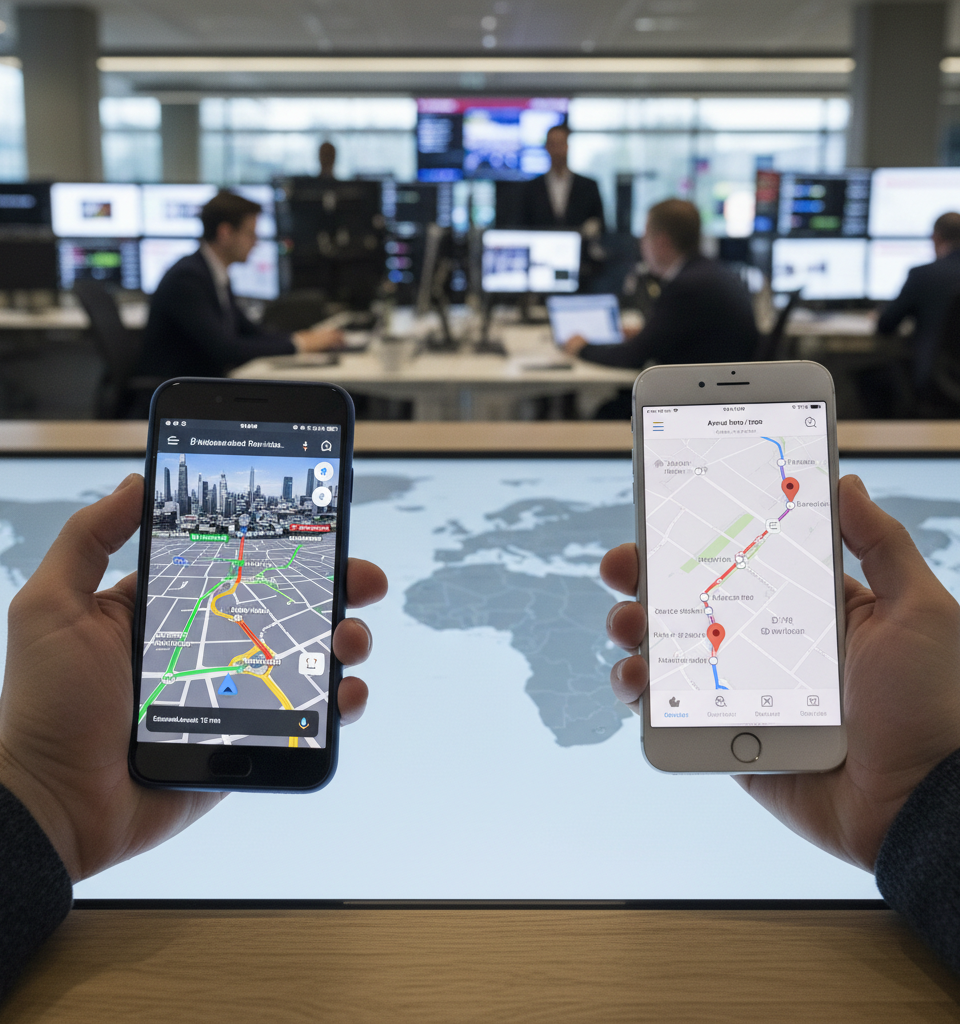
A recent comprehensive analysis comparing Google Maps and Apple Maps has concluded that Google's offering maintains its lead as the superior navigation tool, despite continued improvements from Apple. The evaluation, which encompassed myriad factors including accuracy, feature richness, ease of use, and integration, underscored Google's sustained advantage in the increasingly critical realm of digital wayfinding. This outcome solidifies Google Maps' standing as a perennial favorite among commuters, travelers, and everyday users globally, influencing daily routines and logistical decisions for hundreds of millions of people.
Context and Evolution of Digital Navigation
The rivalry between Google Maps and Apple Maps has been a focal point in the tech industry for over a decade, epitomizing the broader competition between the two tech giants. Apple's initial foray into mapping in 2012 was notoriously problematic, plagued by inaccurate data, mislabeled locations, and a host of navigational errors that led to widespread user dissatisfaction and a rare public apology from then-CEO Tim Cook. This incident significantly propelled Google Maps, which had already established itself as a robust and reliable service stemming from its 2005 launch, into an almost unassailable position.
Over the subsequent years, Apple has invested billions of dollars into rectifying these issues, acquiring mapping startups like C3 Technologies and building its own fleet of data collection vehicles, significantly narrowing the feature gap and improving its accuracy. The stakes are immense, with digital maps being critical infrastructure for ride-sharing, logistics, local search, and personal travel, representing a market valued at over $20 billion annually.
Key Differentiating Factors and User Experience
Several critical elements contributed to Google Maps' victory in the recent evaluation. Its unparalleled data breadth and depth remain its strongest asset, offering more comprehensive points of interest (POIs), frequently updated business information, and richer user-generated content, including reviews and photos. The analysis found Google Maps to be consistently more reliable for public transit information, offering detailed schedules, real-time delays, and multi-modal routing options across a wider array of cities.
Furthermore, Google's advanced search capabilities, powered by its enormous underlying search engine, allow for more nuanced and accurate queries, whether searching for a specific restaurant dish or a business with particular amenities. While Apple Maps has seen significant gains in its 'Look Around' feature (Apple's answer to Street View) and 3D city models, Google's 'Live View' AR navigation and extensive indoor mapping capabilities in complex venues like airports offered a more robust real-world navigational experience. The integration with other Google services, such as Gmail for flight times and Google Assistant for voice commands, also provides a seamless user journey.
Industry and Market Impact
The continued dominance of Google Maps has profound implications across various sectors. For businesses dependent on local search and foot traffic, being accurately represented and highly rated on Google Maps is paramount, directly influencing customer acquisition. The ride-sharing industry, dominated by players like Uber and Lyft, largely relies on Google's mapping APIs and data for their operational efficiency, highlighting its deep entanglement in the gig economy.
Urban planning and emergency services also leverage Google's data for traffic analysis and response coordination. Apple's persistent efforts, despite not fully overtaking Google, are vital for maintaining competitive pressure, preventing a monolithic control over digital geography, and driving innovation across the industry. This competition has pushed both platforms to continually enhance features like eco-friendly routing, EV charging station locations, and real-time incident reporting.
Expert Perspectives
Industry analysts generally concur with these findings. "While Apple Maps has come a very long way from its early days, making it a perfectly viable option for many casual users, Google Maps still maintains a significant edge in sheer data volume and sophisticated functionalities," states Dr. Elena Petrova, a geospatial technology expert at GeoTech Insights.
"Google's early lead in data collection, coupled with its AI-driven search algorithms, creates a virtuous cycle of improvement that is incredibly difficult for competitors to replicate entirely. " She estimates that Google Maps still commands roughly 70-80% of the global mobile navigation market share outside of China, a testament to its enduring user base and feature set.
The Road Ahead: Future Developments
The future of digital mapping promises continued innovation, with both Google and Apple heavily investing in augmented reality (AR) navigation, more personalized routing based on user preferences, and deeper integration with smart vehicles. Google is expected to further refine its "Immersive View" for select cities, offering a photorealistic, 3D exploration experience powered by AI predictions for traffic and weather. Apple, conversely, is reportedly focusing on expanding its high-definition map data to more regions, enhancing detail within its 3D city models, and potentially integrating more directly with Apple's rumored AR/VR hardware initiatives.
The ongoing development of autonomous vehicles will also profoundly shape these platforms, requiring even more granular and accurate real-time mapping data. As these technologies evolve, the battle for digital navigation supremacy will likely shift from basic routing to who can provide the richest, most intuitive, and contextually aware digital representation of the physical world.