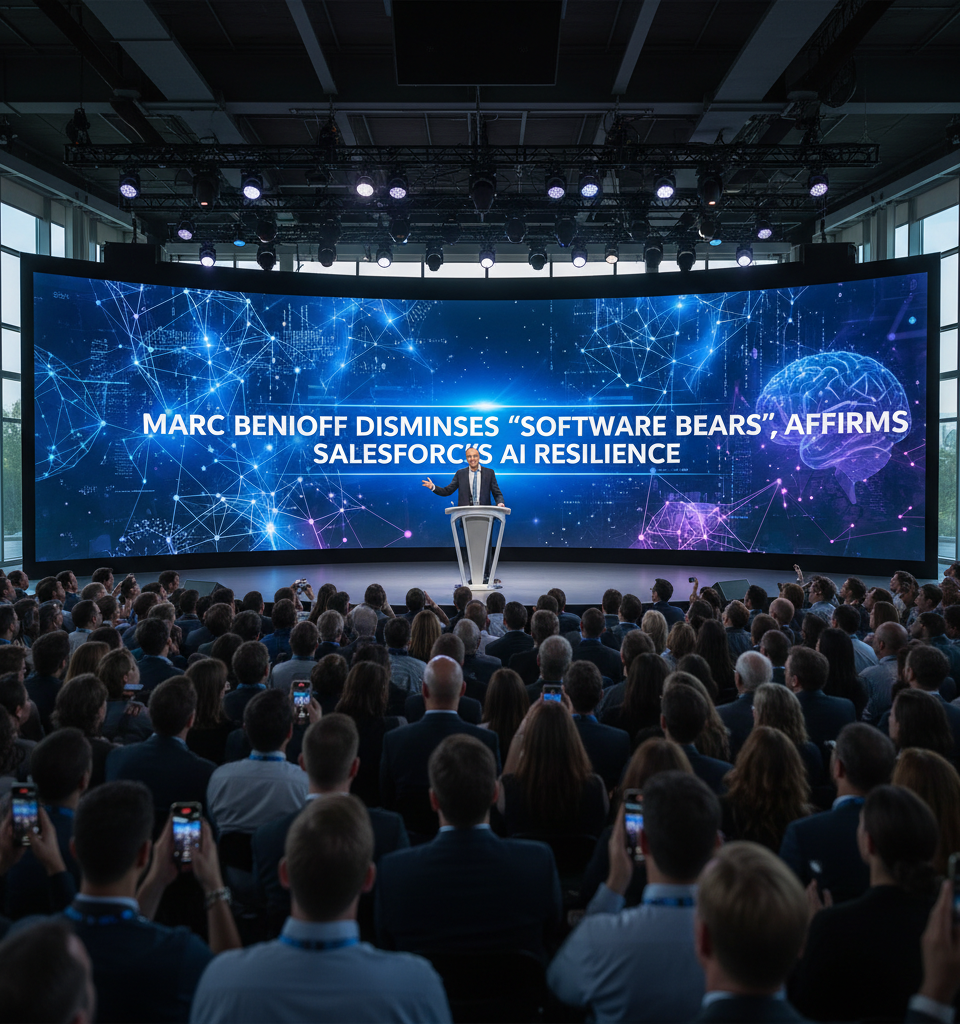
Navigating a Shifting Tech Landscape
Benioff's assertive posture comes at a critical juncture for enterprise software companies, which are facing intense scrutiny as generative AI rapidly evolves. Investors and analysts have increasingly questioned the longevity and competitive edge of legacy platforms, fearing disruptive displacement by agile, AI-native startups. Salesforce, a pioneer in cloud-based Customer Relationship Management (CRM), has long been a bellwether for the broader software-as-a-service (SaaS) market. The company’s ability to adapt and integrate AI efficiently will likely serve as a benchmark for its industry peers, making Benioff's recent statements more than just a defense of Salesforce but a strategic declaration for the sector.
Strategic Clarity Amidst Market Volatility Key to
Benioff's argument is the notion that AI is an additive, rather than subtractive, force for Salesforce's ecosystem. He highlighted the company's significant investments in AI capabilities, including its Einstein Copilot and Data Cloud platforms, which are designed to seamlessly embed generative AI directly into existing CRM workflows. These integrations aim to enhance productivity, automate routine tasks, and provide deeper customer insights without requiring enterprises to rip and replace their established Salesforce infrastructure. This strategy is critical for retaining a vast customer base that has invested heavily in Salesforce licenses and customizations over years, even decades.
Broader Industry Implications and Competitive Dynamics
Salesforce's approach exemplifies a broader trend among established tech giants: leveraging their extensive customer bases and deep domain expertise to integrate AI rather than concede ground to pure-play AI disruptors. Competitors like Oracle, SAP, and Microsoft are pursuing similar strategies, aiming to weave AI into their respective enterprise resource planning (ERP) and productivity suites. The success of this integration model will determine whether traditional software providers can maintain their market dominance or if a new generation of AI-first companies will erode their market share. Benioff's confidence suggests an belief that the complexity and mission-critical nature of enterprise software deployments favor incumbent platforms capable of robust, secure, and integrated AI solutions.
Analyst Perspectives: Cautious Optimism Meets Strategic Pivoting
Financial analysts and industry experts offer a mixed but generally optimistic view on Salesforce's AI strategy. While some analysts have expressed concerns about increased R&D costs and the potential for margin compression as AI features become table stakes, many acknowledge Salesforce's strong customer lock-in and its proven track record of adapting to technological shifts. "Salesforce's massive install base provides a formidable moat," noted one analyst from Gartner. "The challenge lies in effectively monetizing AI features and proving their tangible ROI to customers who are also grappling with their own AI adoption curves." The upcoming earnings reports and customer adoption metrics for AI products will be closely watched indicators of the strategy's success.
The Road Ahead: Innovation and Integration as Cornerstones
Looking forward, Salesforce's trajectory will hinge on its continued ability to innovate and deliver practical, high-value AI solutions that resonate with its diverse enterprise clientele. The company is expected to further enhance its Data Cloud capabilities, which are crucial for feeding reliable, secure data to its AI models, and to expand its ecosystem of AI-powered applications through its AppExchange. Upcoming Dreamforce conferences and investor events will undoubtedly serve as platforms for Benioff to elaborate on Salesforce's roadmap, emphasizing a vision where AI is not just a feature, but an intrinsic layer woven across the entire Customer 360 platform, solidifying its position against any perceived 'software bears'.