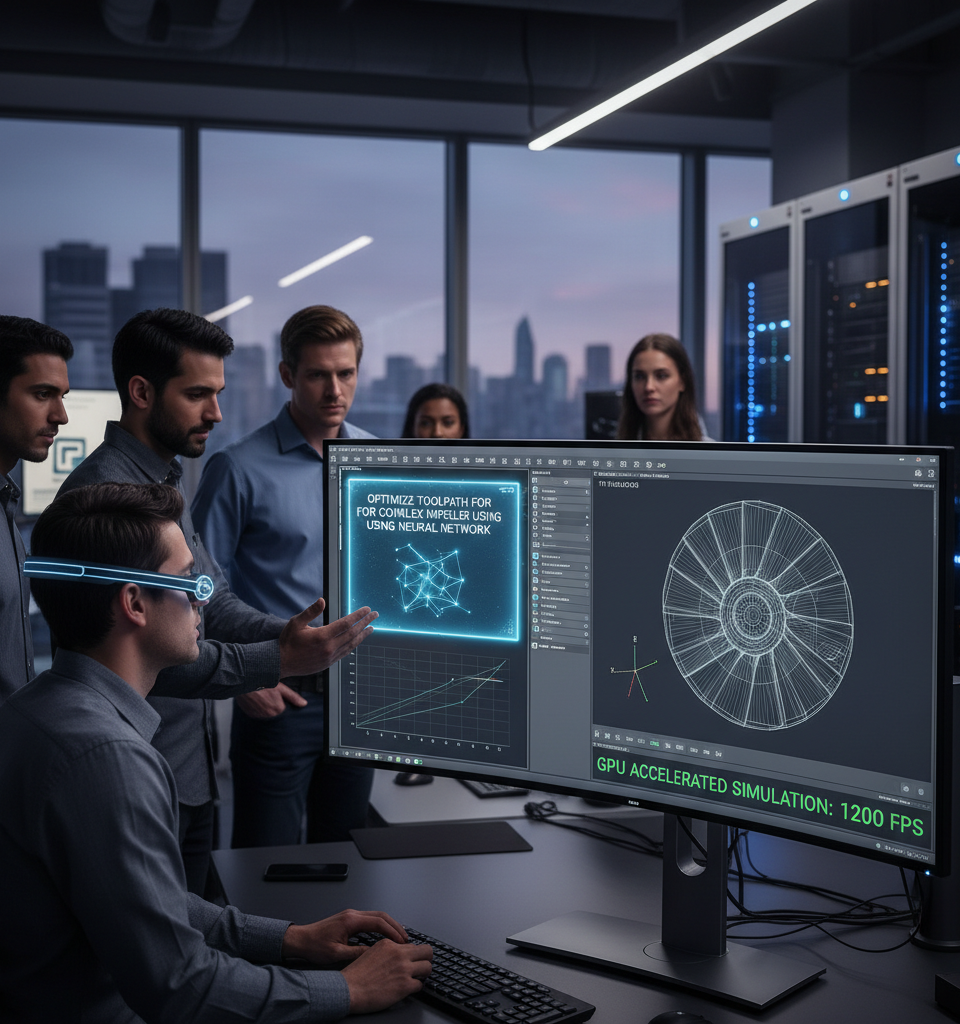
The manufacturing sector is poised for a significant efficiency boost following the recent unveiling of Mastercam's latest software incarnation, which integrates sophisticated artificial intelligence (AI) and GPU-accelerated simulation into its Computer-Aided Manufacturing (CAM) programming suite. This strategic enhancement, designed to streamline machine tool programming, allows users to intuitively adjust feeds and speeds via voice or text commands while simultaneously leveraging high-resolution, rapid verification through advanced GPU simulations. The development promises to significantly reduce setup times, optimize toolpaths, and minimize errors, thereby driving greater productivity and precision across diverse manufacturing operations.
Context and Industry Evolution
For decades, CAM programming has been a critical yet often complex bottleneck in the manufacturing workflow. Traditional methods frequently involved extensive manual adjustments and iterative testing, consuming valuable time and resources. The demand for faster product development cycles, coupled with increasing complexity in part designs, has intensified the pressure on manufacturers to adopt more agile and intelligent solutions. This update from Mastercam, a dominant player in the CAM software market, arrives at a pivotal moment, addressing these industry pain points head-on. It represents a natural progression in the integration of advanced computational power, moving beyond mere automation to intelligent process optimization.
Key Technological Advancements
Central to this release are two powerful technological pillars: AI-driven parameter adjustment and GPU-based simulation. The AI functionality, accessible through natural language processing (NLP), empowers machinists to interact with the software using simple voice or text commands, instructing it to fine-tune critical machining parameters such as feed rates and spindle speeds. This intuitive interface democratizes complex optimization, making it accessible to a broader range of operators.
Concurrently, the integration of Graphics Processing Unit (GPU) technology dramatically accelerates simulation and verification processes. Unlike traditional CPU-bound simulations that can be time-consuming and lack visual fidelity, GPU acceleration enables near real-time, high-resolution visualization of toolpaths and material removal. This allows for immediate identification of potential collisions, inefficiencies, or surface finish issues, significantly compressing the verification cycle.
Impact on the Manufacturing Landscape
This technological convergence is set to have a profound impact on the manufacturing landscape. For small-to-medium enterprises (SMEs), the reduced cycle times and enhanced precision could translate into substantial cost savings and increased competitiveness. Larger corporations stand to benefit from mass customization capabilities and streamlined production lines. The ability to quickly iterate and verify complex machining strategies will foster greater innovation in product design and material utilization. Furthermore, by making CAM programming more intuitive, the software could help bridge the skilled labor gap in the manufacturing sector, allowing newer generations of technicians to more rapidly gain proficiency.
Expert Perspectives
Industry analysts are quick to commend Mastercam's strategic direction. Dr. Alistair Finch, a senior analyst at Manufacturing Tech Insights, stated, "This release from Mastercam isn't just an incremental update; it's a paradigm shift in how CAM programming can be approached. The blend of accessible AI for parameter optimization and the visual fidelity of GPU simulation positions manufacturers to achieve unprecedented levels of efficiency and quality. We anticipate a measurable reduction in scrap rates and significant improvements in machine uptime across facilities that adopt this technology." He added that the focus on user interaction through voice and text commands also points towards a future of more human-centric manufacturing interfaces.
Future Implications and Developments
Looking ahead, these advancements lay the groundwork for even more sophisticated integrations. The continuous learning capabilities of AI could lead to even more predictive and adaptive CAM systems, where the software not only optimizes current operations but also anticipates future challenges based on historical data. Further developments could include tighter integration with digital twin technologies, real-time feedback from machine sensors to dynamically adjust programs, and enhanced collaboration tools for geographically dispersed teams. As computing power continues to advance, the potential for zero-defect manufacturing through intelligent, self-optimizing CAM systems moves closer to reality, promising an exhilarating future for precision engineering and production efficiency.