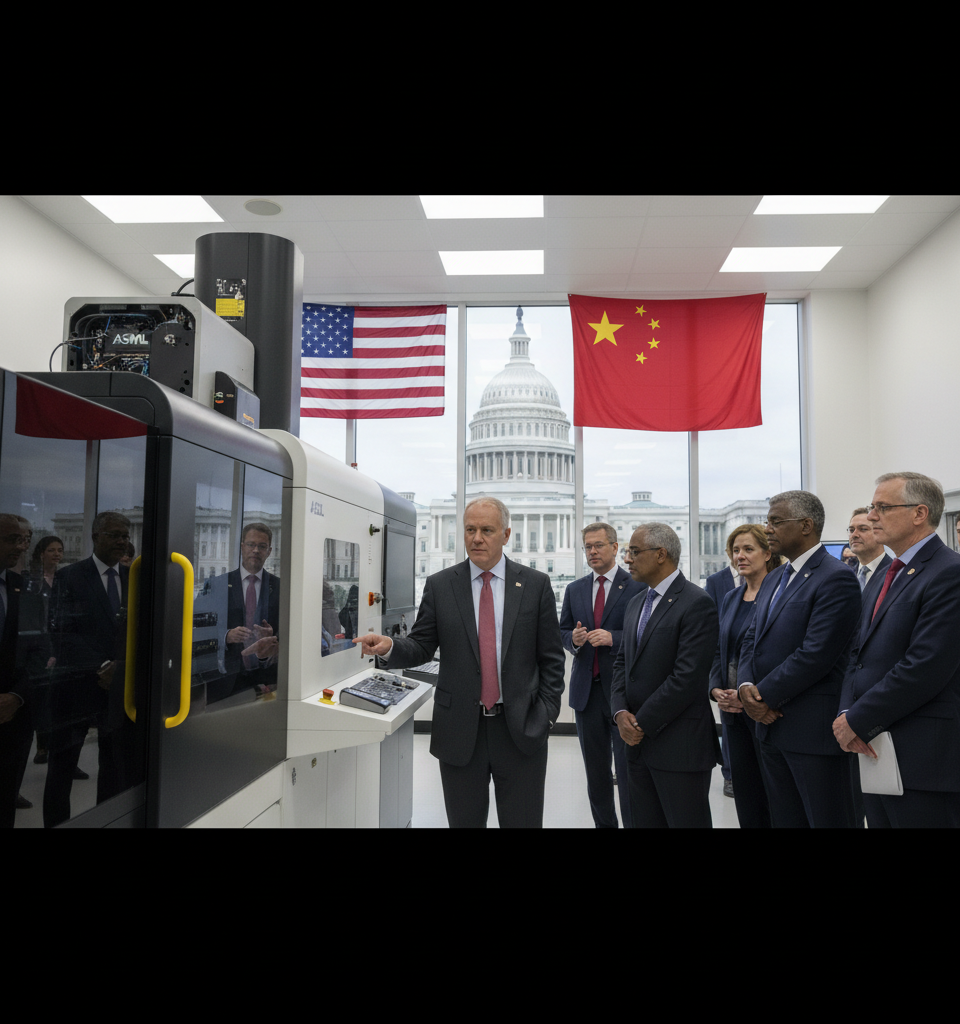
Washington D.C. – A new bipartisan legislative proposal, the 'Maintaining American Leadership in Semiconductors' (MATCH) Act, is poised to dramatically expand US jurisdiction over the export of advanced chipmaking technology, placing Dutch lithography giant ASML Holding N.V. squarely in its crosshairs. The proposed act seeks to codify and strengthen existing US efforts to curtail China's access to cutting-edge semiconductor manufacturing equipment, particularly ASML's highly coveted ultraviolet (EUV) and deep ultraviolet (DUV) immersion lithography systems. This legislative offensive, spearheaded by key figures in Congress, marks a significant escalation in the ongoing technological competition between the United States and China, with potentially far-reaching implications for global semiconductor supply chains and the future of international trade.
The Geopolitical Chessboard: Why This Matters
This legislative move isn't merely about trade; it's a critical maneuver in the geopolitical chess game for technological dominance. Semiconductors are the bedrock of modern economies and national security, powering everything from smartphones and AI to advanced weaponry. The US, recognizing China's ambition for self-sufficiency in chip production, has progressively implemented measures to slow its progress, citing national security concerns. ASML, as the sole producer of EUV lithography machines essential for manufacturing the most advanced chips, and a dominant player in DUV systems, holds a uniquely powerful position. The MATCH Act aims to ensure that US policy, rather than Dutch or European Union regulations alone, dictates where ASML's advanced machinery can be sold, particularly concerning China.
Key Legislative Provisions and Their Reach
The MATCH Act seeks to explicitly define US jurisdiction over foreign-made equipment containing a certain threshold of US technology or intellectual property. While the precise percentage is subject to debate and negotiation, the intent is to ensnare ASML's sophisticated DUV immersion systems – which incorporate significant American components and patents – under US export control regulations. Currently, ASML has been barred by the Dutch government, under US pressure, from selling its most advanced EUV machines to China. However, sales of some DUV systems to Chinese foundries have continued, albeit under increasing scrutiny. The MATCH Act would empower the US Commerce Department to unilaterally block these DUV sales if they are deemed to pose a national security risk, irrespective of Dutch government approval. Sources suggest the act could mandate a broader interpretation of 'US person' involvement and technology thresholds, making it harder for companies like ASML to circumvent restrictions.
Broadening Industry and Market Impact
An expansion of US export controls, particularly to ASML's DUV systems, would send shockwaves through the global semiconductor industry. Chinese chip manufacturers, already facing hurdles in upgrading their fabs, would see their access to crucial equipment severely limited, potentially stalling their progress in mature node production. This could consolidate the manufacturing lead of Taiwan's TSMC and South Korea's Samsung in the short term, but also accelerate China's efforts to develop indigenous alternatives, albeit at a significant cost and over a longer timeframe. For ASML, China represents a substantial market, accounting for approximately 15% of its revenue in 2023, totaling over €3 billion. Restricting these sales could impact ASML's revenue forecasts, production schedules, and potentially compel further diversification of its customer base.
Analyst Perspectives on ASML's Dilemma
Industry analysts are closely watching the legislative progress, with many forecasting increased friction between diplomatic and commercial interests. "The MATCH Act is a clear signal that the US intends to harden its technology export policies, potentially forcing ASML into an even tighter geopolitical corner," noted a senior analyst at a prominent financial institution. "While ASML has consistently emphasized its compliance with all relevant laws, the expansion of US extraterritorial reach puts the company in a difficult position, balancing sovereign Dutch interests with the commercial realities of its significant US supply chain dependencies." Others highlight the risk of a retaliatory response from Beijing, potentially impacting other Western technology firms operating in China.
What's Next: Legislative Path and Global Repercussions
The MATCH Act is currently navigating the congressional committee process, with proponents aiming for swift passage. If enacted, its implementation would require detailed rule-making by the US Commerce Department, which would specify the precise scope and enforcement mechanisms. This legislative battle underscores the delicate balance companies like ASML must maintain between national interests, commercial imperatives, and the complex web of global supply chains. The outcome will not only redefine the future of semiconductor trade but also serve as a critical test of the efficacy of unilateral export controls in an increasingly interconnected global economy, potentially paving the way for similar legislation targeting other high-tech sectors.
The Unintended Consequences of Decoupling
While the immediate goal of the MATCH Act is to hobble China's advanced chip ambitions, critics warn of potential unintended consequences. A drastic reduction in chip equipment sales to China could accelerate Beijing's domestic semiconductor development programs, albeit at potentially lower efficiencies, leading to a fragmented global ecosystem. This 'decoupling' could result in higher costs for consumers worldwide due to less efficient supply chains and reduce the overall pace of technological innovation by limiting cross-border collaboration. Furthermore, it risks alienating key allies like the Netherlands, who may view such extraterritorial legislation as an infringement on their sovereignty and economic interests, potentially straining trans-Atlantic relations at a time when Western unity is paramount.
ASML's Strategic Pivots Amidst Uncertainty
In anticipation of or response to such legislative pressures, ASML has already been exploring strategies to mitigate risks. This includes diversifying its supply chain away from heavily concentrated regions and investing in R&D to maintain its technological lead, making it indispensable even to nations seeking self-sufficiency. The company's statements have consistently emphasized its commitment to navigating the complex geopolitical landscape while upholding its business objectives and legal obligations. The passing of the MATCH Act would undoubtedly necessitate further strategic adjustments, potentially accelerating its investment in non-Chinese markets and fostering closer ties with other allied nations seeking to bolster their domestic chip production capabilities.