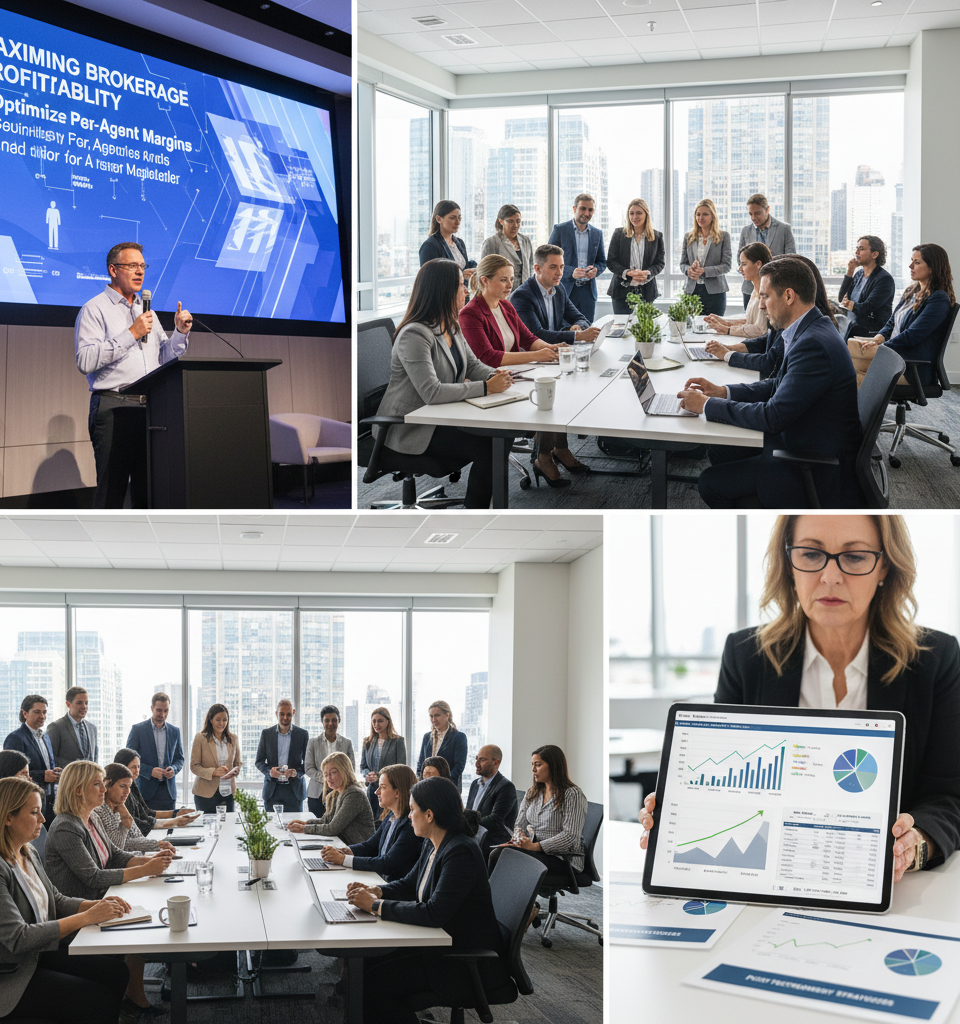
Maximizing Brokerage Profitability: Strategies for Optimizing Per-Agent Margins Post-Recruitment
Joe Killinger•April 23, 2026•4 min read
Key Takeaways
Read this first — then go as deep as you need.
Brokerage Owners Pivot to Profit: Unlocking Per-Agent Margins New York, NY – As the real estate industry continues to navigate fluctuating market dynamics, brokerage owners are increasingly shifting their strategic focus from aggressive agent recruitment to the crucial, yet often overlooked, optimization of per-agent profitability. Industry luminary Joe Killinger, a seasoned voice in real estate consulting, recently highlighted this pivotal transition, asserting that once a robust agent roster is established, the imperative becomes maximizing the financial contribution of each individual. This strategic reorientation is not merely about cost-cutting but involves a multifaceted approach to enhancing revenue generation and operational efficiency, promising a significant uplift in a brokerage's bottom line. The renewed emphasis on per-agent margins arrives at a time when thinning profit margins and escalating operational costs are pressuring brokerage firms across the nation. For years, the real estate brokerage model has often prioritized raw agent count, believing that a larger sales force inherently translates to greater market share and revenue. However, a closer look at profitability metrics reveals that a high agent count, without corresponding productivity and efficient support structures, can lead to diluted earnings and increased overhead. Killinger's insights underscore a broader industry maturation, where sustainable growth is now defined by efficiency and strategic investment in agent success, rather than mere numbers. Key strategies for improving per-agent margins, as advocated by Killinger and other industry experts, encompass several critical areas. Firstly, investing in advanced technology platforms, such as AI-powered lead generation systems and comprehensive CRM software, can significantly boost agent productivity and conversion rates. "Brokers need to provide their agents with tools that genuinely make them more effective, not just busier," Killinger stated in a recent interview. Secondly, a refined commission structure that rewards higher performance and promotes a tiered support system can incentivize agents to achieve more. Furthermore, offering value-added services, such as in-house marketing support, professional development courses, and transaction coordination, allows brokerages to command a greater share of the agent's commission or levy service fees, transforming cost centers into revenue generators. The potential impact on the broader real estate landscape is substantial. Brokerages that successfully implement these margin-optimizing strategies are likely to gain a significant competitive advantage. They will be better positioned to attract top-tier talent seeking environments that offer robust support and higher earning potential, creating a virtuous cycle of productivity and profitability. Conversely, firms that fail to adapt risk stagnation, agent attrition to more progressive brokerages, and ultimately, a decline in market relevance. This strategic pivot could catalyze a market correction, favoring brokerages that prioritize operational excellence and agent empowerment over brute-force recruitment. Industry analysts and financial experts largely concur with Killinger's perspective. "The days of 'stack 'em high, watch 'em fly' are dissipating," notes Dr. Sarah Jenkins, a real estate economist at Global Market Analytics. "We're seeing a clear trend towards quality over quantity. Brokerages are realizing that a highly productive, well-supported agent force of 50 can outperform a poorly managed team of 100, both in terms of market share and net profit." Data from the National Association of Realtors indicates that top-performing agents often contribute upwards of 20-25% of a brokerage's total revenue, highlighting the disproportionate impact of high achievers. Looking ahead, the emphasis on per-agent margin optimization is expected to drive several key developments. We anticipate a surge in demand for real estate technology solutions focused on agent productivity, lead conversion, and seamless transaction management. Brokerages will likely invest more heavily in robust training and mentorship programs, viewing these not as costs but as direct investments in agent profitability. Furthermore, the industry may see a consolidation of smaller brokerages unable to meet the high operational standards and support infrastructure required to thrive in this new paradigm. The competitive landscape will demand continuous innovation and a data-driven approach to agent management and financial strategy. Ultimately, the journey from successful recruitment to sustained per-agent profitability requires a holistic and analytical approach. Brokerage owners must move beyond simple headcount metrics and delve into the granular details of agent performance, contribution to overhead, and the efficacy of support systems. By strategically adjusting commission models, investing in impactful technology, and fostering a culture of high performance, brokerages can transform their operational models into engines of enduring financial success, ensuring not just survival, but true prosperity in an evolving market.
Discussion
Join the discussion
Sign in to leave a comment on this article.
Loading comments...
Enjoying this article?
Get more like it delivered to your inbox — free.
This article was compiled by GlobalSell News from publicly available reporting and has been edited for clarity and length. For full details, read the original source.