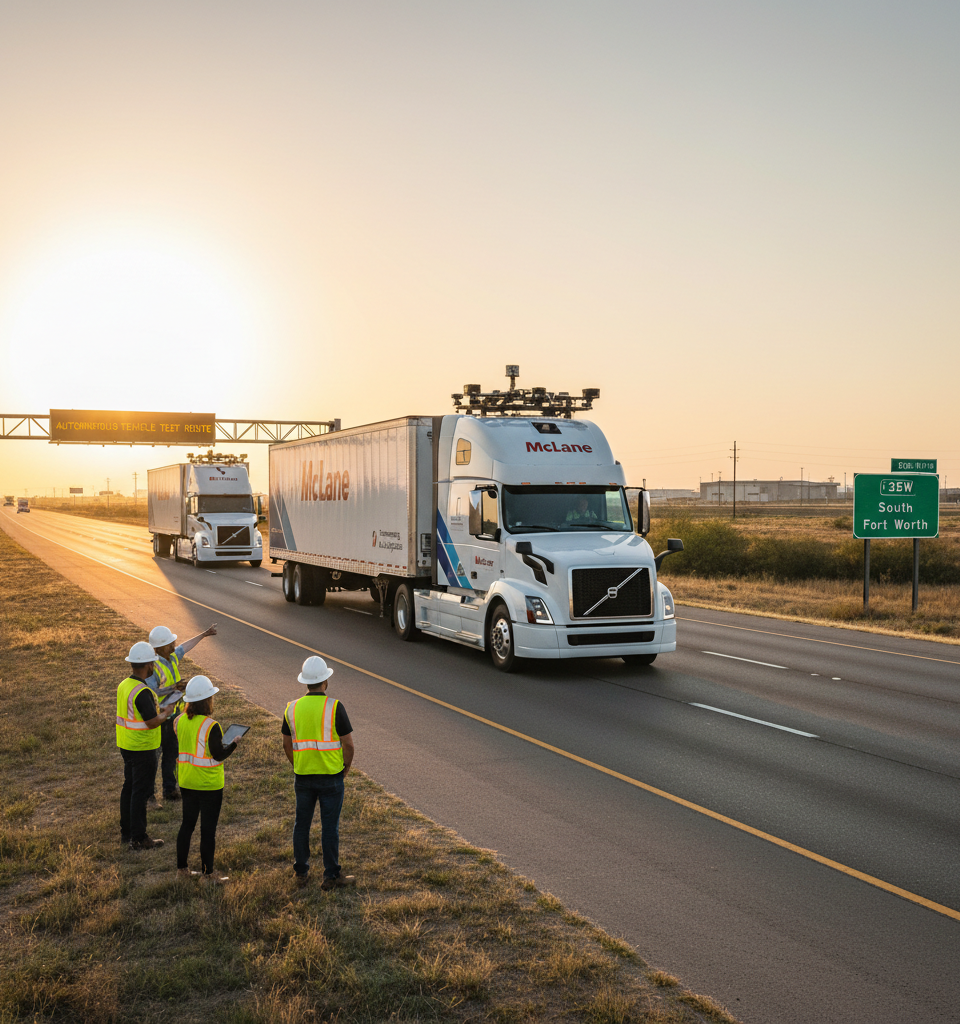
McLane Company, Inc., a leading supply chain services company, and Aurora Innovation, Inc., a prominent autonomous vehicle technology developer, have initiated autonomous commercial freight hauling between Dallas and Fort Worth, Texas. This launch follows a successful two-year pilot program that saw autonomous Aurora Driver-powered trucks complete over 280,000 miles with a perfect 100% on-time delivery record. Concurrently, Aurora and Volvo Autonomous Solutions have extended their driverless truck route by 200 miles, connecting Fort Worth, Texas, to Oklahoma City, Oklahoma, further solidifying the trajectory of autonomous logistics in the North American transportation sector.
Context and Background
The move towards autonomous trucking is driven by several factors, including a persistent shortage of human truck drivers, rising operational costs, and the demand for enhanced safety and efficiency in freight transportation. The trucking industry, a backbone of the U.S. economy, faces an ongoing challenge to meet growing logistical demands. Companies like Aurora are leveraging advanced AI and sensor technology to develop systems capable of navigating complex highway environments, aiming to alleviate these pressures. The collaboration between McLane and Aurora began in 2021, focusing on integrating autonomous technology into McLane’s demanding 24/7 logistics network. This partnership highlights a proactive approach by traditional logistics giants to adopt innovative solutions.
Key Details and Pilot Success
The fully autonomous commercial hauls for McLane are ferrying auto parts and consumer staples multiple times a week. The pilot program, which spanned two years, demonstrated the reliability and efficiency of the Aurora Driver. The trucks, operating without human safety drivers on board during commercial runs, maintained an impeccable 100% on-time delivery rate, an impressive feat in high-stakes logistics. This success underscores the maturity of Aurora’s technology and the operational readiness for widespread deployment. The expansion of the Volvo autonomous route to Oklahoma City adds a crucial 200 miles to the network, increasing the geographic scope and economic impact of these driverless operations.
Industry and Market Impact
These developments represent a significant step change for the trucking industry. The commercial deployment of autonomous trucks by a major logistics player like McLane, coupled with route expansion, signals a growing confidence in the technology’s viability and an acceleration toward industry-wide adoption. The American Trucking Associations (ATA) projects that the industry will face a shortage of over 160,000 drivers by 2030. Autonomous technology offers a potential solution to this critical labor gap, allowing human drivers to focus on shorter, more complex local routes, while autonomous trucks handle the long-haul, repetitive highway segments. This phased integration could optimize asset utilization, reduce fuel consumption through more consistent driving patterns, and potentially lower accident rates attributed to human error or fatigue.
Expert Perspective
Industry analysts view these milestones as pivotal in the journey toward mainstream autonomous freight. Dr. Ken Washington, CEO of the Automated Vehicle Safety Consortium, noted recently, "The robust testing and validation from pilots like McLane's are essential for building public trust and regulatory confidence in autonomous systems." Analysts at Morgan Stanley project that the autonomous trucking market could reach $120 billion by 2040, driven by efficiency gains and a compelling return on investment for fleet operators. The successful transition from piloted operations to fully driverless commercial runs, particularly with a 100% on-time record, is a strong indicator of the technology's readiness and competitive advantage.
What's Next
The immediate future will likely see further expansion of commercial routes and an increase in the frequency of autonomous hauls. Aurora and Volvo Autonomous Solutions are expected to continue scaling their operations, potentially adding more lanes and customers as the technology proves its economic benefits. Regulatory frameworks will also play a crucial role, with states like Texas and Oklahoma proving to be forward-thinking in their approach to autonomous vehicle legislation. This trend could encourage other states to follow suit, creating a more cohesive national network for driverless logistics. The ongoing collection of millions of miles of operational data will be critical for continuous improvement of the Aurora Driver, enhancing its capabilities in diverse weather conditions and traffic scenarios, paving the way for a more integrated autonomous logistics ecosystem.