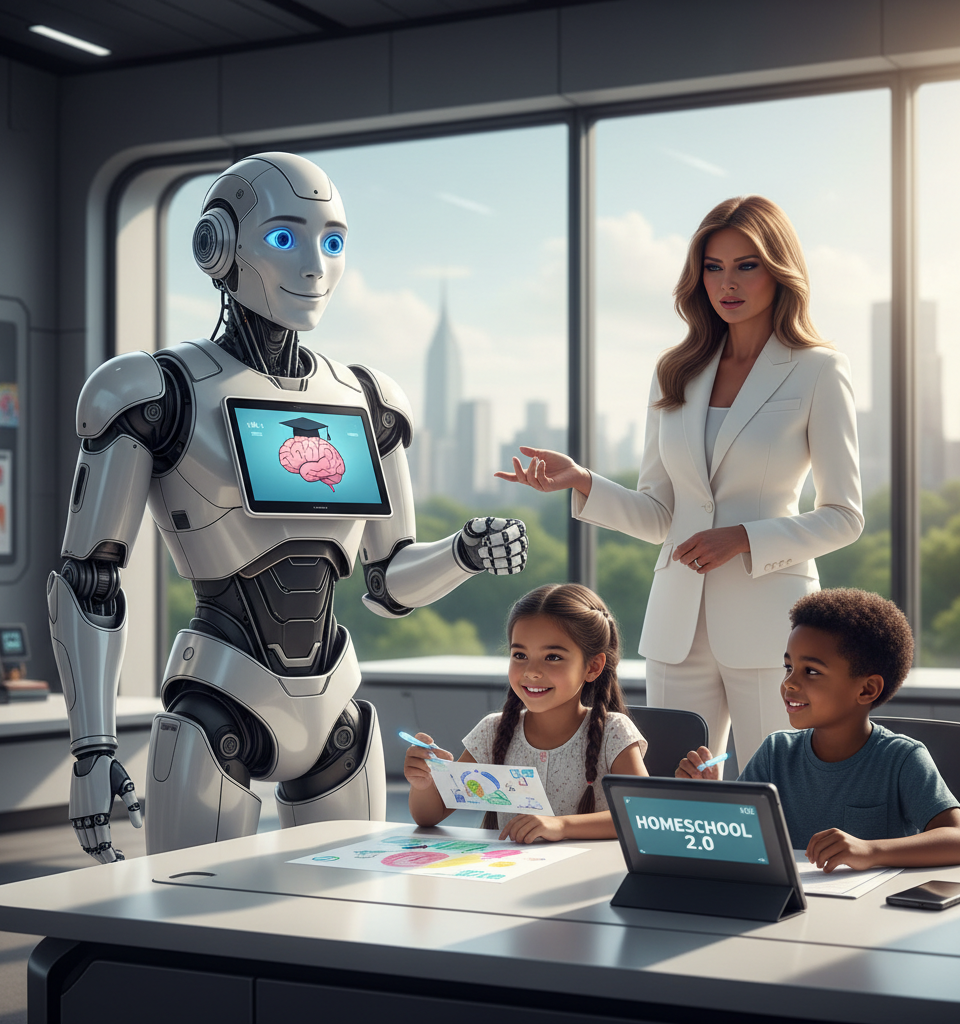
Former First Lady Melania Trump has made a noteworthy public statement advocating for the substantial integration of artificial intelligence (AI) and robotics within the American education system. Her vision, articulated in a recent public address, posits a future where AI tutors play a transformative role, potentially reshaping both conventional classroom instruction and the burgeoning homeschooling landscape across the nation. This high-profile endorsement is anticipated to spark an intense and wide-ranging debate among K-12 educators, higher education institutions, technology developers, and parents regarding the ethical, pedagogical, and practical implications of such advanced technological adoption.
Context and Significance: A New Era for EdTech
Mrs. Trump's pronouncement arrives at a critical juncture, as the global educational technology (EdTech) market continues its rapid expansion, projected to reach over $400 billion by 2026, with AI-driven learning tools forming a significant growth segment. The past decade has seen a gradual increase in technology integration in schools, propelled by initiatives addressing digital literacy and personalized learning. However, the concept of widespread AI tutors, particularly for homeschooling, represents a more radical departure from traditional methods. This initiative draws parallels to past educational reforms attempting to leverage technology, yet distinguishes itself by championing autonomous, intelligent agents designed to deliver personalized instruction, assessment, and even emotional support in a learning environment.
Key Details of the Proposal and its Potential Scope
While specific policy details remain to be fully elaborated, sources close to Mrs. Trump indicate that her vision encompasses AI frameworks capable of adapting to individual student learning styles, identifying knowledge gaps in real-time, and deploying tailored instructional content. This approach aims to address the persistent challenge of varied learning paces and needs within diverse student populations. For homeschooling families, this implies access to sophisticated, on-demand academic support that could potentially alleviate some of the burdens of curriculum development and individualized teaching often faced by parents. The proposal reportedly includes a focus on Natural Language Processing (NLP) technologies to enable conversational AI tutors, and robotic platforms for interactive, hands-on learning experiences, especially in STEM fields. Early estimates suggest that a phased national rollout could require an initial investment of several billion dollars for infrastructure, content development, and teacher training.
Industry Impact and Market Disruption
The implications for the EdTech industry are profound. Such an endorsement from a figure with national recognition could serve as a powerful catalyst, driving accelerated investment and innovation in AI-powered learning solutions. Companies specializing in adaptive learning platforms, educational robotics, and AI content generation stand to benefit significantly. Traditional textbook publishers and educational software providers may face pressure to pivot their strategies, integrating AI functionalities and data analytics to remain competitive. Furthermore, the burgeoning market for AI-driven educational professional development for teachers – a workforce currently estimated at 3.5 million public school teachers in the U.S. – would see substantial growth as educators adapt to new pedagogical paradigms alongside AI assistants.
Expert Perspectives: Opportunities and Challenges
Educational experts and technologists are offering a mixed, albeit cautious, reception. Dr. Anya Sharma, a leading researcher in AI in education from Stanford University, notes, "The potential for AI to personalize education on an unprecedented scale is undeniable. Imagine a system that truly understands a student's cognitive map and provides surgical interventions. However, concerns regarding data privacy, algorithmic bias, and the potential erosion of human-teacher interaction are significant and must be meticulously addressed well in advance of widespread deployment." Conversely, Dr. Mark Henderson, CEO of Futura EdTech, comments, "This proactive embrace of AI is exactly what American education needs to prepare students for the 21st-century economy. We've seen a 15-20% improvement in learning outcomes in pilot programs utilizing advanced AI tutors for specific subjects like mathematics."
The Path Ahead: Pilot Programs and Public Dialogue
The immediate future is likely to involve a series of pilot programs, potentially in select school districts or homeschooling cooperatives, designed to test the efficacy and address the practical challenges of this ambitious vision. These pilots will be crucial for gathering empirical data on student engagement, academic performance, and the psychological impact of AI-driven learning. Concurrently, a significant public dialogue is anticipated, involving parents, educators, civil liberties advocates, and technology ethicists. Key debates will center on funding mechanisms, teacher retraining initiatives, equitable access to technology for underprivileged communities, and the critical question of maintaining human connection in a technologically mediated learning environment. The success of Melania Trump's advocated integration will hinge not only on technological prowess but also on careful societal deliberation and policy development.