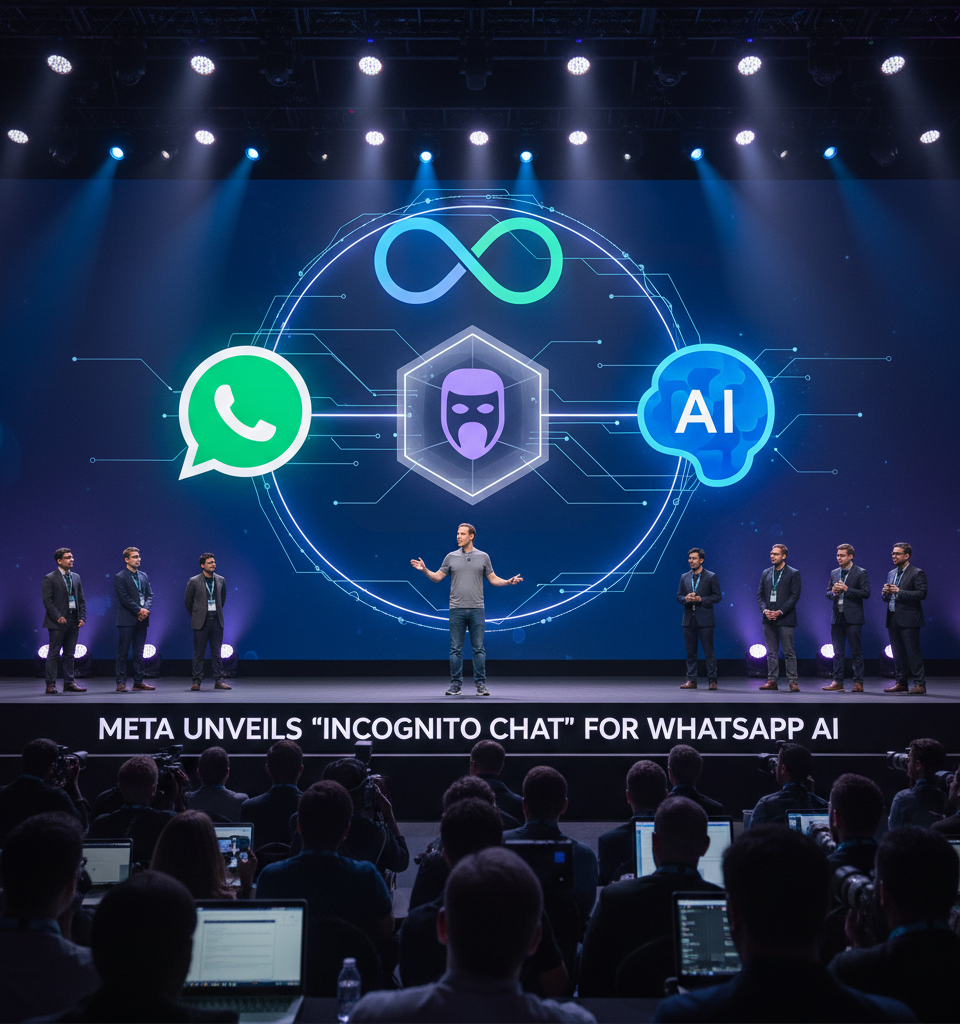
This week, Meta Platforms rolled out a groundbreaking 'Incognito Chat' mode for its Meta AI assistant, integrated across WhatsApp and the standalone Meta AI application. This innovative feature, designed to address mounting user privacy concerns, promises a level of data confidentiality unprecedented in conversational AI. Conversations conducted in this mode are processed within Meta's secure Private Processing enclave, automatically deleted upon session conclusion, and leave no retrievable server-side record, effectively positioning it as the industry's first "even Meta cannot read" AI interaction method.
The launch of Incognito Chat is a strategic maneuver by Meta to differentiate its AI offerings in an increasingly competitive and privacy-conscious technological landscape. As artificial intelligence becomes more ubiquitous, so too do questions about data handling, user surveillance, and the potential for misuse of personal information. Traditional AI assistants, by their very design, often require extensive data collection and retention to learn and personalize user experiences. Meta's new mode directly challenges this paradigm, aiming to build trust by guaranteeing ephemeral interactions. This move also implicitly acknowledges the public's growing skepticism towards large tech companies' data practices, particularly as regulatory bodies worldwide impose stricter data protection laws like GDPR and CCPA.
Key to the Incognito Chat's functionality is Meta's Private Processing enclave technology. This secure computational environment isolates user data during AI interactions, preventing it from being accessed or stored outside the session. Crucially, the system is engineered so that Meta itself, or any of its employees, cannot access the content of these private conversations. By operating on a "deleted by default" principle and eschewing server-side logging, Meta aims to offer a truly private AI experience, contrasting sharply with many existing AI models that use user interactions for ongoing training and improvement. This technical underpinning is a direct answer to the "awkward fact" that most major AI assistants inevitably retain some form of user data.
From an industry perspective, Meta's Incognito Chat could set a new benchmark for privacy in AI. While end-to-end encryption has become standard for messaging platforms like WhatsApp, extending this privacy guarantee to AI interactions is a novel and potentially disruptive development. Competitors such as Google, Microsoft, and OpenAI, whose AI models (e.g., Gemini, Copilot, ChatGPT) typically retain user inputs for iterative learning, may face pressure to introduce similar privacy-enhancing features. This could lead to a broader industry shift towards more ephemeral and private AI interactions, moving beyond mere anonymization to true data deletion and non-retention.
Industry analysts have largely welcomed Meta's initiative, viewing it as a proactive step towards rebuilding user trust. Dr. Anya Sharma, a leading AI ethics researcher, commented, "Meta's Incognito Chat addresses a critical vulnerability in the current AI ecosystem. By prioritizing user privacy at an architectural level, they are not only innovating technologically but also setting a precedent for ethical AI development. The challenge now lies in effectively communicating this complex technical security to the average user." Others suggest this move could appeal particularly to enterprises and individuals handling sensitive information, opening new avenues for AI adoption in regulated industries.
The future implications of Incognito Chat are substantial. If widely adopted and proven effective, it could accelerate the integration of AI into highly sensitive applications, from personal finance discussions to healthcare consultations, where data confidentiality is paramount. Meta has indicated that this is just the beginning of its privacy-centric AI initiatives, suggesting further enhancements and integrations are on the horizon. The success of Incognito Chat will likely depend on Meta's ability to maintain its technical assurances, withstand potential external pressures for data access, and educate users about the true extent of this privacy guarantee. This development signals a potential paradigm shift, where AI's utility no longer inherently conflicts with fundamental privacy rights, paving the way for a more secure and trusted AI future.