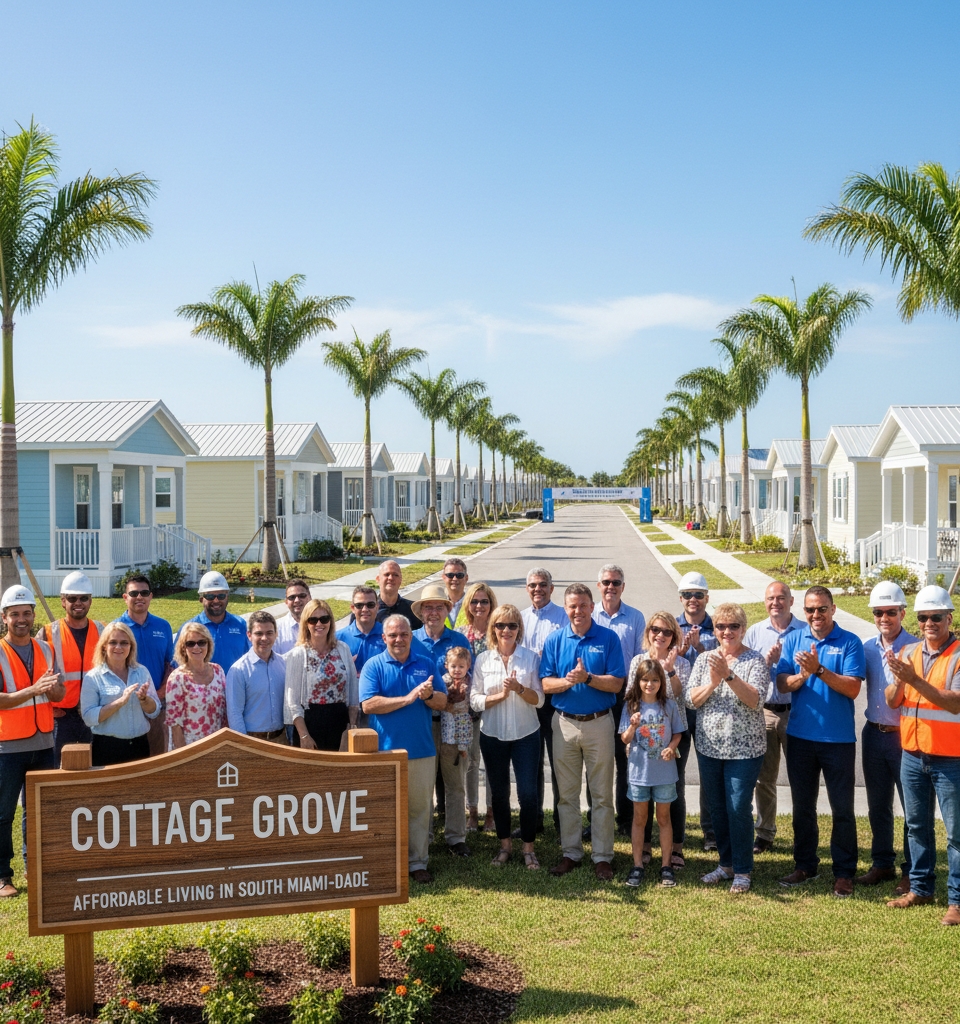
In a significant development for South Florida’s housing market, Cottage Grove, a new manufactured home community comprising 349 single-family residences, has officially opened its doors in South Miami-Dade County. This marks the first new community of its kind in the Miami area in decades, offering a crucial pathway to homeownership for residents facing soaring housing costs. With prices beginning at an accessible $129,900, the project is poised to alleviate some of the pressure in one of the nation's least affordable metropolitan areas.
Addressing South Florida's Housing Crisis
The launch of Cottage Grove arrives at a critical juncture for Miami-Dade County, a region grappling with an acute housing affordability crisis. The median home price in Miami-Dade consistently ranks among the highest nationally, pushing homeownership out of reach for many working-class families and essential service providers. The scarcity of new, entry-level housing options has exacerbated this issue, creating intense competition for existing properties. This new community directly addresses the void, showcasing manufactured homes as a viable, high-quality, and cost-effective alternative to traditional site-built residences, which have become increasingly expensive to construct and acquire in the dense urban and suburban corridors of South Florida.
Community Features and Affordability
Cottage Grove is designed to blend affordability with modern living. Each of the 349 single-family homes will feature contemporary designs and amenities, catering to diverse family needs. The starting price of $129,900 is remarkably competitive, especially when juxtaposed against the median home price in Miami-Dade County, which hovers significantly higher—often exceeding $500,000 for traditional homes.
While specific square footage details were not immediately released, the focus is on providing efficient, well-designed living spaces within a planned community environment. Future residents can anticipate a range of community amenities, which often include common areas, recreational facilities, and green spaces, fostering a sense of community among homeowners. The development represents a collaborative effort aiming to deliver quality housing at a scale needed to make a substantial impact.
Impact on the Regional Housing Market
The introduction of Cottage Grove is expected to have a notable impact on the broader South Florida housing market. By adding 349 units to the inventory at a significantly lower price point, it could help to temper the relentless upward pressure on home prices in the region. This influx of affordable housing options could also free up existing rental stock, indirectly benefiting renters as well. Furthermore, it challenges long-held preconceptions about manufactured homes, positioning them as an integral, modern component of the housing solution. Developers and policymakers will closely watch the success of Cottage Grove as a potential blueprint for similar projects in other high-cost-of-living areas across the state.
Expert Perspectives on Manufactured Housing
Housing analysts and economists generally welcome such developments, emphasizing the critical role new manufactured home communities can play in alleviating housing shortages. "Manufactured housing has evolved significantly, offering durable, energy-efficient, and aesthetically pleasing homes that can be built faster and at a lower cost than traditional construction," stated Dr. Elena Rodriguez, a housing market expert at the University of Miami.
She added, "Projects like Cottage Grove are essential for creating diverse housing options and preventing our communities from becoming exclusive enclaves for the wealthy. " The reduced construction time and controlled environment of factory production contribute to significant cost savings, which are then passed on to the buyer, making homeownership attainable for a broader segment of the population.
Future Implications and Development Trends
The successful launch of Cottage Grove could catalyze a renewed interest in manufactured home communities across South Florida and potentially beyond. It may encourage other developers to explore this housing model as a viable strategy to meet demand, especially given the rising costs of land, labor, and materials for traditional construction. Future developments may see increased integration of smart home technology, sustainable building practices, and enhanced community facilities within manufactured home communities.
The long-term implications include a more diversified housing stock, potentially greater economic stability for residents through homeownership, and a template for addressing similar housing challenges in other rapidly growing urban centers. The project is a testament to innovative approaches in housing and underscores a shift in how affordable homeownership is being redefined in the 21st century. Its performance will be closely watched as a bellwether for future urban planning and housing policy decisions in the state.