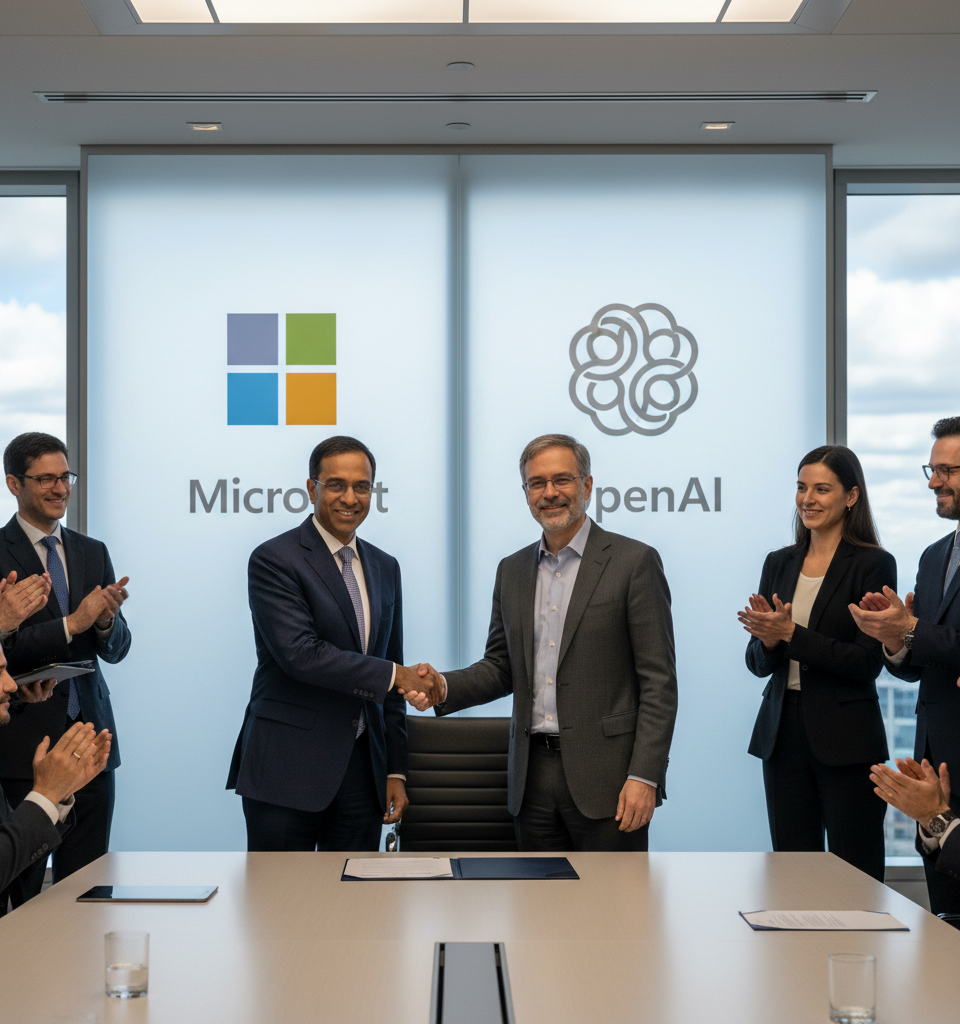
Microsoft and OpenAI officially announced a significant amendment to their long-standing partnership agreement on Monday, transforming Microsoft's previously exclusive licensing rights to OpenAI's intellectual property into a non-exclusive arrangement. This pivotal change, effective immediately, reconfigures how both entities will leverage OpenAI's cutting-edge artificial intelligence models while maintaining core aspects of their collaborative framework. The news was met with a modest dip in Microsoft's share price, reflecting investor reaction to the revised terms.
The Evolution of a Landmark Partnership
This revised agreement marks a notable evolution in one of the tech industry's most closely watched alliances. Initially lauded as a strategic coup for Microsoft, the exclusive licensing deal underscored the deep integration between the software giant and the leading AI research lab. The original partnership was instrumental in fueling OpenAI's computational needs, particularly for training large language models like GPT-4, and provided Microsoft with a competitive edge in integrating advanced AI into its product suite. The modification reflects a maturing relationship and potentially a broader strategic play by OpenAI to diversify its commercial avenues.
Key Details of the Revised Agreement Under the new terms,
Microsoft retains a non-exclusive license to OpenAI's intellectual property, which extends through 2032. Crucially, Microsoft will continue to serve as OpenAI's primary cloud partner, leveraging its Azure infrastructure for the AI developer's intensive computational demands. Furthermore, Microsoft's substantial 27% equity stake in OpenAI remains unchanged, solidifying its significant financial interest in the company's future success. In return, OpenAI will continue to pay Microsoft a share of its revenue through 2030, with this income stream subject to a pre-determined total cap. Following the announcement, Microsoft shares experienced a approximately 3% decline, indicating a market recalibration of the partnership's perceived value.
Industry and Market Implications
The shift to a non-exclusive license has broad implications for the burgeoning AI industry. For OpenAI, it opens doors to potential licensing agreements with other significant technology players, fostering a more diversified revenue stream and broadening the reach of its AI technologies. This could accelerate the adoption of OpenAI's models across a wider array of platforms and services, potentially intensifying competition within the AI ecosystem. For Microsoft, while losing exclusivity, the continued deep integration with Azure and its substantial equity stake mean it remains a pivotal player in OpenAI's development, albeit now sharing the spoils with potential future partners.
Expert Perspectives on the Strategic Move
Industry analysts are weighing in on the strategic rationale behind this high-profile revision. According to Sarah Chen, a senior analyst at Tech Insights Group, "This isn't necessarily a blow to Microsoft, but rather a strategic decoupling that allows OpenAI more operational flexibility and market penetration. Microsoft's retained primary cloud partnership and significant equity stake ensure they still benefit immensely from OpenAI's growth, even without exclusivity. It's a pragmatic adjustment reflecting the rapid evolution of the AI market." Other experts suggest that the move could also be a proactive measure by OpenAI to address potential antitrust concerns by demonstrating a more open approach to its technology licensing.
Future Outlook and Upcoming Developments
The revised agreement sets the stage for a new phase in AI innovation and commercialization. OpenAI is now poised to explore a wider range of partnerships, potentially accelerating the development and deployment of its advanced AI models in new sectors. For Microsoft, the focus will likely shift to leveraging its non-exclusive access to enhance its own product offerings, ensuring it remains at the forefront of AI integration. Investors will be keenly watching how OpenAI utilizes its newfound commercial freedom and how Microsoft navigates the increasingly competitive AI landscape with its redefined, yet still substantial, stake in the future of artificial intelligence. Further licensing announcements from OpenAI with other major entities could be anticipated in the coming months, shaping the next chapter of the AI revolution.