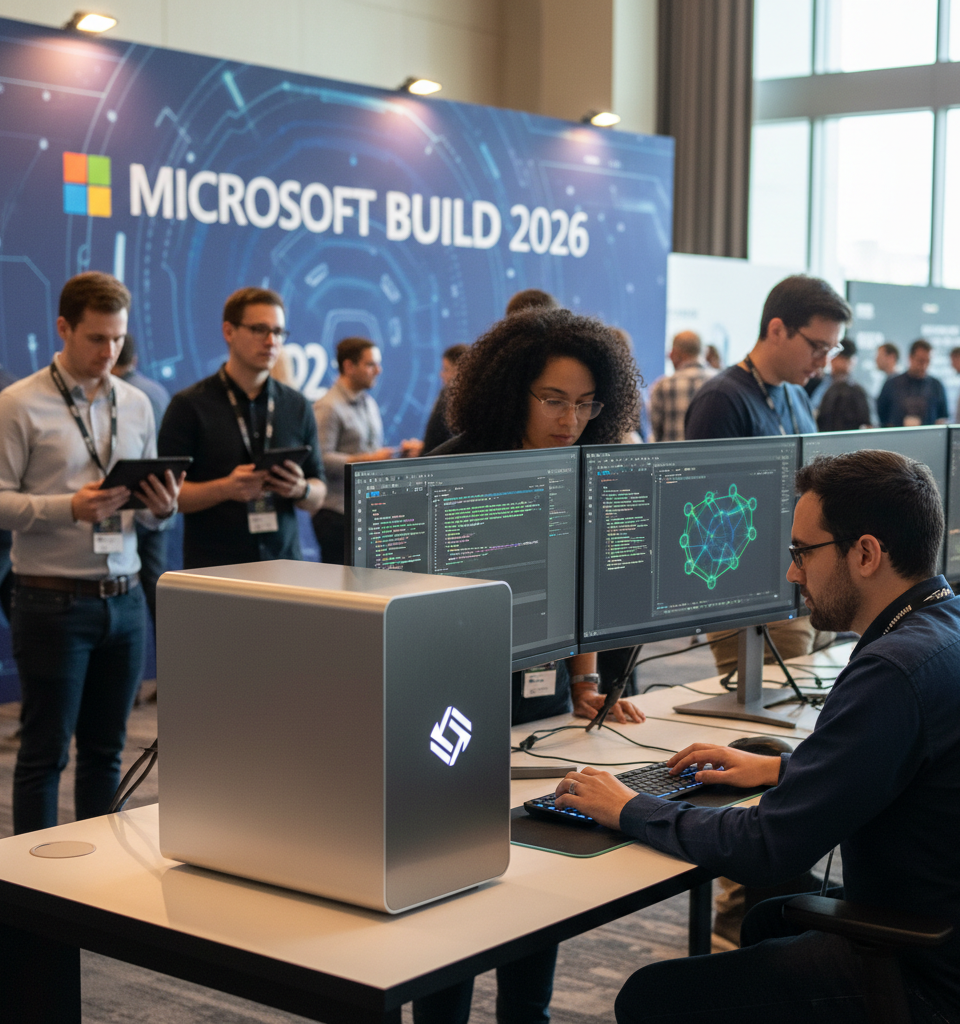
Redmond, Washington — Microsoft on Monday unveiled a significant new hardware offering, the Surface RTX Spark Dev Box, positioning it as a potential disruptor to the prevailing economics of artificial intelligence development. The compact desktop computer, announced at the Microsoft Build 2026 conference, is engineered to empower software developers to execute large AI models directly from their workstations, thereby reducing reliance on costly cloud computing resources.
This strategic move by Microsoft directly challenges the per-token pricing structure that has largely defined the AI industry's economic model since the debut of ChatGPT approximately three and a half years ago. The introduction of local, high-performance AI processing hardware could fundamentally alter how developers approach model training, inference, and deployment, offering an alternative to continuous cloud subscription fees.
The Surface RTX Spark Dev Box comes equipped with formidable specifications designed for intense AI workloads. It notably incorporates Nvidia’s new Blackwell-architecture RTX Spark processor, a cutting-edge component expected to deliver substantial improvements in AI processing capabilities. Complementing this powerful CPU is a substantial 128 gigabytes of unified memory, a configuration optimized for handling the memory-intensive demands of large-scale AI models. This combination aims to provide the computational horsepower necessary for developers to locally manage complex AI tasks previously relegated to server farms or cloud platforms.
The implications of such a device for the broader AI and cloud computing industries are considerable. The per-token pricing model, while offering flexibility, has often led to unpredictable and escalating costs for developers and enterprises heavily leveraging AI. By enabling local execution, Microsoft is offering a pathway to potentially fixed-cost AI development, which could be particularly attractive for startups and independent developers seeking to manage budgets more effectively. This could also foster greater innovation by reducing the financial barrier to experimentation with large models.
Analysts are already considering how this could shift market dynamics. While cloud providers continue to offer unparalleled scalability and global distribution, the Surface RTX Spark Dev Box presents a compelling argument for localized, high-performance development environments. This might not entirely replace cloud AI services but could significantly reduce their usage for initial development, testing, and fine-tuning phases. The competition between hardware-centric local AI and software-as-a-service cloud AI is poised to intensify, potentially leading to more diversified pricing models and service offerings across the industry.
Microsoft's commitment to hybrid computing solutions, blending local power with cloud capabilities, appears to be a core strategy moving forward. The Surface RTX Spark Dev Box exemplifies this approach, providing a dedicated tool for high-end AI development that complements rather than entirely replaces cloud infrastructure. The long-term success of this device will likely depend on its performance benchmarks against cloud alternatives, ease of integration into existing developer workflows, and the overall cost-effectiveness it grants over time.
Looking ahead, the availability of such powerful local AI hardware could accelerate the development of more sophisticated and personalized AI applications. Developers may find new freedom to iterate quickly without incurring significant cloud egress costs or latency issues. This initiative by Microsoft suggests a future where AI processing becomes more distributed, potentially leading to a more robust and resilient AI ecosystem, and prompting other hardware manufacturers to follow suit with their own localized AI acceleration solutions.