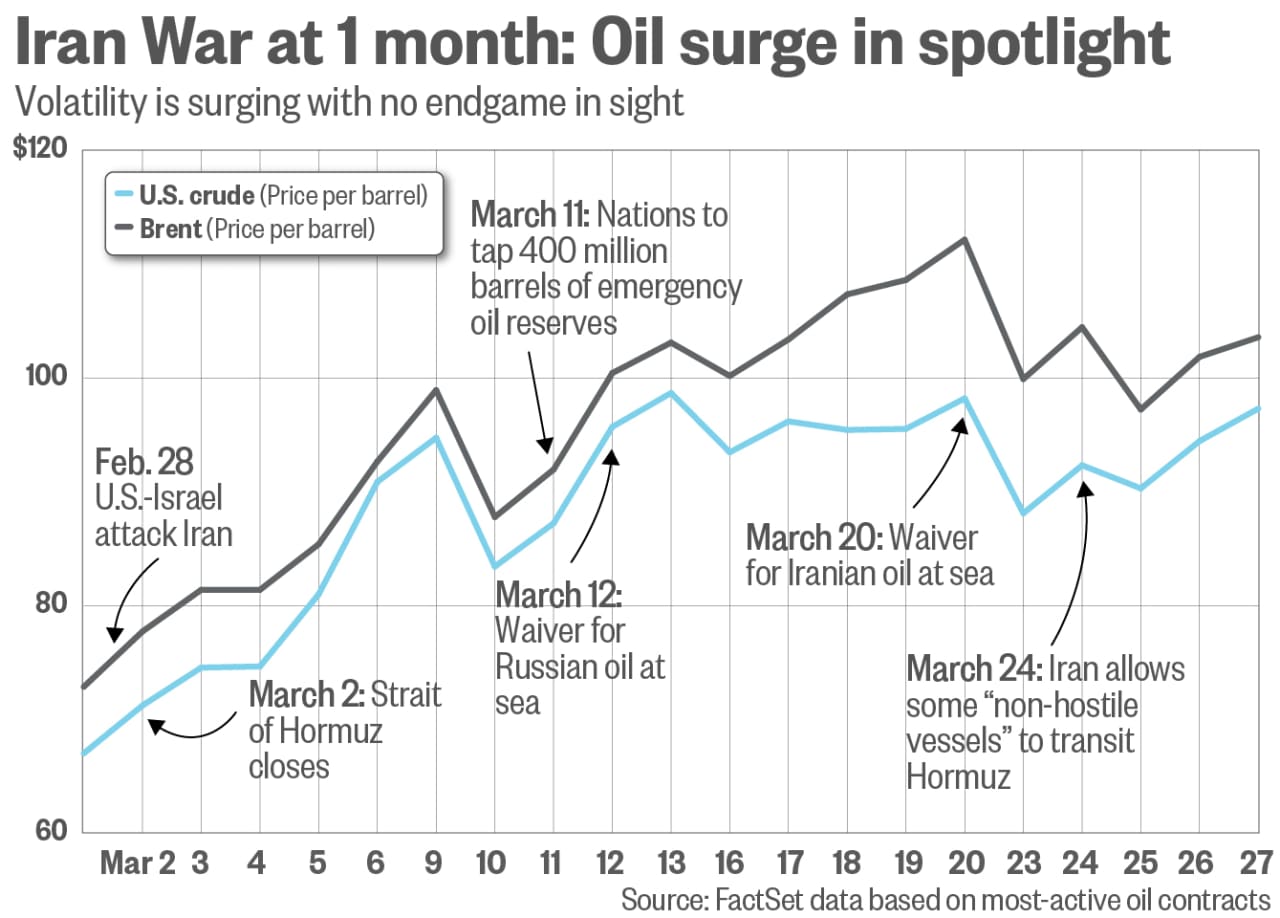
New York, NY – October 26, 2023 – Global financial markets are grappling with escalating anxiety over a protracted oil shock as the geopolitical crisis involving Iran enters its second month, with President Trump's recent diplomatic efforts failing to calm investors. The persistent instability threatens to push crude prices higher, impacting global supply chains and consumer spending, and casting a shadow over an already fragile international economic outlook.
This deepening apprehension stems from the critical role the Middle East plays in global energy supply. The region accounts for roughly one-third of the world's oil production, with the Strait of Hormuz, a narrow choke point off Iran's coast, serving as a transit route for about 20% of global petroleum consumption. Any significant disruption, or even the credible threat of one, sends ripples through international commodity markets, highlighting the precarious balance between geopolitical stability and economic well-being.
Key details fueling this concern include the recent surge in Brent crude futures, which have climbed over 15% since the conflict's outset, briefly touching highs not seen in nearly a decade. Though prices have seen some intraday volatility, the underlying trend remains upward, with WTI crude breaking the psychological $90 per barrel mark. Diplomatic overtures from the White House, aimed at de-escalation, have been met with skepticism by traders who point to ongoing rhetoric and military posturing from regional actors as counteracting any perceived progress. "The market isn't buying a quick resolution here," stated Sarah Jenkins, a senior energy analyst at Aurora Financial. "The underlying risks to supply are simply too high to ignore."
The implications for the broader economy are substantial. Higher oil prices translate directly into increased costs for transportation, manufacturing, and consumer goods. Airlines face soaring fuel bills, potentially leading to higher ticket prices and reduced demand. Manufacturers grapple with elevated input costs, which could force them to raise prices or absorb hits to their profit margins. For the average consumer, this means higher prices at the gas pump and potentially across supermarket aisles, eroding purchasing power and risking a slowdown in economic growth. Initial forecasts from the International Energy Agency (IEA) suggest that a sustained $10 increase in crude prices could shave 0.1-0.2% off global GDP.
Industry experts are largely aligned on the challenging road ahead. "We're not just looking at a transient spike; this has the hallmarks of a more structural shift in energy markets," commented Dr. Michael Chen, an economics professor at Columbia University. "Companies are already reassessing their supply chain resilience, and we're seeing cautious capital expenditure planning. The fear isn't just about current price levels, but the uncertainty of future supply." JP Morgan Chase recently revised its year-end Brent crude price forecast upwards to $98 per barrel, citing the escalating geopolitical risk premium.
Looking ahead, the market's focus will remain squarely on diplomatic progress, or lack thereof, and any potential escalation in the region. Upcoming meetings between the UN Security Council members are anticipated, though analysts are tempering expectations for immediate breakthroughs. The possibility of broader sanctions against Iranian oil exports, currently a complex and contentious issue, also looms large. Such a move, while politically driven, could further constrict global supply and send prices spiraling.
The coming weeks are critical. Should the conflict intensify or broaden, the threat of reaching triple-digit oil prices and the subsequent global economic ramifications become increasingly probable. Conversely, a clear and decisive path to de-escalation and stability, while currently appearing remote, would significantly mitigate these concerns. Until then, Wall Street, and indeed the global economy, remains in a holding pattern, acutely sensitive to every headline from the Middle East.